Home
Department Of Physics text logo
  • Research
    • Our research
    • Our research groups
    • Our research in action
    • Research funding support
    • Summer internships for undergraduates
  • Study
    • Undergraduates
    • Postgraduates
  • Engage
    • For alumni
    • For business
    • For schools
    • For the public
  • Support
Menu
Atomic and Laser Physics
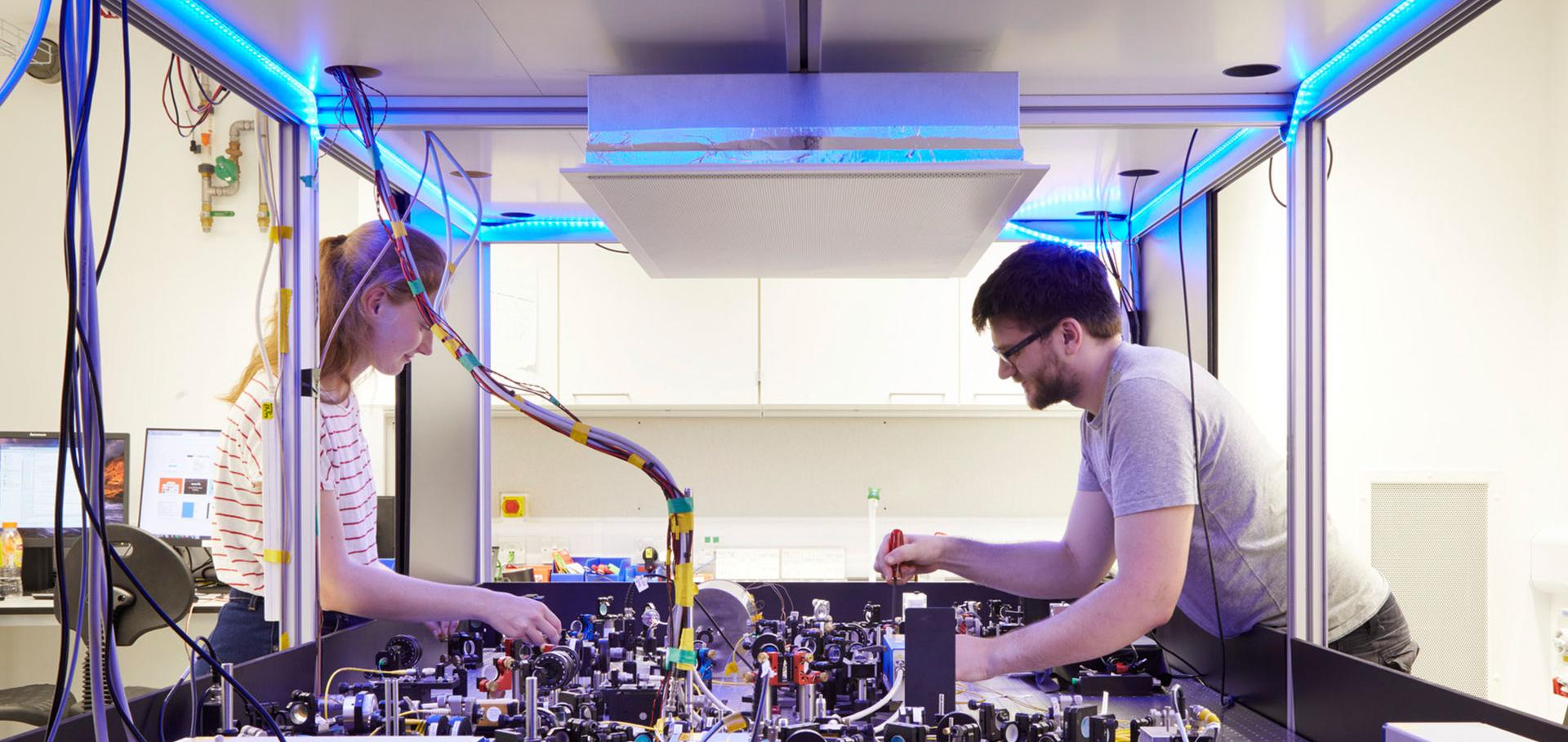
Credit: Jack Hobhouse

Prof Vlatko Vedral FInstP

Professor of Quantum Information Science

Sub department

  • Atomic and Laser Physics

Research groups

  • Frontiers of quantum physics
vlatko.vedral@physics.ox.ac.uk
Telephone: 01865 (2)72389
Clarendon Laboratory, room 241.8
  • About
  • Publications

Local distinguishability of multipartite orthogonal quantum states.

Phys Rev Lett 85:23 (2000) 4972-4975

Authors:

J Walgate, AJ Short, L Hardy, V Vedral

Abstract:

We consider one copy of a quantum system prepared in one of two orthogonal pure states, entangled or otherwise, and distributed between any number of parties. We demonstrate that it is possible to identify which of these two states the system is in by means of local operations and classical communication alone. The protocol we outline is both completely reliable and completely general; it will correctly distinguish any two orthogonal states 100% of the time.
More details from the publisher
More details

Two-state teleportation

Physical Review A - Atomic, Molecular, and Optical Physics 61:6 (2000) 1-8

Authors:

L Henderson, L Hardy, V Vedral

Abstract:

Quantum teleportation with additional a priori information about the input state achieves higher fidelity than teleportation of a completely unknown state. However, perfect teleporation of two nonorthogonal input states requires the same amount of entanglement as perfect teleportation of an unknown state, namely one ebit. We analyze how well two-state teleportation can be achieved using every degree of pure-state entanglement. We find the highest fidelity of "teleportation" that can be achieved with only classical communication but no shared entanglement. A two-state telecloning scheme is constructed. ©2000 The American Physical Society.

Detection of Geometric Phases in Superconducting Nanocircuits

(2000)

Authors:

Giuseppe Falci, Rosario Fazio, G Massimo Palma, Jens Siewert, Vlatko Vedral
More details from the publisher

Geometric quantum computation

J MOD OPTIC 47:14-15 (2000) 2501-2513

Authors:

A Ekert, M Ericsson, P Hayden, H Inamori, JA Jones, DKL Oi, V Vedral

Abstract:

We describe in detail a general strategy for implementing a conditional geometric phase between two spins. Combined with single-spin operations, this simple operation is a universal gate for quantum computation, in that any unitary transformation can be implemented with arbitrary precision using only single-spin operations and conditional phase shifts. Thus quantum geometrical phases can form the basis of any quantum computation. Moreover, as the induced conditional phase depends only on the geometry of the paths executed by the spins it is resilient to certain types of errors and offers the potential of a naturally fault-tolerant way of performing quantum computation.
More details from the publisher
More details
Details from ArXiV

Bounds on relative entropy of entanglement for multi-party systems

(2000)

Authors:

MB Plenio, V Vedral
More details from the publisher

Pagination

  • First page First
  • Previous page Prev
  • …
  • Page 149
  • Page 150
  • Page 151
  • Page 152
  • Current page 153
  • Page 154
  • Page 155
  • Page 156
  • Page 157
  • …
  • Next page Next
  • Last page Last

Footer Menu

  • Contact us
  • Giving to the Dept of Physics
  • Work with us
  • Media

User account menu

  • Log in

Follow us

FIND US

Clarendon Laboratory,

Parks Road,

Oxford,

OX1 3PU

CONTACT US

Tel: +44(0)1865272200

University of Oxfrod logo Department Of Physics text logo
IOP Juno Champion logo Athena Swan Silver Award logo

© University of Oxford - Department of Physics

Cookies | Privacy policy | Accessibility statement

Built by: Versantus

  • Home
  • Research
  • Study
  • Engage
  • Our people
  • News & Comment
  • Events
  • Our facilities & services
  • About us
  • Giving to Physics
  • Current students
  • Staff intranet