Home
Department Of Physics text logo
  • Research
    • Our research
    • Our research groups
    • Our research in action
    • Research funding support
    • Summer internships for undergraduates
  • Study
    • Undergraduates
    • Postgraduates
  • Engage
    • For alumni
    • For business
    • For schools
    • For the public
  • Support
Menu
Atomic and Laser Physics
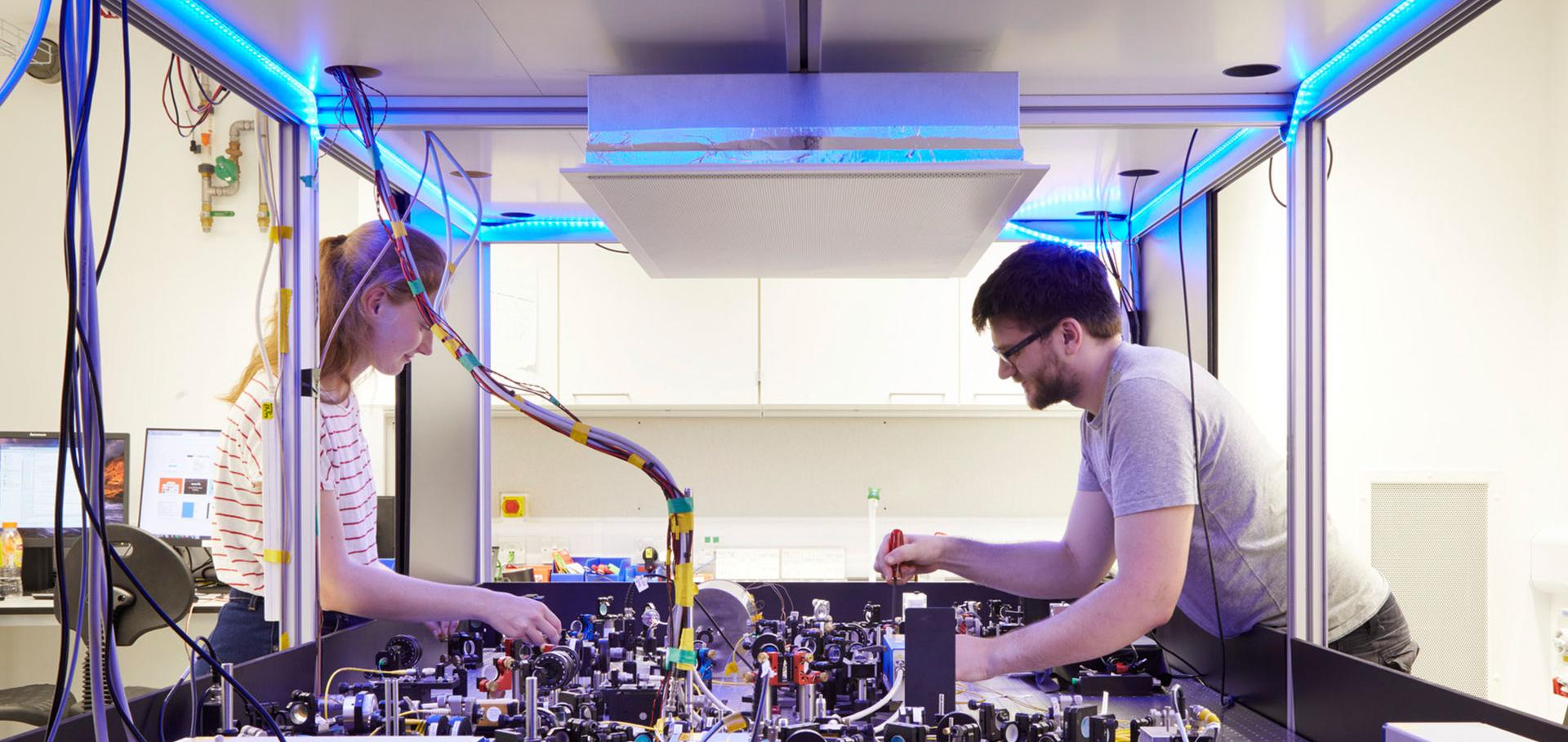
Credit: Jack Hobhouse

Prof Vlatko Vedral FInstP

Professor of Quantum Information Science

Sub department

  • Atomic and Laser Physics

Research groups

  • Frontiers of quantum physics
vlatko.vedral@physics.ox.ac.uk
Telephone: 01865 (2)72389
Clarendon Laboratory, room 241.8
  • About
  • Publications

How to Teach AI to Play Bell Non-Local Games: Reinforcement Learning

(2019)

Authors:

Kishor Bharti, Tobias Haug, Vlatko Vedral, Leong-Chuan Kwek
More details from the publisher

Theoretical description and experimental simulation of quantum entanglement near open time-like curves via pseudo-density operators

(2019)

Authors:

C Marletto, V Vedral, S Virzì, E Rebufello, A Avella, F Piacentini, M Gramegna, IP Degiovanni, M Genovese
More details from the publisher

Phase diffusion and the small-noise approximation in linear amplifiers: Limitations and beyond

Quantum Verein zur Forderung des Open Access Publizierens in den Quantenwissenschaften 3 (2019) 200

Authors:

Andy Chia, Michal Hajdušek, Rosario Fazio, Leong-Chuan Kwek, Vlatko Vedral
More details from the publisher

Is the fermionic exchange phase also acquired locally?

Journal of Physics Communications IOP Publishing 3:11 (2019) 111001

Authors:

Chiara Marletto, Vlatko Vedral
More details from the publisher

Modular quantum computation in a trapped ion system

Nature Communications Springer Nature 10:1 (2019) ARTN 4692

Authors:

Kuan Zhang, Jayne Thompson, Xiang Zhang, Yangchao Shen, Yao Lu, Shuaining Zhang, Jiajun Ma, Vlatko Vedral, Mile Gu, Kihwan Kim

Abstract:

Modern computation relies crucially on modular architectures, breaking a complex algorithm into self-contained subroutines. A client can then call upon a remote server to implement parts of the computation independently via an application programming interface (API). Present APIs relay only classical information. Here we implement a quantum API that enables a client to estimate the absolute value of the trace of a server-provided unitary operation [Formula: see text]. We demonstrate that the algorithm functions correctly irrespective of what unitary [Formula: see text] the server implements or how the server specifically realizes [Formula: see text]. Our experiment involves pioneering techniques to coherently swap qubits encoded within the motional states of a trapped [Formula: see text] ion, controlled on its hyperfine state. This constitutes the first demonstration of modular computation in the quantum regime, providing a step towards scalable, parallelization of quantum computation.
More details from the publisher
Details from ORA
More details
More details

Pagination

  • First page First
  • Previous page Prev
  • …
  • Page 24
  • Page 25
  • Page 26
  • Page 27
  • Current page 28
  • Page 29
  • Page 30
  • Page 31
  • Page 32
  • …
  • Next page Next
  • Last page Last

Footer Menu

  • Contact us
  • Giving to the Dept of Physics
  • Work with us
  • Media

User account menu

  • Log in

Follow us

FIND US

Clarendon Laboratory,

Parks Road,

Oxford,

OX1 3PU

CONTACT US

Tel: +44(0)1865272200

University of Oxfrod logo Department Of Physics text logo
IOP Juno Champion logo Athena Swan Silver Award logo

© University of Oxford - Department of Physics

Cookies | Privacy policy | Accessibility statement

Built by: Versantus

  • Home
  • Research
  • Study
  • Engage
  • Our people
  • News & Comment
  • Events
  • Our facilities & services
  • About us
  • Giving to Physics
  • Current students
  • Staff intranet