Home
Department Of Physics text logo
  • Research
    • Our research
    • Our research groups
    • Our research in action
    • Research funding support
    • Summer internships for undergraduates
  • Study
    • Undergraduates
    • Postgraduates
  • Engage
    • For alumni
    • For business
    • For schools
    • For the public
  • Support
Menu
Atomic and Laser Physics
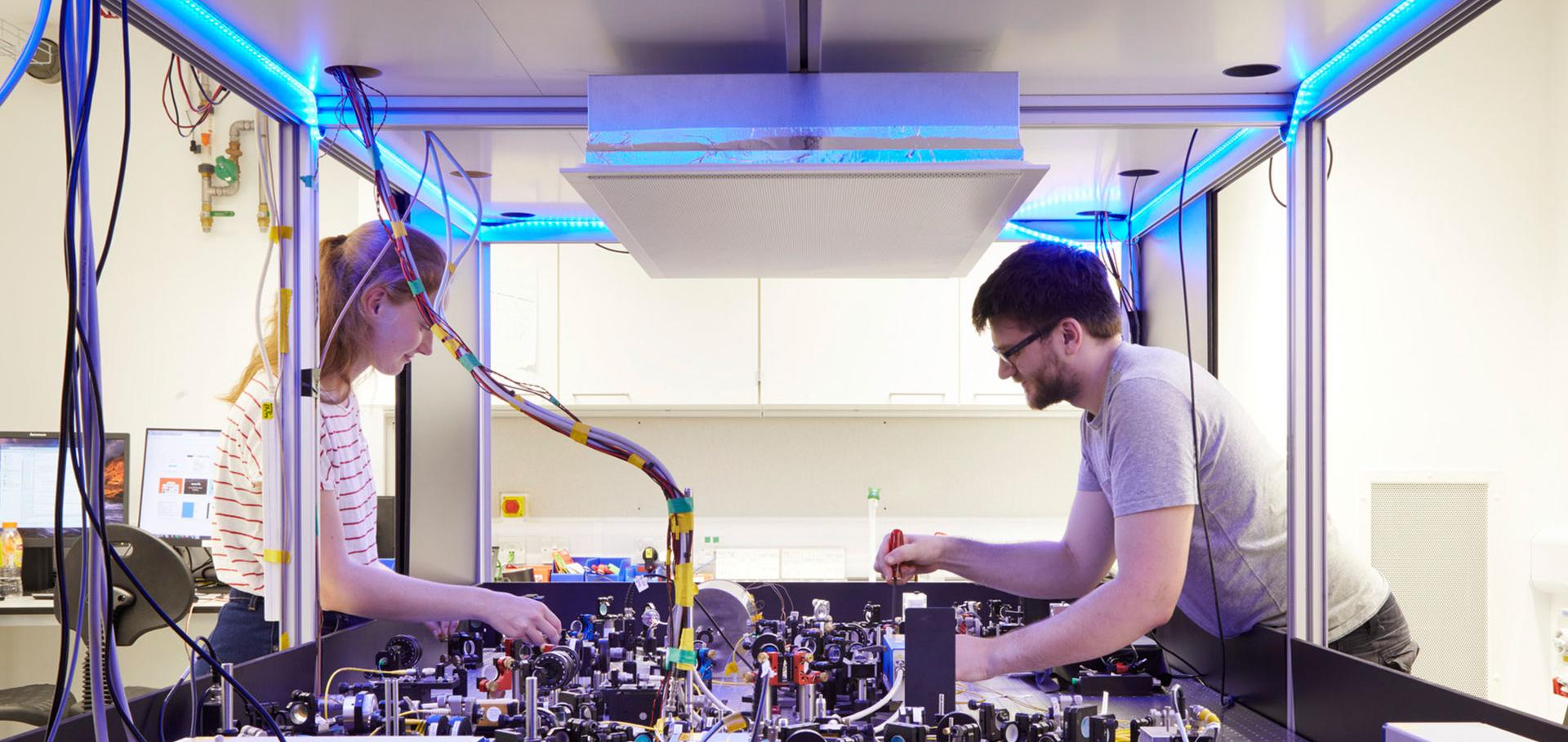
Credit: Jack Hobhouse

Prof Vlatko Vedral FInstP

Professor of Quantum Information Science

Sub department

  • Atomic and Laser Physics

Research groups

  • Frontiers of quantum physics
vlatko.vedral@physics.ox.ac.uk
Telephone: 01865 (2)72389
Clarendon Laboratory, room 241.8
  • About
  • Publications

A nanophotonic structure containing living photosynthetic bacteria

Small Wiley‐VCH Verlag 13:38 (2017) 1701777

Authors:

D Coles, LC Flatten, T Sydney, E Hounslow, SK Saikin, A Aspuru-Guzik, Vlatko Vedral, JK Tang, Robert A Taylor, JM Smith, DG Lidzey

Abstract:

Photosynthetic organisms rely on a series of self‐assembled nanostructures with tuned electronic energy levels in order to transport energy from where it is collected by photon absorption, to reaction centers where the energy is used to drive chemical reactions. In the photosynthetic bacteria Chlorobaculum tepidum, a member of the green sulfur bacteria family, light is absorbed by large antenna complexes called chlorosomes to create an exciton. The exciton is transferred to a protein baseplate attached to the chlorosome, before migrating through the Fenna–Matthews–Olson complex to the reaction center. Here, it is shown that by placing living Chlorobaculum tepidum bacteria within a photonic microcavity, the strong exciton–photon coupling regime between a confined cavity mode and exciton states of the chlorosome can be accessed, whereby a coherent exchange of energy between the bacteria and cavity mode results in the formation of polariton states. The polaritons have energy distinct from that of the exciton which can be tuned by modifying the energy of the optical modes of the microcavity. It is believed that this is the first demonstration of the modification of energy levels within living biological systems using a photonic structure.
More details from the publisher
Details from ORA
More details
More details

The classical-quantum divergence of complexity in modelling spin chains

Quantum Verein zur Forderung des Open Access Publizierens in den Quantenwissenschaften 1 (2017) 25

Authors:

Whei Yeap Suen, Jayne Thompson, Andrew JP Garner, Vlatko Vedral, Mile Gu
More details from the publisher

Universal upper bounds on the Bose-Einstein condensate and the Hubbard star

Physical Review B American Physical Society 96:6 (2017) 064502

Authors:

Felix Tennie, Vlatko Vedral, Christian Schilling

Abstract:

For N hard-core bosons on an arbitrary lattice with d sites and independent of additional interaction terms we prove that the hard-core constraint itself already enforces a universal upper bound on the Bose-Einstein condensate given by Nmax=(N/d)(d-N+1). This bound can only be attained for one-particle states |φ) with equal amplitudes with respect to the hard-core basis (sites) and when the corresponding N-particle state |Ψ) is maximally delocalized. This result is generalized to the maximum condensate possible within a given sublattice. We observe that such maximal local condensation is only possible if the mode entanglement between the sublattice and its complement is minimal. We also show that the maximizing state |Ψ) is related to the ground state of a bosonic "Hubbard star" showing Bose-Einstein condensation.
More details from the publisher
Details from ORA
More details
Details from ArXiV
More details

Why we need to quantise everything, including gravity

NPJ QUANTUM INFORMATION 3 (2017) ARTN 29

Authors:

C Marletto, V Vedral
More details from the publisher
Details from ORA
More details

Universal upper bounds on the Bose-Einstein condensate and the Hubbard star

(2017)

Authors:

Felix Tennie, Vlatko Vedral, Christian Schilling
More details from the publisher

Pagination

  • First page First
  • Previous page Prev
  • …
  • Page 41
  • Page 42
  • Page 43
  • Page 44
  • Current page 45
  • Page 46
  • Page 47
  • Page 48
  • Page 49
  • …
  • Next page Next
  • Last page Last

Footer Menu

  • Contact us
  • Giving to the Dept of Physics
  • Work with us
  • Media

User account menu

  • Log in

Follow us

FIND US

Clarendon Laboratory,

Parks Road,

Oxford,

OX1 3PU

CONTACT US

Tel: +44(0)1865272200

University of Oxfrod logo Department Of Physics text logo
IOP Juno Champion logo Athena Swan Silver Award logo

© University of Oxford - Department of Physics

Cookies | Privacy policy | Accessibility statement

Built by: Versantus

  • Home
  • Research
  • Study
  • Engage
  • Our people
  • News & Comment
  • Events
  • Our facilities & services
  • About us
  • Giving to Physics
  • Current students
  • Staff intranet