Home
Department Of Physics text logo
  • Research
    • Our research
    • Our research groups
    • Our research in action
    • Research funding support
    • Summer internships for undergraduates
  • Study
    • Undergraduates
    • Postgraduates
  • Engage
    • For alumni
    • For business
    • For schools
    • For the public
  • Support
Menu
Atomic and Laser Physics
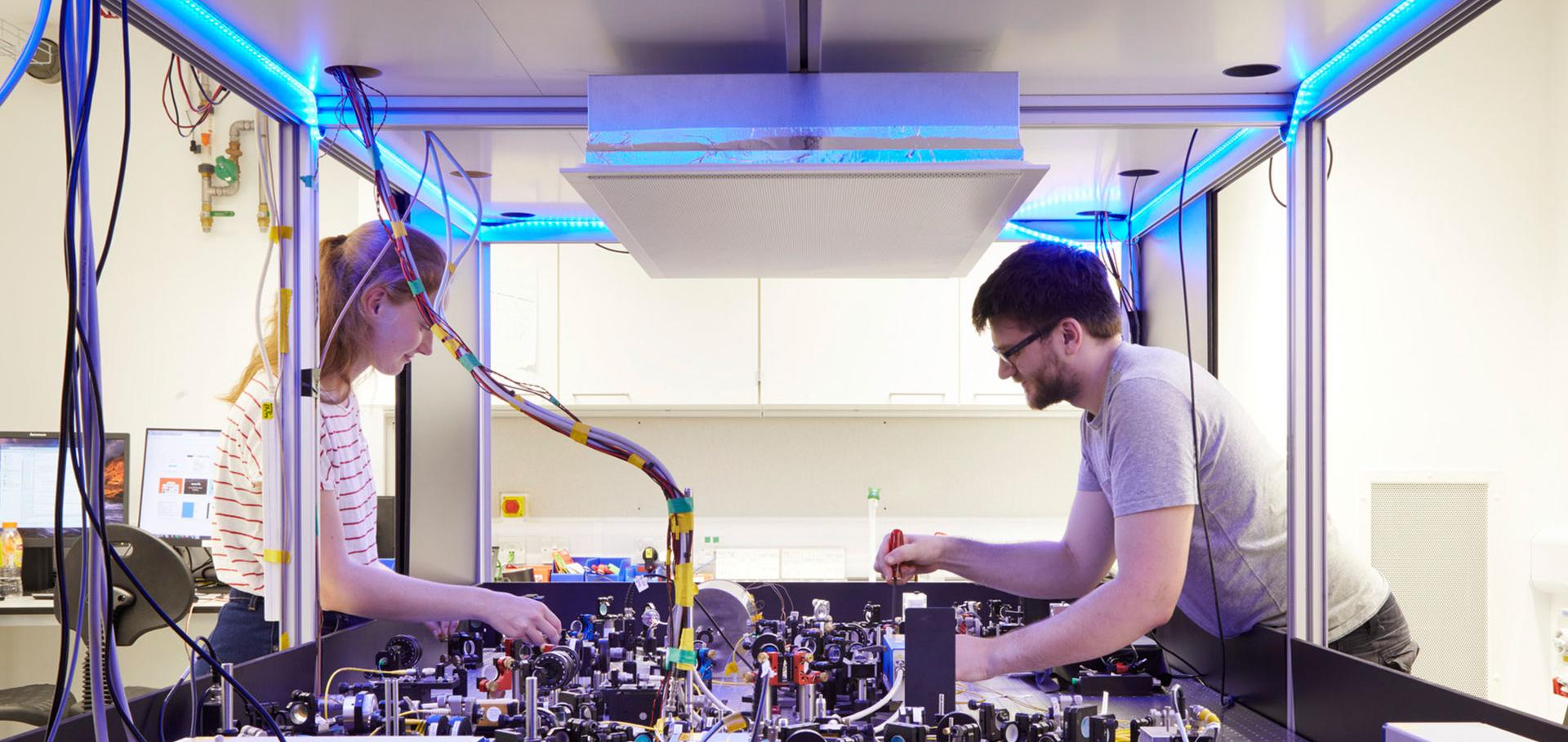
Credit: Jack Hobhouse

Prof Vlatko Vedral FInstP

Professor of Quantum Information Science

Sub department

  • Atomic and Laser Physics

Research groups

  • Frontiers of quantum physics
vlatko.vedral@physics.ox.ac.uk
Telephone: 01865 (2)72389
Clarendon Laboratory, room 241.8
  • About
  • Publications

Photonic Maxwell’s Demon

Physical Review Letters American Physical Society (APS) 116:5 (2016) 050401

Authors:

Mihai D Vidrighin, Oscar Dahlsten, Marco Barbieri, MS Kim, Vlatko Vedral, Ian A Walmsley
More details from the publisher
More details
More details
Details from ArXiV

Quantum thermodynamics for a model of an expanding Universe

Classical and Quantum Gravity IOP Publishing 33:3 (2016) 035003

Authors:

Nana Liu, John Goold, Ivette Fuentes, Vlatko Vedral, Kavan Modi, David Edward Bruschi
More details from the publisher

Entanglement Rényi α entropy

Physical Review A American Physical Society (APS) 93:2 (2016) 022324

Authors:

Yu-Xin Wang, Liang-Zhu Mu, Vlatko Vedral, Heng Fan
More details from the publisher
More details

General framework for quantum macroscopicity in terms of coherence

Physical Review A American Physical Society (APS) 93:2 (2016) 022122

Authors:

Benjamin Yadin, Vlatko Vedral
More details from the publisher
Details from ArXiV

Quantum Quasi-Zeno Dynamics: Transitions mediated by frequent projective measurements near the Zeno regime

arXiv ArXiv (2016)

Authors:

Thomas Elliott, Vlatko Vedral

Abstract:

Frequent observation of a quantum system leads to quantum Zeno physics, where the system evolution is constrained to states commensurate with the measurement outcome. We show that, more generally, the system can evolve between such states through higher-order virtual processes that pass through states outside the measurement subspace. We derive effective Hamiltonians to describe this evolution, and the dependence on the time between measurements. We demonstrate application of this phenomena to prototypical quantum many-body system examples, spin chains and atoms in optical lattices, where it facilitates correlated dynamical effects.
Details from ORA
More details from the publisher
More details

Pagination

  • First page First
  • Previous page Prev
  • …
  • Page 52
  • Page 53
  • Page 54
  • Page 55
  • Current page 56
  • Page 57
  • Page 58
  • Page 59
  • Page 60
  • …
  • Next page Next
  • Last page Last

Footer Menu

  • Contact us
  • Giving to the Dept of Physics
  • Work with us
  • Media

User account menu

  • Log in

Follow us

FIND US

Clarendon Laboratory,

Parks Road,

Oxford,

OX1 3PU

CONTACT US

Tel: +44(0)1865272200

University of Oxfrod logo Department Of Physics text logo
IOP Juno Champion logo Athena Swan Silver Award logo

© University of Oxford - Department of Physics

Cookies | Privacy policy | Accessibility statement

Built by: Versantus

  • Home
  • Research
  • Study
  • Engage
  • Our people
  • News & Comment
  • Events
  • Our facilities & services
  • About us
  • Giving to Physics
  • Current students
  • Staff intranet