Home
Department Of Physics text logo
  • Research
    • Our research
    • Our research groups
    • Our research in action
    • Research funding support
    • Summer internships for undergraduates
  • Study
    • Undergraduates
    • Postgraduates
  • Engage
    • For young people
    • For teachers
    • For the public
    • For alumni
    • For business
  • Support
Menu
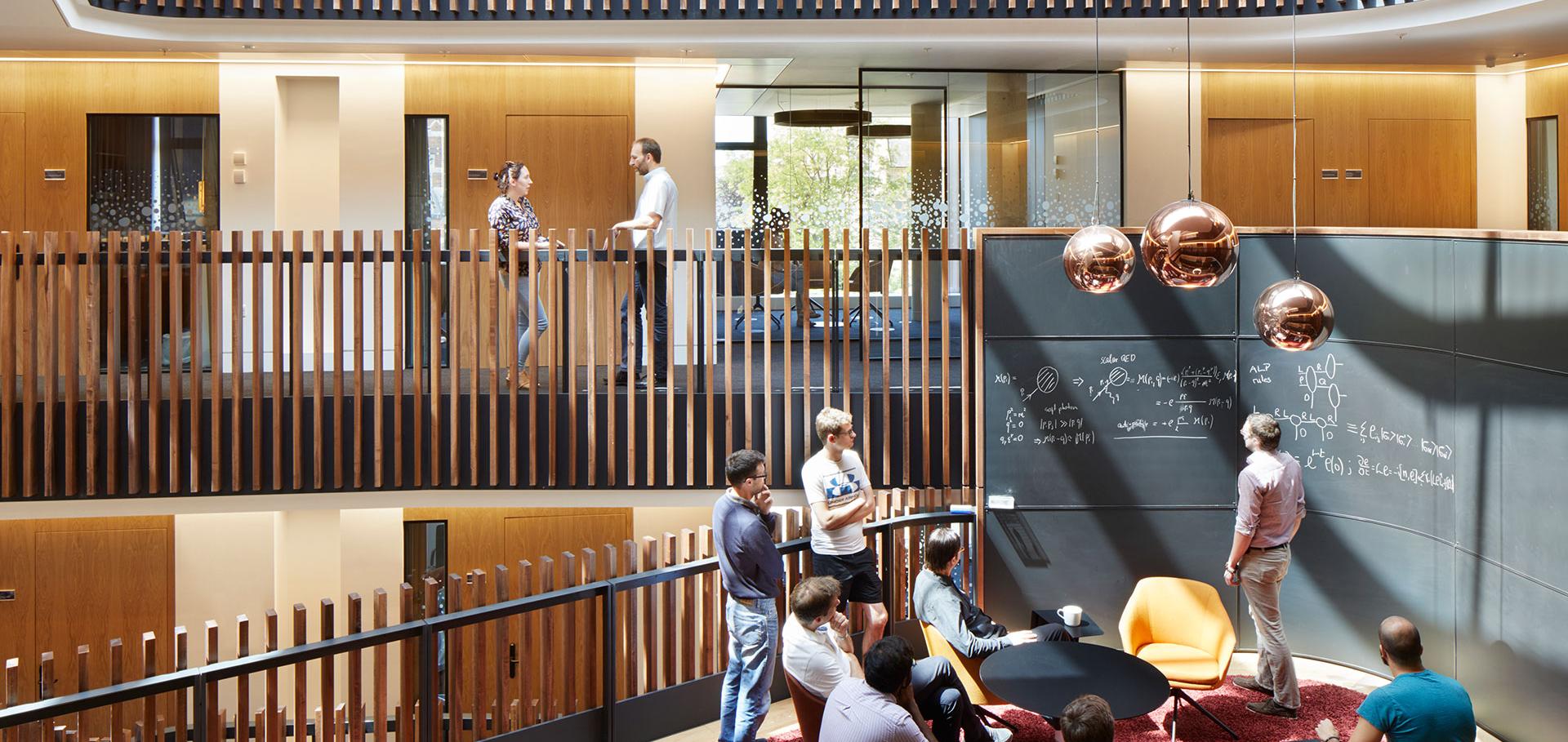
Theoretical physicists working at a blackboard collaboration pod in the Beecroft building.
Credit: Jack Hobhouse

Dr Sebastian Von Hausegger

Visitor

Research theme

  • Astronomy and astrophysics
  • Biological physics
  • Particle astrophysics & cosmology

Sub department

  • Rudolf Peierls Centre for Theoretical Physics

Research groups

  • Beecroft Institute for Particle Astrophysics and Cosmology
  • Oxford Molecular Motors
  • Cosmology
  • Rubin-LSST
  • The Square Kilometre Array (SKA)
sebastian.vonhausegger@physics.ox.ac.uk
Telephone: 01865210826
Rudolf Peierls Centre for Theoretical Physics, room 50.25
  • About
  • Teaching
  • Research
  • Outreach
  • Publications

A Test of the Cosmological Principle with Quasars

Letters of the Astrophysical Journal American Astronomical Society 908 (2021) L51-L51

Authors:

Nathan Secrest, Sebastian von Hausegger, Mohamed Rameez, Roya Mohayaee, Subir Sarkar, Jacques Colin

Abstract:

We study the large-scale anisotropy of the Universe by measuring the dipole in the angular distribution of a flux-limited, all-sky sample of 1.36 million quasars observed by the Wide-field Infrared Survey Explorer (WISE). This sample is derived from the new CatWISE2020 catalog, which contains deep photometric measurements at 3.4 and 4.6 $\mu$m from the cryogenic, post-cryogenic, and reactivation phases of the WISE mission. While the direction of the dipole in the quasar sky is similar to that of the cosmic microwave background (CMB), its amplitude is over twice as large as expected, rejecting the canonical, exclusively kinematic interpretation of the CMB dipole with a p-value of $5\times10^{-7}$ ($4.9\sigma$ for a normal distribution, one-sided), the highest significance achieved to date in such studies. Our results are in conflict with the cosmological principle, a foundational assumption of the concordance $\Lambda$CDM model.
More details from the publisher
Details from ORA
More details
Details from ArXiV

A fast semi-discrete optimal transport algorithm for a unique reconstruction of the early Universe

(2020)

Authors:

Bruno Lévy, Roya Mohayaee, Sebastian VON HAUSEGGER
More details
Details from ArXiV

CMB foreground measurements through broad-band radio spectro-polarimetry: prospects of the SKA-MPG telescope

Monthly Notices of the Royal Astronomical Society Oxford University Press (OUP) 488:2 (2019) 1618-1634

Authors:

Aritra Basu, Dominik J Schwarz, Hans-Rainer Klöckner, Sebastian von Hausegger, Michael Kramer, Gundolf Wieching, Blakesley Burkhart
More details from the publisher
More details

Statistical properties of polarized CMB foreground maps

Monthly Notices of the Royal Astronomical Society Oxford University Press (OUP) 487:4 (2019) 5814-5823

Authors:

Sebastian von Hausegger, Aske Gammelgaard Ravnebjerg, Hao Liu
More details from the publisher
More details

Methods for pixel domain correction of EB leakage

Physical Review D American Physical Society (APS) 100:2 (2019) 023538

Authors:

Hao Liu, James Creswell, Sebastian von Hausegger, Pavel Naselsky
More details from the publisher
More details

Pagination

  • First page First
  • Previous page Prev
  • Page 1
  • Page 2
  • Page 3
  • Page 4
  • Page 5
  • Current page 6
  • Page 7
  • Page 8
  • Next page Next
  • Last page Last

Footer Menu

  • Contact us
  • Giving to the Dept of Physics
  • Work with us
  • Media

User account menu

  • Log in

Follow us

FIND US

Clarendon Laboratory,

Parks Road,

Oxford,

OX1 3PU

CONTACT US

Tel: +44(0)1865272200

University of Oxfrod logo Department Of Physics text logo
IOP Juno Champion logo Athena Swan Silver Award logo

© University of Oxford - Department of Physics

Cookies | Privacy policy | Accessibility statement

Built by: Versantus

  • Home
  • Research
  • Study
  • Engage
  • Our people
  • News & Comment
  • Events
  • Our facilities & services
  • About us
  • Giving to Physics
  • Current students
  • Staff intranet