Home
Department Of Physics text logo
  • Research
    • Our research
    • Our research groups
    • Our research in action
    • Research funding support
    • Summer internships for undergraduates
  • Study
    • Undergraduates
    • Postgraduates
  • Engage
    • For alumni
    • For business
    • For schools
    • For the public
Menu
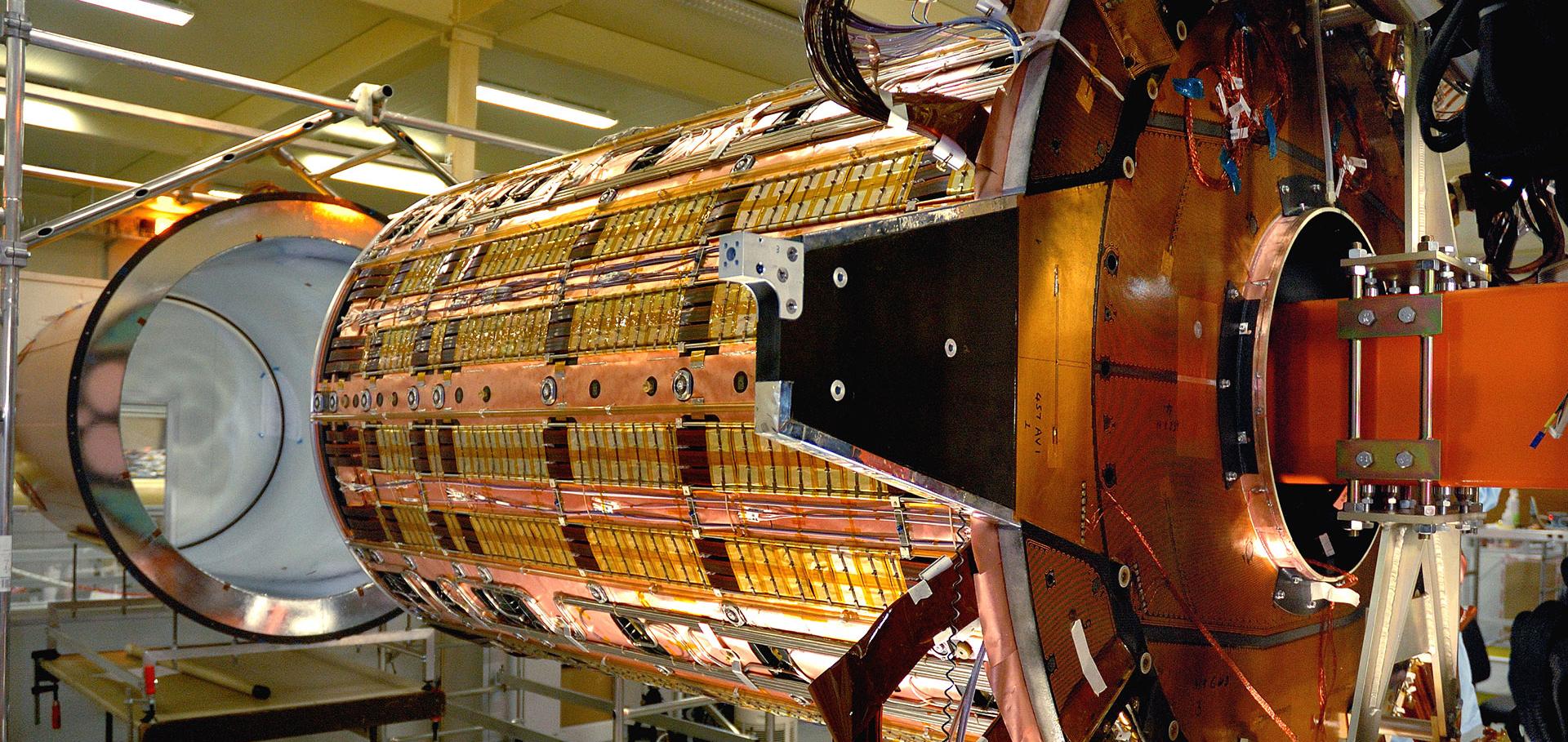
Insertion of STC into TRT at the Department of Physics, Oxford
Credit: CERN

Prof Roman Walczak

Emeritus Professor

Research theme

  • Accelerator physics
  • Lasers and high energy density science
  • Plasma physics

Sub department

  • Particle Physics

Research groups

  • Laser-plasma accelerator group
Roman.Walczak@physics.ox.ac.uk
Denys Wilkinson Building, room 659
  • About
  • Publications

Stability of the modulator in a plasma-modulated plasma accelerator

Physical Review E American Physical Society 108:1 (2023) 15204

Authors:

Jj van de Wetering, SM Hooker, R Walczak

Abstract:

We explore the regime of operation of the modulator stage of a recently proposed laser-plasma accelerator scheme [Phys. Rev. Lett. 127, 184801 (2021)], dubbed the plasma-modulated plasma accelerator (P-MoPA). The P-MoPA scheme offers a potential route to high-repetition-rate, GeV-scale plasma accelerators driven by picosecond-duration laser pulses from, for example, kilohertz thin-disk lasers. The first stage of the P-MoPA scheme is a plasma modulator in which a long, high-energy “drive” pulse is spectrally modulated by copropagating in a plasma channel with the low-amplitude plasma wave driven by a short, low-energy “seed” pulse. The spectrally modulated drive pulse is converted to a train of short pulses, by introducing dispersion, which can resonantly drive a large wakefield in a subsequent accelerator stage with the same on-axis plasma density as the modulator. In this paper we derive the 3D analytic theory for the evolution of the drive pulse in the plasma modulator and show that the spectral modulation is independent of transverse coordinate, which is ideal for compression into a pulse train. We then identify a transverse mode instability (TMI), similar to the TMI observed in optical fiber lasers, which sets limits on the energy of the drive pulse for a given set of laser-plasma parameters. We compare this analytic theory with particle-in-cell (PIC) simulations and find that even higher energy drive pulses can be modulated than those demonstrated in the original proposal.
More details from the publisher
Details from ORA
More details
More details

Measurement of the decay of laser-driven linear plasma wakefields

(2023)

Authors:

J Jonnerby, A von Boetticher, J Holloway, L Corner, A Picksley, AJ Ross, RJ Shalloo, C Thornton, N Bourgeois, R Walczak, SM Hooker
Details from ArXiV
More details from the publisher

Demonstration of tunability of HOFI waveguides via start-to-end simulations

(2023)

Authors:

SM Mewes, GJ Boyle, A Ferran Pousa, RJ Shalloo, J Osterhoff, C Arran, L Corner, R Walczak, SM Hooker, M Thévenet
More details from the publisher

Stability of the Modulator in a Plasma-Modulated Plasma Accelerator

(2023)

Authors:

Johannes J van de Wetering, Simon M Hooker, Roman Walczak
Details from ArXiV
More details from the publisher

Modulational instability in large-amplitude linear laser wakefields

(2023)

Authors:

Alexander von Boetticher, Roman Walczak, Simon Hooker
Details from ArXiV
More details from the publisher

Pagination

  • First page First
  • Previous page Prev
  • Page 1
  • Page 2
  • Current page 3
  • Page 4
  • Page 5
  • Page 6
  • Page 7
  • Page 8
  • Page 9
  • …
  • Next page Next
  • Last page Last

Footer Menu

  • Contact us
  • Giving to the Dept of Physics
  • Work with us
  • Media

User account menu

  • Log in

Follow us

FIND US

Clarendon Laboratory,

Parks Road,

Oxford,

OX1 3PU

CONTACT US

Tel: +44(0)1865272200

University of Oxfrod logo Department Of Physics text logo
IOP Juno Champion logo Athena Swan Silver Award logo

© University of Oxford - Department of Physics

Cookies | Privacy policy | Accessibility statement

Built by: Versantus

  • Home
  • Research
  • Study
  • Engage
  • Our people
  • News & Comment
  • Events
  • Our facilities & services
  • About us
  • Giving to Physics
  • Current students
  • Staff intranet