Home
Department Of Physics text logo
  • Research
    • Our research
    • Our research groups
    • Our research in action
    • Research funding support
    • Summer internships for undergraduates
  • Study
    • Undergraduates
    • Postgraduates
  • Engage
    • For alumni
    • For business
    • For schools
    • For the public
  • Support
Menu
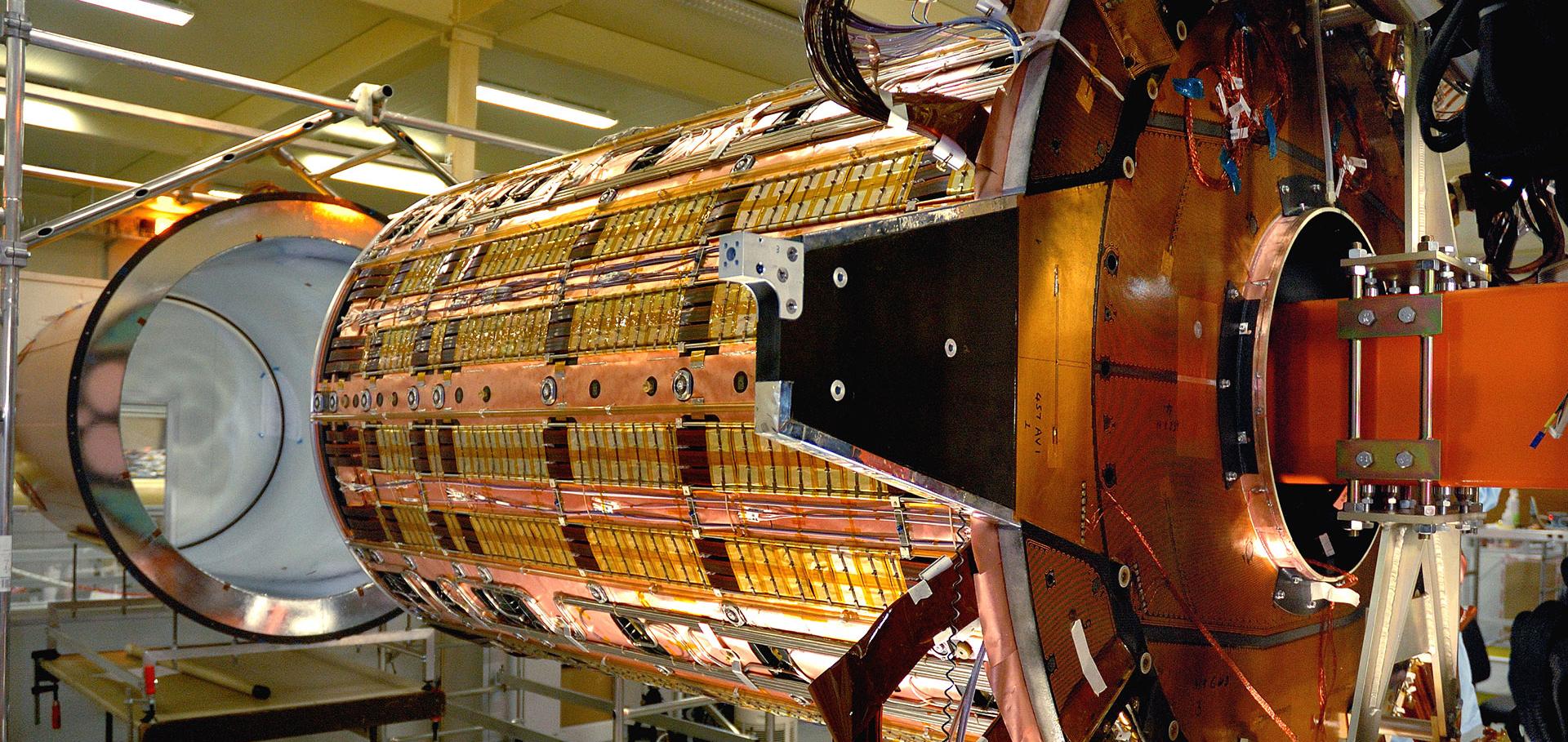
Insertion of STC into TRT at the Department of Physics, Oxford
Credit: CERN

David Wark

Professor of Particle Physics

Sub department

  • Particle Physics

Research groups

  • Accelerator Neutrinos
dave.wark@physics.ox.ac.uk
Telephone: 01865 (2)73400
Denys Wilkinson Building, room 626
  • About
  • Publications

First measurement of the nu(mu) charged-current cross section on a water target without pions in the final state

Physical Review D American Physical Society 97:1 (2018) 012001

Authors:

K Abe, J Amey, C Andreopoulos, Giles D Barr, David Coplowe, Stephen Dolan, Xianguo Lu, Raj Shah, Tomislav Vladisavljevic, David L Wark, Alfons JG Weber

Abstract:

This paper reports the first differential measurement of the charged-current interaction cross section of νμ on water with no pions in the final state. This flux-averaged measurement has been made using the T2K experiment’s off-axis near detector, and is reported in doubly differential bins of muon momentum and angle. The flux-averaged total cross section in a restricted region of phase space was found to be σ=(0.95±0.08(stat)±0.06(det syst)±0.04(model syst)±0.08(flux))×10^−38 cm^2/n.
More details from the publisher
Details from ORA
More details
Details from ArXiV

Neutrino oscillations: status and prospects of accelerator and reactor experiments

Journal of Physics Conference Series IOP Publishing 934:1 (2017) 012001

Authors:

Yury Kudenko, David Wark
More details from the publisher
More details

Search for an excess of events in the super-kamiokande detector in the directions of the astrophysical neutrinos reported by the IceCube Collaboration

Astrophysical Journal American Astronomical Society 850:2 (2017) 166

Authors:

K Abe, C Bronner, G Pronost, Y Hayato, M Ikeda, K Iyogi, J Kameda, Y Kato, Y Kishimoto, L Marti, M Miura, S Moriyama, M Nakahata, Y Nakano, S Nakayama, Y Okajima, A Orii, H Sekiya, M Shiozawa, Y Sonoda, A Takeda, A Takenaka, H Tanaka, S Tasaka, T Tomura, R Akutsu, T Kajita, K Kaneyuki, Y Nishimura, K Okumura, KM Tsui, L Labarga, P Fernandez, FDM Blaszczyk, J Gustafson, C Kachulis, E Kearns, JL Raaf, JL Stone, LR Sulak, S Berkman, S Tobayama, M Goldhaber, M Elnimr, WR Kropp, S Mine, S Locke, P Weatherly, MB Smy, HW Sobel

Abstract:

We present the results of a search in the Super-Kamiokande (SK) detector for excesses of neutrinos with energies above a few GeV that are in the direction of the track events reported in IceCube. Data from all SK phases (SK-I through SK-IV) were used, spanning a period from 1996 April to 2016 April and corresponding to an exposure of 225 kiloton-years. We considered the 14 IceCube track events from a data set with 1347 livetime days taken from 2010 to 2014. We use Poisson counting to determine if there is an excess of neutrinos detected in SK in a 10° search cone (5° for the highest energy data set) around the reconstructed direction of the IceCube event. No significant excess was found in any of the search directions we examined. We also looked for coincidences with a recently reported IceCube multiplet event. No events were detected within a ±500 s time window around the first detected event, and no significant excess was seen from that direction over the lifetime of SK.
More details from the publisher
Details from ORA
More details

A Measurement of the Tau Neutrino Cross Section in Atmospheric Neutrino Oscillations with Super-Kamiokande

(2017)

Authors:

Super-Kamiokande Collaboration, :, Z Li, K Abe, C Bronner, Y Hayato, M Ikeda, K Iyogi, J Kameda, Y Kato, Y Kishimoto, Ll Marti, M Miura, S Moriyama, M Nakahata, Y Nakajima, Y Nakano, S Nakayama, A Orii, G Pronost, H Sekiya, M Shiozawa, Y Sonoda, A Takeda, A Takenaka, H Tanaka, S Tasaka, T Tomura, R Akutsu, T Kajita, Y Nishimura, K Okumura, KM Tsui, P Fernandez, L Labarga, FDM Blaszczyk, J Gustafson, C Kachulis, E Kearns, JL Raaf, JL Stone, LR Sulak, S Berkman, S Tobayama, M Elnimr, WR Kropp, S Locke, S Mine, P Weatherly, MB Smy, HW Sobel, V Takhistov, KS Ganezer, J Hill, JY Kim, IT Lim, RG Park, A Himmel, E O'Sullivan, K Scholberg, CW Walter, T Ishizuka, T Nakamura, JS Jang, K Choi, JG Learned, S Matsuno, SN Smith, J Amey, RP Litchfield, WY Ma, Y Uchida, MO Wascko, S Cao, M Friend, T Hasegawa, T Ishida, T Ishii, T Kobayashi, T Nakadaira, K Nakamura, Y Oyama, K Sakashita, T Sekiguchi, T Tsukamoto, KE Abe, M Hasegawa, AT Suzuki, Y Takeuchi, T Yano, T Hayashino, T Hiraki, S Hirota, K Huang, M Jiang, M Mori, KE Nakamura, T Nakaya, ND Patel, RA Wendell, LHV Anthony, N McCauley, A Pritchard, Y Fukuda, Y Itow, M Murase, F Muto, P Mijakowski, K Frankiewicz, CK Jung, X Li, JL Palomino, G Santucci, C Vilela, MJ Wilking, C Yanagisawa, G Yang, S Ito, D Fukuda, H Ishino, A Kibayashi, Y Koshio, H Nagata, M Sakuda, C Xu, Y Kuno, D Wark, F Di Lodovico, B Richards, SM Sedgwick, R Tacik, SB Kim, A Cole, L Thompson, H Okazawa, Y Choi, K Ito, K Nishijima, M Koshiba, Y Suda, M Yokoyama, RG Calland, M Hartz, K Martens, M Murdoch, B Quilain, C Simpson, Y Suzuki, MR Vagins, D Hamabe, M Kuze, Y Okajima, T Yoshida, M Ishitsuka, JF Martin, CM Nantais, HA Tanaka, T Towstego, A Konaka, S Chen, L Wan, Y Zhang, A Minamino, RJ Wilkes
More details from the publisher
Details from ArXiV

Measurement of neutrino and antineutrino oscillations by the T2K experiment including a new additional sample of nu(e) interactions at the far detector

Physical Review D American Physical Society 96:9 (2017) 092006

Authors:

K Abe, J Amey, C Andreopoulos, Giles Barr, David Coplowe, Stephen Dolan, Xianguo Lu, Raj Shah, Tomislav Vladisavljevic, David L Wark, Alfons JG Weber

Abstract:

The T2K experiment reports an updated analysis of neutrino and antineutrino oscillations in appearance and disappearance channels. Asample of electron neutrino candidates at Super-Kamiokande in which a pion decay has been tagged is added to the four single-ring samples used in previous T2K oscillation analyses. Through combined analyses of these five samples, simultaneous measurements of four oscillation parameters, |Δm2/32|, sin2 θ23, sin2 θ13, and δCP and of the mass ordering are made. A set of studies of simulated data indicates that the sensitivity to the oscillation parameters is not limited by neutrino interaction model uncertainty. Multiple oscillation analyses are performed, and frequentist and Bayesian intervals are presented for combinations of the oscillation parameters with and without the inclusion of reactor constraints on sin2 θ13.When combined with reactor measurements, the hypothesis of CP conservation (δCP = 0 or π) is excluded at 90% confidence level. The 90% confidence region for δCP is [−2.95;−0.44] ([−1.47;−1.27]) for normal (inverted) ordering. The central values and 68% confidence intervals for the other oscillation parameters for normal (inverted) ordering are Δm2/32 = 2.54 ± 0.08(2.51 ± 0.08) × 10^−3 eV^2/c^4 and sin2θ23 = 0.55+0.05/−0.09 (0.55+0.05/−0.08 ), compatible with maximal mixing. In the Bayesian analysis, the data weakly prefer normal ordering (Bayes factor 3.7) and the upper octant for sin2 θ23 (Bayes factor 2.4).
More details from the publisher
Details from ORA
More details
Details from ArXiV

Pagination

  • First page First
  • Previous page Prev
  • …
  • Page 18
  • Page 19
  • Page 20
  • Page 21
  • Current page 22
  • Page 23
  • Page 24
  • Page 25
  • Page 26
  • …
  • Next page Next
  • Last page Last

Footer Menu

  • Contact us
  • Giving to the Dept of Physics
  • Work with us
  • Media

User account menu

  • Log in

Follow us

FIND US

Clarendon Laboratory,

Parks Road,

Oxford,

OX1 3PU

CONTACT US

Tel: +44(0)1865272200

University of Oxfrod logo Department Of Physics text logo
IOP Juno Champion logo Athena Swan Silver Award logo

© University of Oxford - Department of Physics

Cookies | Privacy policy | Accessibility statement

Built by: Versantus

  • Home
  • Research
  • Study
  • Engage
  • Our people
  • News & Comment
  • Events
  • Our facilities & services
  • About us
  • Giving to Physics
  • Current students
  • Staff intranet