

Combined CDF and D0 Upper Limits on Standard Model Higgs Boson Production with up to 8.2 fb$^-1$ of Data
Higgs self-coupling measurements using deep learning in the $b\bar{b}b\bar{b}$ final state
The Journal of High Energy Physics Springer Verlag (Germany)
Abstract:
Measuring the Higgs trilinear self-coupling $\lambda_{hhh}$ is experimentally demanding but fundamental for understanding the shape of the Higgs potential. We present a comprehensive analysis strategy for the HL-LHC using di-Higgs events in the four $b$-quark channel ($hh \to 4b$), extending current methods in several directions. We perform deep learning to suppress the formidable multijet background with dedicated optimisation for BSM $\lambda_{hhh}$ scenarios. We compare the $\lambda_{hhh}$ constraining power of events using different multiplicities of large radius jets with a two-prong structure that reconstruct boosted $h \to bb$ decays. We show that current uncertainties in the SM top Yukawa coupling $y_t$ can modify $\lambda_{hhh}$ constraints by $\sim 20\%$. For SM $y_t$, we find prospects of $-0.8 < \lambda_{hhh} / \lambda_{hhh}^\text{SM} < 6.6$ at 68% CL under simplified assumptions for 3000~fb$^{-1}$ of HL-LHC data. Our results provide a careful assessment of di-Higgs identification and machine learning techniques for all-hadronic measurements of the Higgs self-coupling and sharpens the requirements for future improvement.Inelastic collisions in radiofrequency-dressed mixtures of ultracold atoms
Abstract:
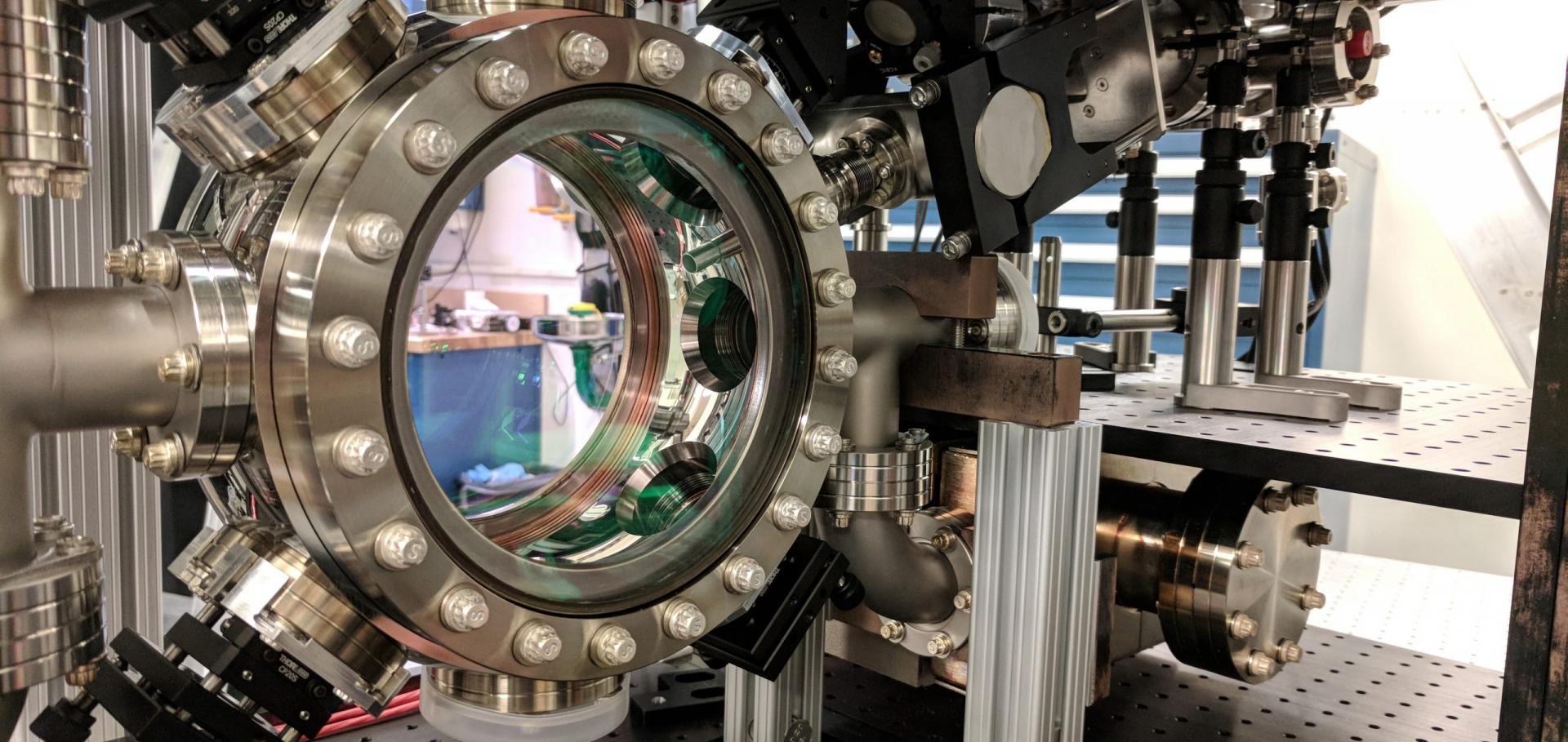
Radiofrequency (RF)-dressed potentials are a promising technique for manipulating atomic mixtures, but so far little work has been undertaken to understand the collisions of atoms held within these traps. In this work, we dress a mixture of 85Rb and 87Rb with RF radiation, characterize the inelastic loss that occurs, and demonstrate species-selective manipulations. Our measurements show the loss is caused by two-body 87Rb+85Rb collisions, and we show the inelastic rate coefficient varies with detuning from the RF resonance. We explain our observations using quantum scattering calculations, which give reasonable agreement with the measurements. The calculations consider magnetic fields both perpendicular to the plane of RF polarization and tilted with respect to it. Our findings have important consequences for future experiments that dress mixtures with RF fields.Quantum Sensors for the Hidden Sector (QSHS) - A Summary of Our First Year!
Sensor Compendium
Office of Scientific and Technical Information (OSTI)