

Measurement of $J/ψ$-jet correlations in $pp$ and Pb+Pb collisions at $\sqrt{s_{\text{NN}}}=5.02$ TeV with the ATLAS detector
ArXiv 2606.31375 (2026)
Measurements of charged-particle pseudorapidity and transverse momentum distributions in O+O and Ne+Ne collisions at $\sqrt{s_{_\text{NN}}} = 5.36$ TeV with the ATLAS detector
ArXiv 2606.20257 (2026)
Observation of centrality-dependent dijet transverse momentum imbalance in O+O and Ne+Ne collisions at $\sqrt{s_{NN}}$ = 5.36 TeV with the ATLAS detector
ArXiv 2606.20463 (2026)
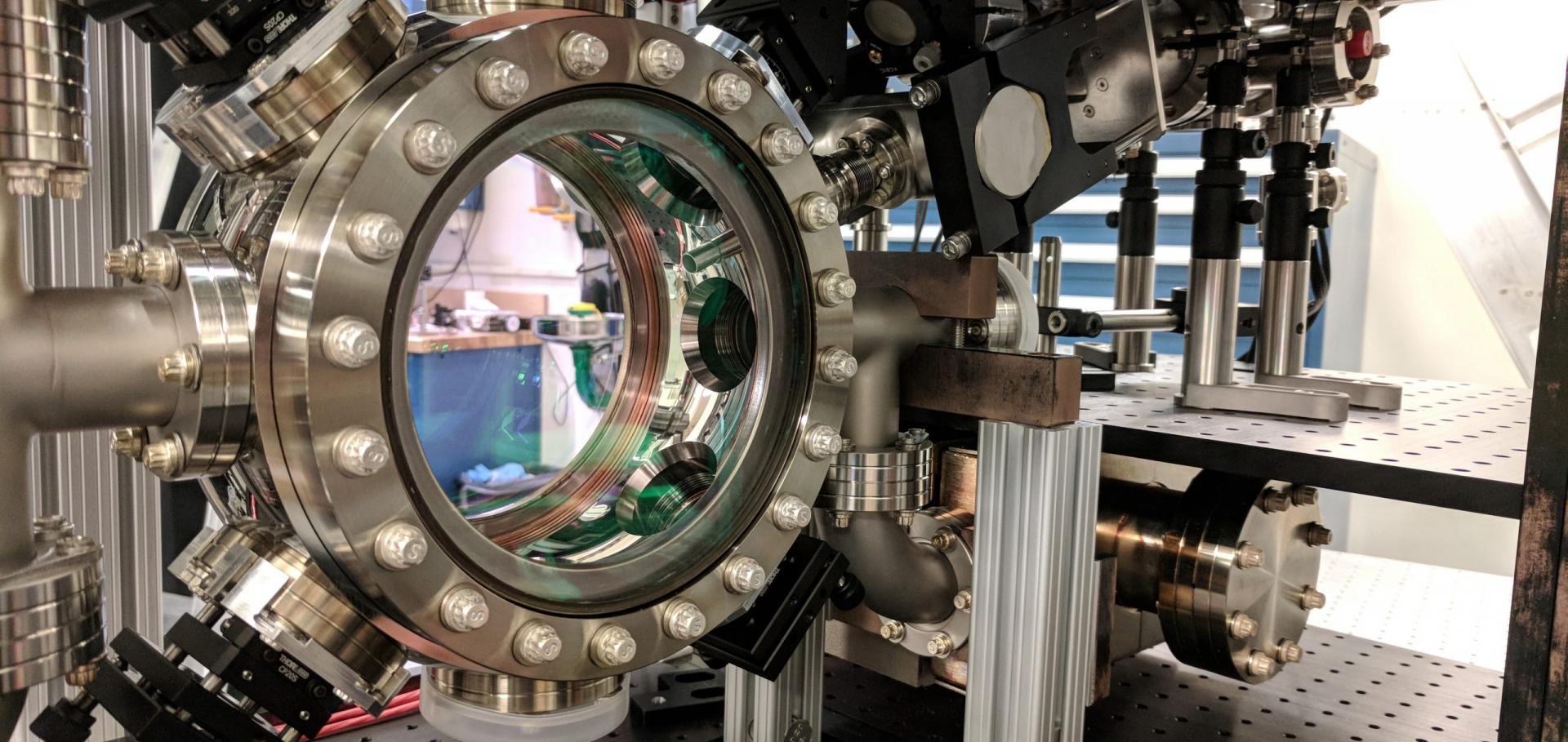
A prototype differential atom interferometer for fundamental physics
Nature Nature Research 654:8119 (2026) 622-628
Abstract:
Gravitational waves and ultralight dark matter are among the most compelling frontiers in fundamental physics, motivating proposals for very-long-baseline atom interferometerssuch as AION1, MAGIS2, AICE3 and AEDGE4 that aim to detect at frequencies at which ground-based5 and space-borne6 laser interferometers lose sensitivity. Very-long-baseline atom interferometers look for signals by comparing the quantum phase evolution of widely separated atomic ensembles interrogated by a common laser. However, their performance depends critically on suppressing noise sources, particularly laser phase noise. The experimental validation of such noise rejection remains an important challenge. Here we demonstrate a prototype differential atom interferometer based on the single-photon clock transition of fermionic 87Sr. Thus, we obtain a gradiometer configuration with a species intrinsically suited to kilometre-scale and space-baseline operation. The instrument operates at the standard quantum limit7 with no excess noise beyond atom shot noise. The differential configuration maintains quantum-limited sensitivity in the presence of several radians of artificially injected laser phase noise per shot, which emulates the conditions expected in a very-long-baseline atom interferometer. We also demonstrate the recovery of coherent oscillatory signals across a broad frequency range under fully phase-randomized conditions, a capability that is inaccessible to a single interferometer operating in the same regime. These results provide an experimental validation of the noise-immune measurement principle underlying very-long-baseline atom interferometers and mark an important step towards next-generation quantum sensors for gravitational-wave detection and searches for ultralight dark matter8, 9.Measurement of isolated photon plus two-jet correlations in Pb+Pb and $pp$ collisions at 5.02 TeV with ATLAS
ArXiv 2606.1776 (2026)