

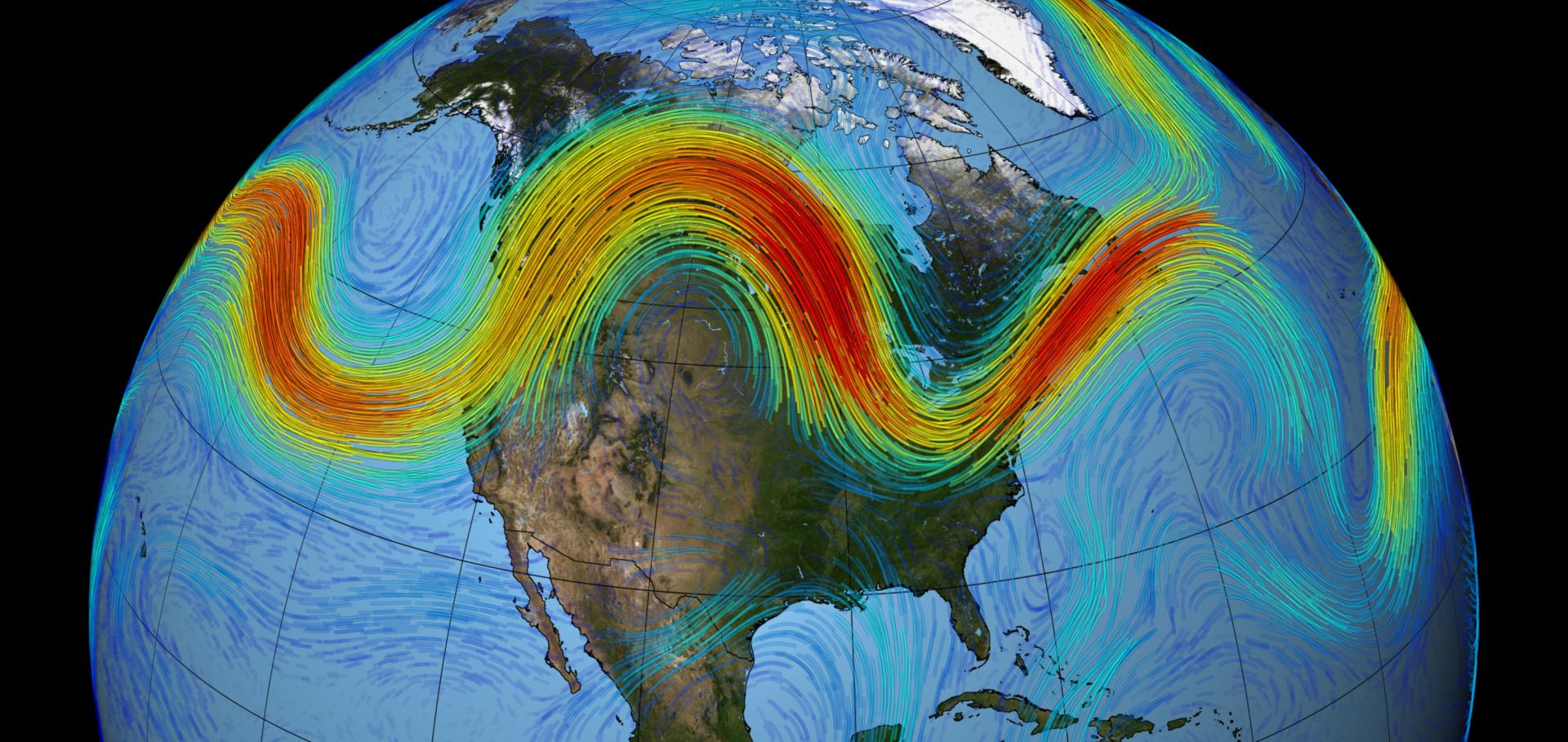
A simple kinematic source of skewness in atmospheric flow fields
Journal of the Atmospheric Sciences 69:2 (2012) 578-590
Abstract:
Geopotential height fields exhibit a well-known pattern of skewness, with distributions that are positively skewed on the poleward side of themidlatitude jets/storm tracks and negatively skewed on the equatorward side. This pattern has often been interpreted as a signature of nonlinear dynamical features, such as blocking highs and cutoff lows, and there is renewed interest in the higher moments of flow variables as indicators of the nature of the underlying dynamics. However, this paper suggests that skewness can arise as a simple kinematic consequence of the presence of jet streams and so may not be a reliable indicator of nonlinear dynamical behavior. In support of this, reanalysis data are analyzed to demonstrate a close link between the jet streams and the skewness patterns. Further evidence is provided by a simple stochastic kinematic model of a jet stream as a Gaussian wind profile. The parameters of this model are fitted to data from the reanalysis and also from an aquaplanet general circulation model. The skewness of the model's geopotential height and zonal wind fields are then compared to those of the original data. This shows that a fluctuating jet stream can produce patterns of skewness that are qualitatively similar to those observed, although the magnitude of the skewness is significantly overestimated by the kinematic model. These results suggest that this simple kinematic effect does contribute to the observed patterns of skewness but that other processes (such as nonlinear dynamics) likely also play a role. © 2012 American Meteorological Society.The north Atlantic jet stream under climate change and its relation to the NAO and EA patterns
Journal of Climate 25:3 (2012) 886-902
Abstract:
This paper describes recent variations of the North Atlantic eddy-driven jet stream and analyzes the mean response of the jet to anthropogenic forcing in climate models. Jet stream changes are analyzed both using a direct measure of the near-surface westerly wind maximum and using an EOF-based approach. This allows jet stream changes to be related to the widely used leading patterns of variability: the North Atlantic Oscillation (NAO) and East Atlantic (EA) pattern. Viewed in NAO-EA state space, isolines of jet latitude and speed resemble a distorted polar coordinate system, highlighting the dependence of the jet stream quantities on both spatial patterns. Some differences in the results of the two methods are discussed, but both approaches agree on the general characteristics of the climate models. While there is some agreement between models on a poleward shift of the jet stream in response to anthropogenic forcing, there is still considerable spread between different model projections, especially in winter. Furthermore, the model responses to forcing are often weaker than their biases when compared to a reanalysis. Diagnoses of jet stream changes can be sensitive to the methodologies used, and several aspects of this are also discussed. © 2012 American Meteorological Society.Atmospheric Low Frequency Variability: The Examples of the North Atlantic and the Indian Monsoon
Chapter in Climate Variability - Some Aspects, Challenges and Prospects, IntechOpen (2012)
Coupled Model Intercomparison Project 5 (CMIP5) simulations of climate following volcanic eruptions
Journal of Geophysical Research Atmospheres 117:17 (2012)
Abstract:
The ability of the climate models submitted to the Coupled Model Intercomparison Project 5 (CMIP5) database to simulate the Northern Hemisphere winter climate following a large tropical volcanic eruption is assessed. When sulfate aerosols are produced by volcanic injections into the tropical stratosphere and spread by the stratospheric circulation, it not only causes globally averaged tropospheric cooling but also a localized heating in the lower stratosphere, which can cause major dynamical feedbacks. Observations show a lower stratospheric and surface response during the following one or two Northern Hemisphere (NH) winters, that resembles the positive phase of the North Atlantic Oscillation (NAO). Simulations from 13 CMIP5 models that represent tropical eruptions in the 19th and 20th century are examined, focusing on the large-scale regional impacts associated with the large-scale circulation during the NH winter season. The models generally fail to capture the NH dynamical response following eruptions. They do not sufficiently simulate the observed post-volcanic strengthened NH polar vortex, positive NAO, or NH Eurasian warming pattern, and they tend to overestimate the cooling in the tropical troposphere. The findings are confirmed by a superposed epoch analysis of the NAO index for each model. The study confirms previous similar evaluations and raises concern for the ability of current climate models to simulate the response of a major mode of global circulation variability to external forcings. This is also of concern for the accuracy of geoengineering modeling studies that assess the atmospheric response to stratosphere-injected particles. © 2012. American Geophysical Union. All Rights Reserved.Trends in Austral jet position in ensembles of high- and low-top CMIP5 models
Journal of Geophysical Research Atmospheres 117:13 (2012)