MACLOUD (MArine CLOUD Brightening) is a UK research project investigating the potential impacts of Marine Cloud Brightening (MCB) across a wide range of spatial and temporal scales.
Marine Cloud Brightening is a proposed climate intervention in which sea-salt aerosol particles are introduced into the marine atmosphere. These particles can act as cloud condensation nuclei, increasing the number of cloud droplets and potentially making low-level marine clouds brighter and longer-lived. The resulting increase in reflected sunlight could produce a cooling effect. However, aerosol-cloud interactions are complex and uncertain, and interventions could have effects extending from individual clouds to regional and global atmospheric and ocean circulation.
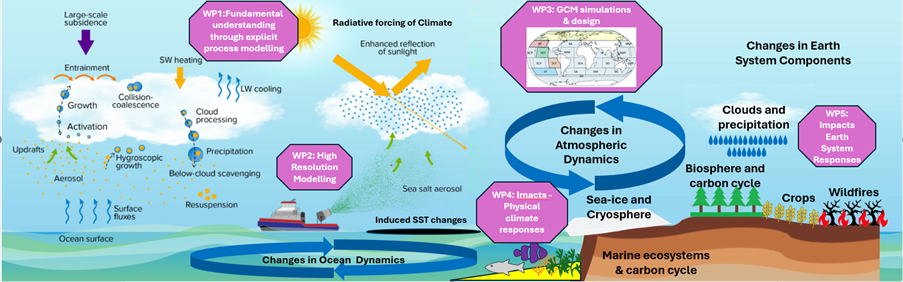
MACLOUD brings together researchers from the Universities of Exeter, Leeds, Manchester, Oxford and Reading to establish a more rigorous physical understanding of these effects. The project uses a hierarchy of models ranging from detailed parcel models and large-eddy simulations to numerical weather prediction models and fully coupled Earth System Models. Connecting processes across these scales will enable MACLOUD to assess both the effectiveness and the potential wider consequences of different MCB strategies.
Our Climate Processes Group contributes expertise in aerosol-cloud interactions and high-resolution modelling to understand how marine clouds respond to deliberate perturbations of sea-salt aerosol.
A key part of our work is investigating aerosol-cloud interactions in kilometre-scale simulations, where important cloud and circulation responses can be represented much more explicitly than in conventional climate models. We use these simulations to understand how changes in aerosol affect cloud properties, radiation, precipitation and the organisation of marine cloud systems.
We also contribute to connecting this detailed process understanding to the larger-scale climatic response to Marine Cloud Brightening. By examining how local aerosol and cloud perturbations translate into regional and potentially larger-scale changes, our research helps assess both the efficacy of MCB and the physical uncertainties and potential unintended consequences associated with its deployment.
This multi-scale approach contributes to MACLOUD's goal of developing a traceable modelling framework in which the representation of MCB in large-scale climate models is informed and tested using increasingly detailed models of the underlying aerosol and cloud processes.
MACLOUD is funded by the UK Natural Environment Research Council (NERC).