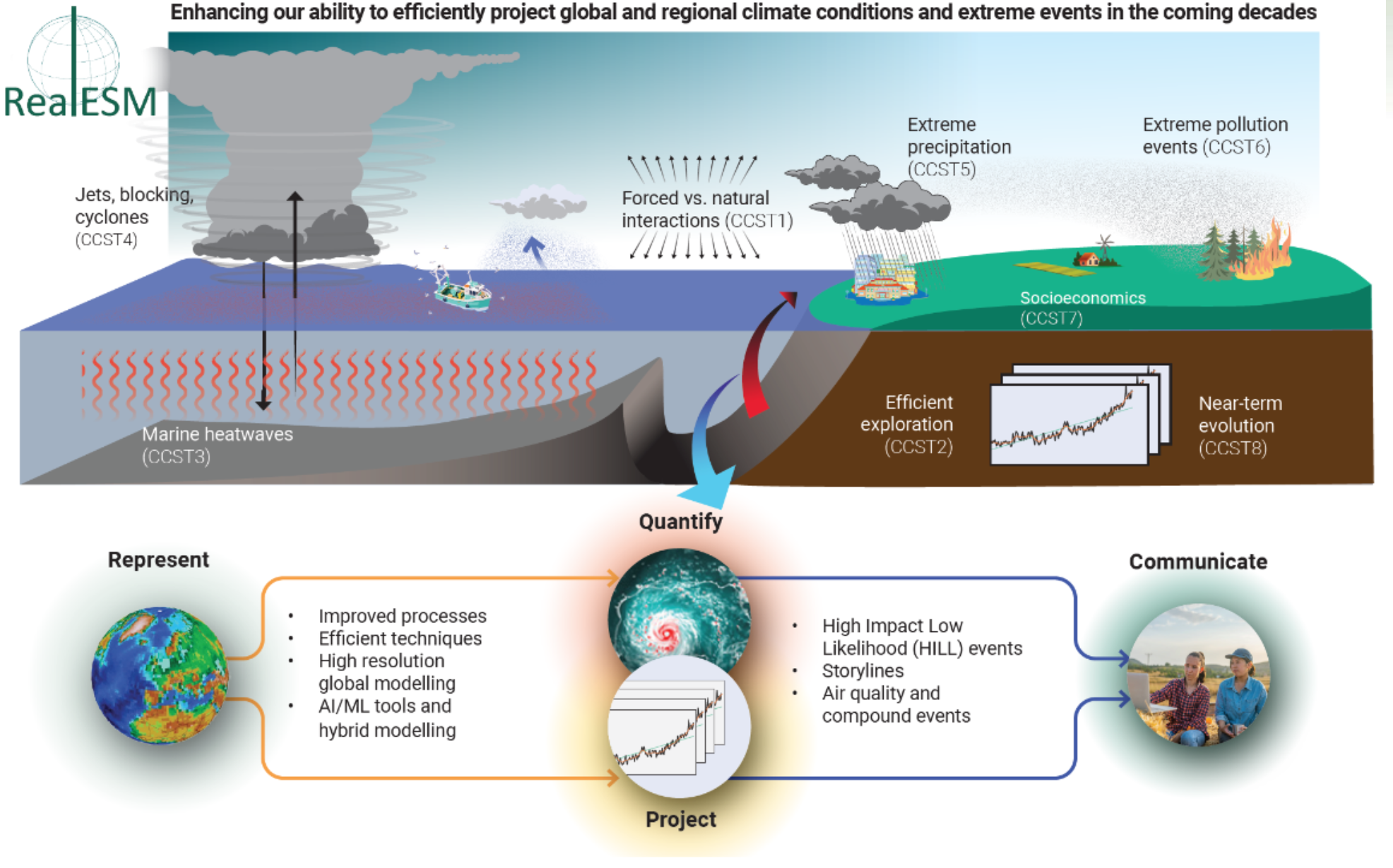
Realistic Earth System Models for Climate Applications (RealESM) is a European research project developing a new generation of Earth system models that combine higher spatial resolution with improved representations of key climate processes.
RealESM aims to improve our ability to anticipate global and regional climate conditions and extreme events over the coming years and decades by combining advances in Earth system modelling with AI tools and efficient analysis methods.
The project focuses particularly on processes and components undergoing rapid change or that are sensitive to model resolution, including natural and anthropogenic aerosol emissions, atmosphere-ocean interactions, marine heatwaves, jet and tropical cyclones, and regional extreme precipitation.
Our Climate Processes Group contributes to RealESM's work on clouds, aerosols and precipitation, with a particular focus on understanding and constraining aerosol effects on climate across scales. We develop and evaluate reduced-complexity representations of atmospheric composition and clouds that can be used efficiently in kilometre-scale Earth system simulations.
Our work combines regional and global kilometre-scale modelling with observations to investigate how model complexity and spatial resolution affect aerosol-cloud interactions. Observational constraints include satellite and ground-based measurements of aerosols, clouds and radiation.
A particular focus is on quantifying the effects of aerosols on radiative forcing, precipitation and extreme events. This includes aerosol-radiation and aerosol-cloud interactions, their influence on local, regional and global precipitation, and the relatively underexplored links between precipitation and aerosol-induced atmospheric absorption. Together, this work will help establish which aerosol and cloud processes need to be represented explicitly in the next generation of high-resolution Earth system models.
RealESM runs from 2026 to 2030 and is coordinated by CICERO Center for International Climate Research.
This project has received funding from the European Union’s Horizon Europe research and innovation programme under grant agreement No 101293649 (RealESM).