

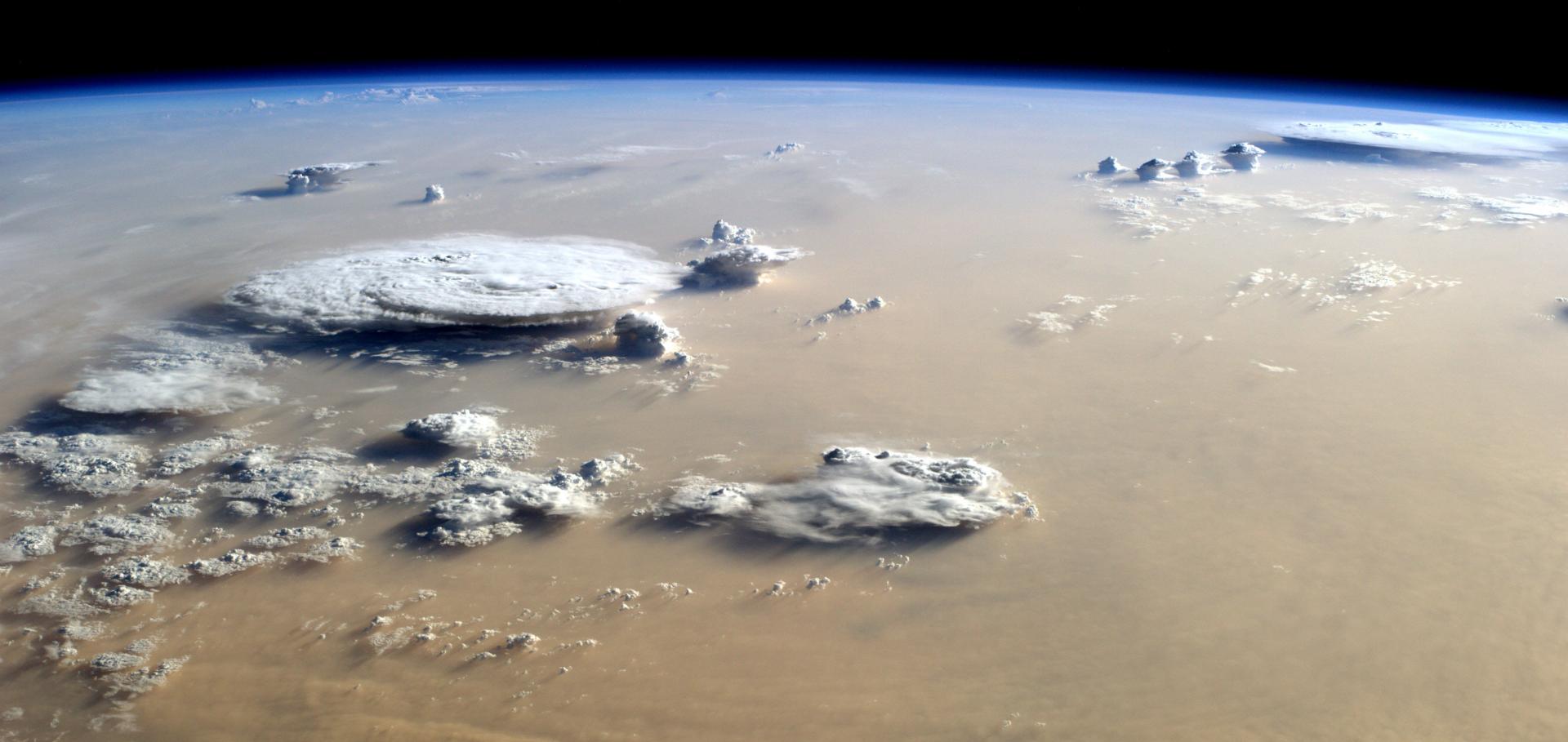
Global dust model intercomparison in AeroCom phase i
Atmospheric Chemistry and Physics 11:15 (2011) 7781-7816
Abstract:
This study presents the results of a broad intercomparison of a total of 15 global aerosol models within the AeroCom project. Each model is compared to observations related to desert dust aerosols, their direct radiative effect, and their impact on the biogeochemical cycle, i.e., aerosol optical depth (AOD) and dust deposition. Additional comparisons to Angström exponent (AE), coarse mode AOD and dust surface concentrations are included to extend the assessment of model performance and to identify common biases present in models. These data comprise a benchmark dataset that is proposed for model inspection and future dust model development. There are large differences among the global models that simulate the dust cycle and its impact on climate. In general, models simulate the climatology of vertically integrated parameters (AOD and AE) within a factor of two whereas the total deposition and surface concentration are reproduced within a factor of 10. In addition, smaller mean normalized bias and root mean square errors are obtained for the climatology of AOD and AE than for total deposition and surface concentration. Characteristics of the datasets used and their uncertainties may influence these differences. Large uncertainties still exist with respect to the deposition fluxes in the southern oceans. Further measurements and model studies are necessary to assess the general model performance to reproduce dust deposition in ocean regions sensible to iron contributions. Models overestimate the wet deposition in regions dominated by dry deposition. They generally simulate more realistic surface concentration at stations downwind of the main sources than at remote ones. Most models simulate the gradient in AOD and AE between the different dusty regions. However the seasonality and magnitude of both variables is better simulated at African stations than Middle East ones. The models simulate the offshore transport of West Africa throughout the year but they overestimate the AOD and they transport too fine particles. The models also reproduce the dust transport across the Atlantic in the summer in terms of both AOD and AE but not so well in winter-spring nor the southward displacement of the dust cloud that is responsible of the dust transport into South America. Based on the dependency of AOD on aerosol burden and size distribution we use model bias with respect to AOD and AE to infer the bias of the dust emissions in Africa and the Middle East. According to this analysis we suggest that a range of possible emissions for North Africa is 400 to 2200 Tg yr-1 and in the Middle East 26 to 526 Tg yr-1. © 2011 Author(s).Correction to “Global‐scale black carbon profiles observed in the remote atmosphere and compared to models”
Geophysical Research Letters American Geophysical Union (AGU) 37:23 (2010)
Corrigendum to "Description and evaluation of GMXe: a new aerosol submodel for global simulations (v1)" published in Geosci. Model Dev., 3, 391–412, 2010
Geoscientific Model Development Copernicus Publications 3:2 (2010) 413-413
Global-scale black carbon profiles observed in the remote atmosphere and compared to models
Geophysical Research Letters 37:18 (2010)
Abstract:
Refractory black carbon (rBC) aerosol loadings and mass size distributions have been quantified during the HIPPO campaign above the remote Pacific from 80N to 67S. Over 100 vertical profiles of rBC loadings, extending from ∼0.3 to ∼14 km were obtained with a Single-Particle Soot Photometer (SP2) during a two-week period in January 2009. The dataset provides a striking, and previously unobtainable, pole-to-pole snapshot of rBC mass loadings. rBC vertical concentration profiles reveal significant dependences on latitude, while associated rBC mass size distributions were highly uniform. The vertical profiles averaged in five latitude zones were compared to an ensemble of AEROCOM model fields. The model ensemble spread in each zone was over an order of magnitude, while the model average over-predicted rBC concentrations overall by a factor five. The comparisons suggest that rBC removal in global models may need to be evaluated separately in different latitude regions and perhaps enhanced. © 2010 by the American Geophysical Union.A critical look at spatial scale choices in satellite-based aerosol indirect effect studies
ATMOSPHERIC CHEMISTRY AND PHYSICS 10:23 (2010) 11459-11470