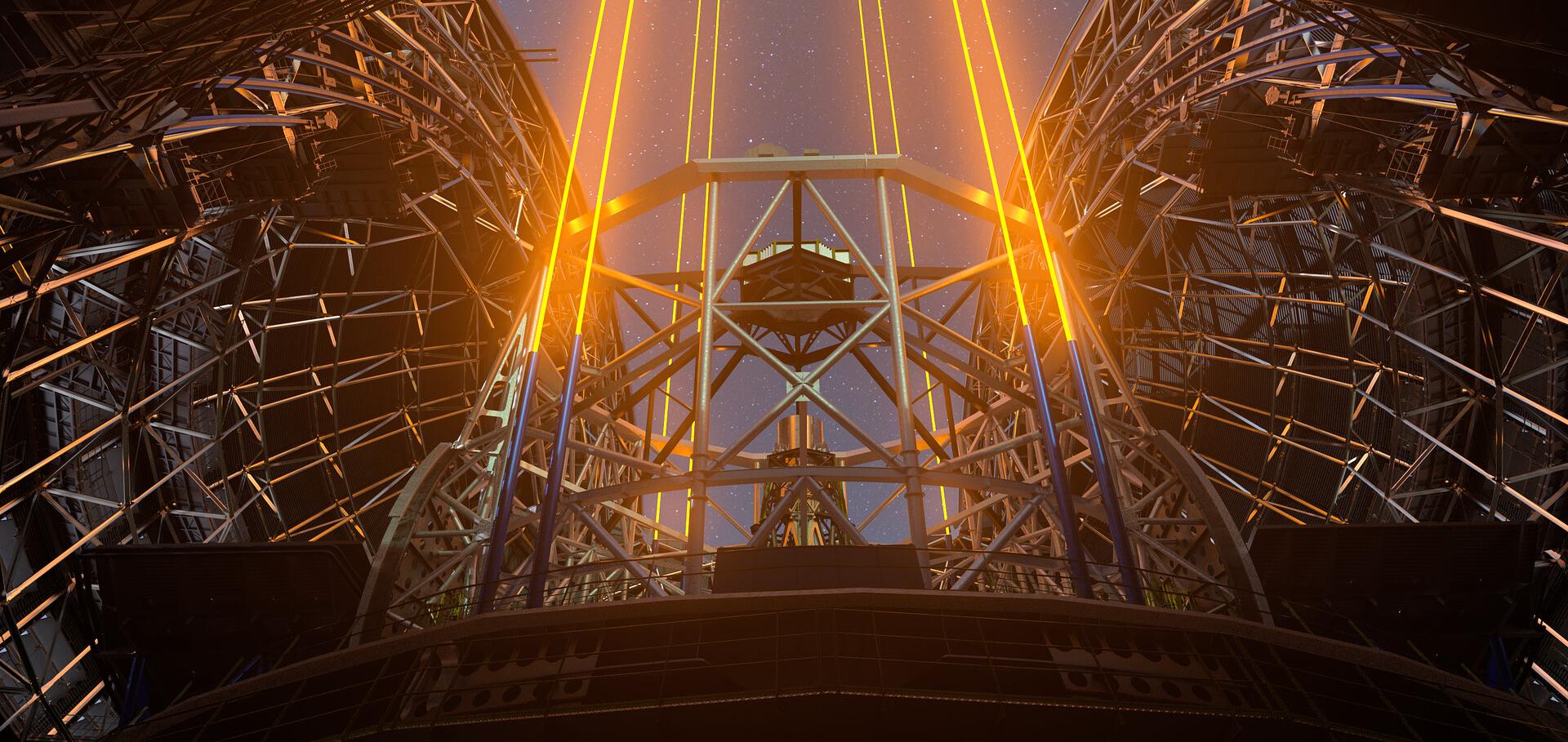
HARMONI: A first light spectrograph for the E-ELT
AO for ELT 2011 - 2nd International Conference on Adaptive Optics for Extremely Large Telescopes (2011)
Abstract:
We describe the current status of the HARMONI instrument design, which will form the basis for the first-light integral field spectrograph on the European Extremely Large Telescope. We review the phase A design, and highlight current on-going work to evolve the design in-line changing telescope requirements and lessons learned during the Phase A work. We also outline the key science drivers for the instrument, and describe briefly the requirements for the laser tomographic adaptive optics system which is expected to feed HARMONI.Laser Tomographic AO system for an integral field spectrograph on the E-ELT: ATLAS project
AO for ELT 2011 - 2nd International Conference on Adaptive Optics for Extremely Large Telescopes (2011)
Abstract:
ATLAS is a generic Laser Tomographic AO (LTAO) system for the E-ELT. Based on modular, relatively simple, and yet innovative concepts, it aims at providing diffraction-limited images in the near infra-red for a close to 100 percent sky coverage.Testing the limit of AO for ELTs: Diffraction limited astronomy in the red optical
AO for ELT 2011 - 2nd International Conference on Adaptive Optics for Extremely Large Telescopes (2011)
Abstract:
Many of the proposed science cases for extremely large telescopes (ELT) are only possible because of the unprecedented sensitivity and spatial resolution due to advanced, e.g. tomographic and multi conjugate, adaptive optic (AO) systems. Current AO systems on 8-10 m telescopes work best at wavelengths longward of 1 μm with Strehl ratios ≥ 15%. At red-optical wavelengths, e.g. in the I band (0.8 μm), the Strehl ratio is at best a few percent. The AO point spread function (PSF) typically has a diffraction-limited core superimposed on the seeing halo, however, for a 5% Strehl ratio the core has a very low intensity above the seeing halo. At an ELT, due to a 3-4 times higher angular resolution, the diffraction limited PSF core of only 5% Strehl ratio stands more prominently atop the shallow seeing halo leading to almost diffraction limited image quality even at low Strehl ratios. Prominent ELT science cases that use the Calcium triplet can exploit this gain in spatial resolution in the red-optical: stellar populations in dense environments or crowded fields; and the case of intermediate mass black holes in nuclear and globular stellar clusters, as well as (super-) massive black holes in galaxies.The ATLAS3D project - I. A volume-limited sample of 260 nearby early-type galaxies: Science goals and selection criteria
Monthly Notices of the Royal Astronomical Society 413:2 (2011) 813-836
Abstract:
The ATLAS3D project is a multiwavelength survey combined with a theoretical modelling effort. The observations span from the radio to the millimetre and optical, and provide multicolour imaging, two-dimensional kinematics of the atomic (Hi), molecular (CO) and ionized gas (Hβ, [Oiii] and [Ni]), together with the kinematics and population of the stars (Hβ, Fe5015 and Mg b), for a carefully selected, volume-limited (1.16 × 10⁵Mpc3) sample of 260 early-type (elliptical E and lenticular S0) galaxies (ETGs). The models include semi-analytic, N-body binary mergers and cosmological simulations of galaxy formation. Here we present the science goals for the project and introduce the galaxy sample and the selection criteria. The sample consists of nearby (D < 42Mpc, |δ- 29°| < 35°, |b| > 15°) morphologically selected ETGs extracted from a parent sample of 871 galaxies (8 per cent E, 22 per cent S0 and 70 per cent spirals) brighter than MK < -21.5mag (stellar mass M{black star}≳ 6 ×10⁹M⊙). We analyse possible selection biases and we conclude that the parent sample is essentially complete and statistically representative of the nearby galaxy population. We present the size-luminosity relation for the spirals and ETGs and show that the ETGs in the ATLAS3D sample define a tight red sequence in a colour-magnitude diagram, with few objects in the transition from the blue cloud. We describe the strategy of the SAURON integral field observations and the extraction of the stellar kinematics with the ppxf method. We find typical 1σ errors of ΔV≈ 6kms-1, Δσ≈ 7kms-1, Δh3≈Δh4≈ 0.03 in the mean velocity, the velocity dispersion and Gauss-Hermite (GH) moments for galaxies with effective dispersion σe≳ 120kms-1. For galaxies with lower σe (≈40 per cent of the sample) the GH moments are gradually penalized by ppxf towards zero to suppress the noise produced by the spectral undersampling and only V and σ can be measured. We give an overview of the characteristics of the other main data sets already available for our sample and of the ongoing modelling projects. © 2011 The Authors Monthly Notices of the Royal Astronomical Society © 2011 RAS.The ATLAS3D project - II. Morphologies, kinemetric features and alignment between photometric and kinematic axes of early-type galaxies
Monthly Notices of the Royal Astronomical Society 414:4 (2011) 2923-2949