Spectral analysis of Uranus' 2014 bright storm with VLT/SINFONI

Icarus Elsevier 264 (2015) 72-89

Authors:

Patrick Irwin, LN Fletcher, Peter Read, D Tice, I de Pater, GS Orton, NA Teanby, GR Davis

Abstract:

An extremely bright storm system observed in Uranus' atmosphere by amateur observers in September 2014 triggered an international campaign to observe this feature with many telescopes across the world. Observations of the storm system in the near infrared were acquired in October and November 2014 with SINFONI on ESO's Very Large Telescope (VLT) in Chile. SINFONI is an Integral Field Unit spectrometer returning 64. ×. 64 pixel images with 2048 wavelengths and uses adaptive optics. Image cubes in the H-band (1.43-1.87. μm) were obtained at spatial resolutions of ~0.1″ per pixel. The observations show that the centre of the storm feature shifts markedly with increasing altitude, moving in the retrograde direction and slightly poleward with increasing altitude. We also see a faint 'tail' of more reflective material to the immediate south of the storm, which again trails in the retrograde direction. The observed spectra were analysed with the radiative transfer and retrieval code, NEMESIS (Irwin et al. [2008]. J. Quant. Spec. Radiat. Transfer, 109, 1136-1150). We find that the storm is well-modelled using either two main cloud layers of a 5-layer aerosol model based on Sromovsky et al. (Sromovsky et al. [2011]. Icarus, 215, 292-312) or by the simpler two-cloud-layer model of Tice et al. (Tice et al. [2013]. Icarus, 223, 684-698). The deep component appears to be due to a brightening (i.e. an increase in reflectivity) and increase in altitude of the main tropospheric cloud deck at 2-3. bars for both models, while the upper component of the feature was modelled as being due to either a thickening of the tropospheric haze of the 2-layer model or a vertical extension of the upper tropospheric cloud of the 5-layer model, assumed to be composed of methane ice and based at the methane condensation level of our assumed vertical temperature and abundance profile at 1.23. bar. We also found this methane ice cloud to be responsible for the faint 'tail' seen to the feature's south and the brighter polar 'hood' seen in all observations polewards of ~45°N for the 5-layer model. During the twelve days between our sets of observations the higher-altitude component of the feature was observed to have brightened significantly and extended to even higher altitudes, while the deeper component faded.

An experimental study of multiple zonal jet formation in rotating, thermally driven convective flows on a topographic beta-plane

Physics of Fluids American Institute of Physics 27:8 (2015) 085111

Authors:

Peter Read, TNL Jacoby, PHT Rogberg, RD Wordsworth, YH Yamazaki, K Miki-Yamazaki, Roland Young, J Sommeria, H Didelle, S Viboud

Abstract:

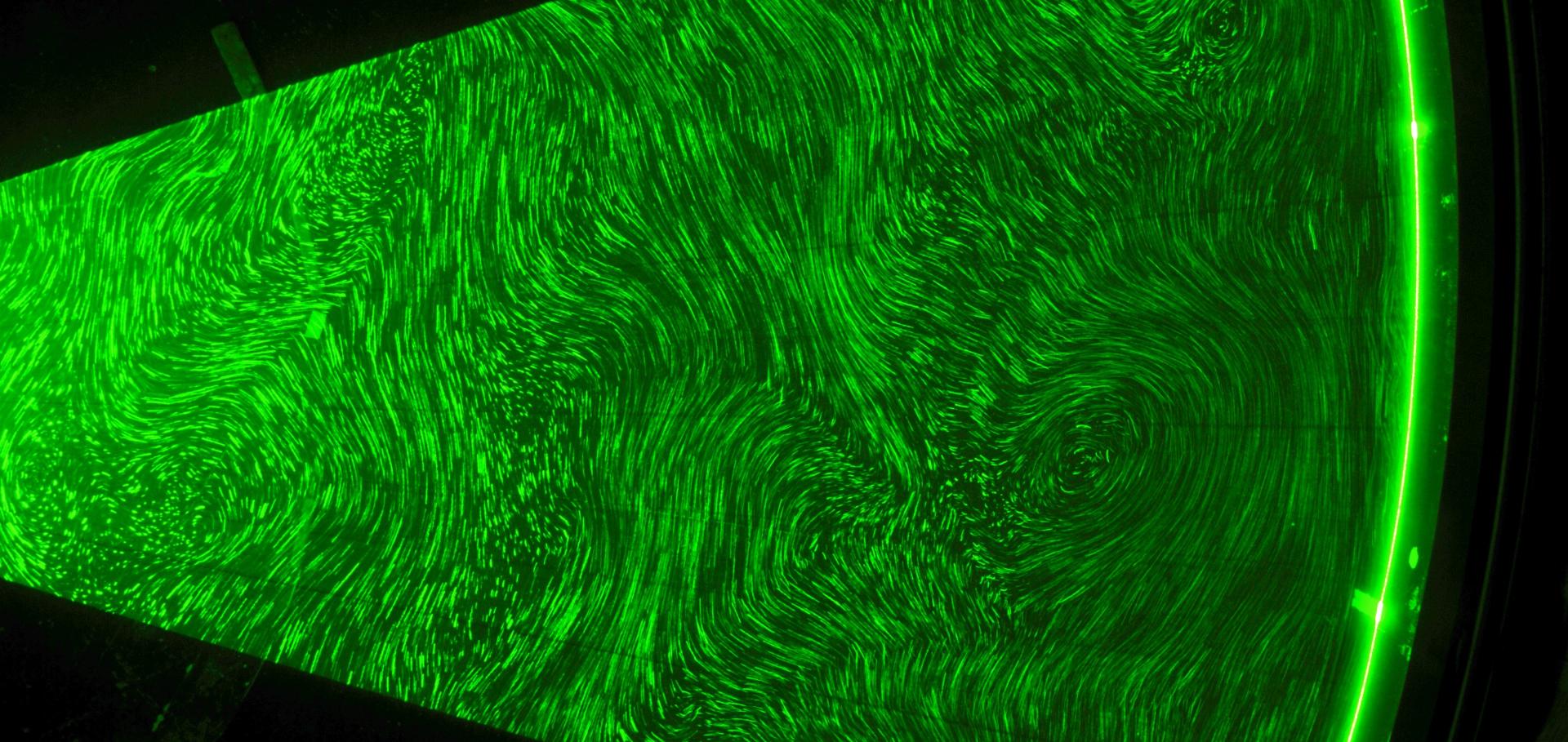
A series of rotating, thermal convection experiments were carried out on the Coriolis platform in Grenoble, France, to investigate the formation and energetics of systems of zonal jets through nonlinear eddy/wave-zonal flow interactions on a topographic ß-plane. The latterwas produced by a combination of a rigid, conically sloping bottom and the rotational deformation of the free upper surface. Convection was driven by a system of electrical heaters laid under the (thermally conducting) sloping bottom and led to the production of intense, convective vortices. These were observed to grow in size as each experiment proceeded and led to the development of weak but clear azimuthal jet-like flows, with a radial scale that varied according to the rotation speed of the platform. Detailed analyses reveal that the kinetic energy-weighted radial wavenumber of the zonal jets, kJ y, scales quite closely either with the Rhines wavenumber as kJ y ≃ 2(βT/2urms)1/2, where urms is the rms total or eddy velocity and βT is the vorticity gradient produced by the sloping topography, or the anisotropy wavenumber as kJ y ≃ 1.25(β3T ε{lunate})1/5, where ε{lunate} is the upscale turbulent energy transfer rate. Jets are primarily produced by the direct quasi-linear action of horizontal Reynolds stresses produced by trains of topographic Rossby waves. The nonlinear production rate of zonal kinetic energy is found to be strongly unsteady, however, with fluctuations of order 10-100 times the amplitude of the mean production rate for all cases considered. The time scale of such fluctuations is found to scale consistently with either an inertial time scale, Τp ~ 1.√urms βT, or the Ekman spin-down time scale. Kinetic energy spectra show some evidence for a k-5/3 inertial subrange in the isotropic component, suggestive of a classical Kolmogorov-Batchelor-Kraichnan upscale energy cascade and a steeper spectrum in the zonal mean flow, though not as steep as k-5, as anticipated for fully zonostrophic flow. This is consistent with a classification of all of these flows as marginally zonostrophic, as expected for values of the zonostrophy parameter Rβ ≃ 1.6-1.7, though a number of properties related to flow anisotropy were found to vary significantly and systematically within this range.

A laboratory study of global-scale wave interactions in baroclinic flow with topography II: vacillations and low-frequency variability

Geophysical and Astrophysical Fluid Dynamics Taylor and Francis 109:4 (2015) 359-390

Authors:

Stephan Risch, Peter Read

Abstract:

A laboratory investigation is presented with the aim of studying systematically the occurrence and characteristics of low-frequency variability of flows resulting from the interaction of a baroclinic flow with periodic bottom topography. Low-frequency variability within the baroclinic wave regime occurred in two distinct forms in separate regions of parameter space. One corresponded to the transition region between the baroclinic travelling and stationary wave regimes. It involved primarily an interaction between the drifting baroclinic waves and stationary components of the topographically forced wave. The resulting flow had characteristics similar to amplitude vacillation and had a time-scale of 30–60 annulus revolutions (days), which also corresponded to the wave drift period. A new regime of low-frequency amplitude vacillation was discovered in the transition region with the axisymmetric flow regime. As the complexity of the flow increased the period of the vacillation cycles grew to ∼100–180 “days”. This slower vacillation seemed to involve a cyclic enabling and disabling of nonlinear interactions between the forced stationary wave and the growing and azimuthally drifting wave, which in turn was linked to a decrease in mean flow shear. Subsequent chains of wave-wave interactions characterised the complex but robust oscillation phenomenon. The resulting behaviour has several features in common with some recent models of intraseasonal oscillations in the mid-latitude troposphere and with sudden stratospheric warmings.

Non-axisymmetric flows in a differential-disk rotating system

Journal of Fluid Mechanics Cambridge University Press (CUP) 775 (2015) 349-386

Authors:

Tony Vo, Luca Montabone, Peter L Read, Gregory J Sheard

An experimental investigation into topographic resonance in a baroclinic rotating annulus

Geophysical & Astrophysical Fluid Dynamics Taylor & Francis 109:4 (2015) 391-421

Authors:

SD Marshall, PL Read