

Turbulent damping of fast tidal oscillations by three-dimensional Rayleigh–Bénard convection with a radiating free surface
Monthly Notices of the Royal Astronomical Society Oxford University Press 549:3 (2026) stag909
Abstract:
We present three-dimensional Dedalus simulations of Rayleigh–Bénard convection with a blackbody-radiating free upper surface, subject to a low-amplitude oscillatory forcing that mimics tidal perturbations in convective envelopes of stars and planets. The forcing period is 10–100 times shorter than the convective time-scale, . Using a Reynolds decomposition of the velocity field averaged over one oscillation period, in which the tidal oscillations naturally constitute the fluctuating field and convection the mean flow, we elucidate the kinetic energy exchange between the two. Provided the oscillatory Reynolds number exceeds a modest threshold, we find that the oscillations systematically transfer kinetic energy to the mean flow at a volume-averaged rate , where is the rms fluctuation velocity. This reflects strong, order-unity correlations between the fluctuation velocities and the mean flow. These arise because the oscillatory forcing displaces fluid elements that are then redirected by buoyancy and incompressibility in the same manner as the mean flow. The transfer is dominated by correlations involving vertical velocity fluctuations and vertical gradients of the mean flow. The resulting energy transfer rate is consistent, within the equilibrium-tide framework, with the observed tidal circularization of solar-type binaries and with the orbital evolution of moons of Jupiter and Saturn. This validates the formalism proposed by C. Terquem (2021) for the dissipation of fast tides, a long-standing problem. Replacing the free surface with a rigid upper boundary significantly and artificially modifies the correlations.A Stratification-Dependent, Enstrophy-Controlled Regime in Baroclinic Turbulence Experiments in the Laboratory
Copernicus Publications (2026)
Abstract:
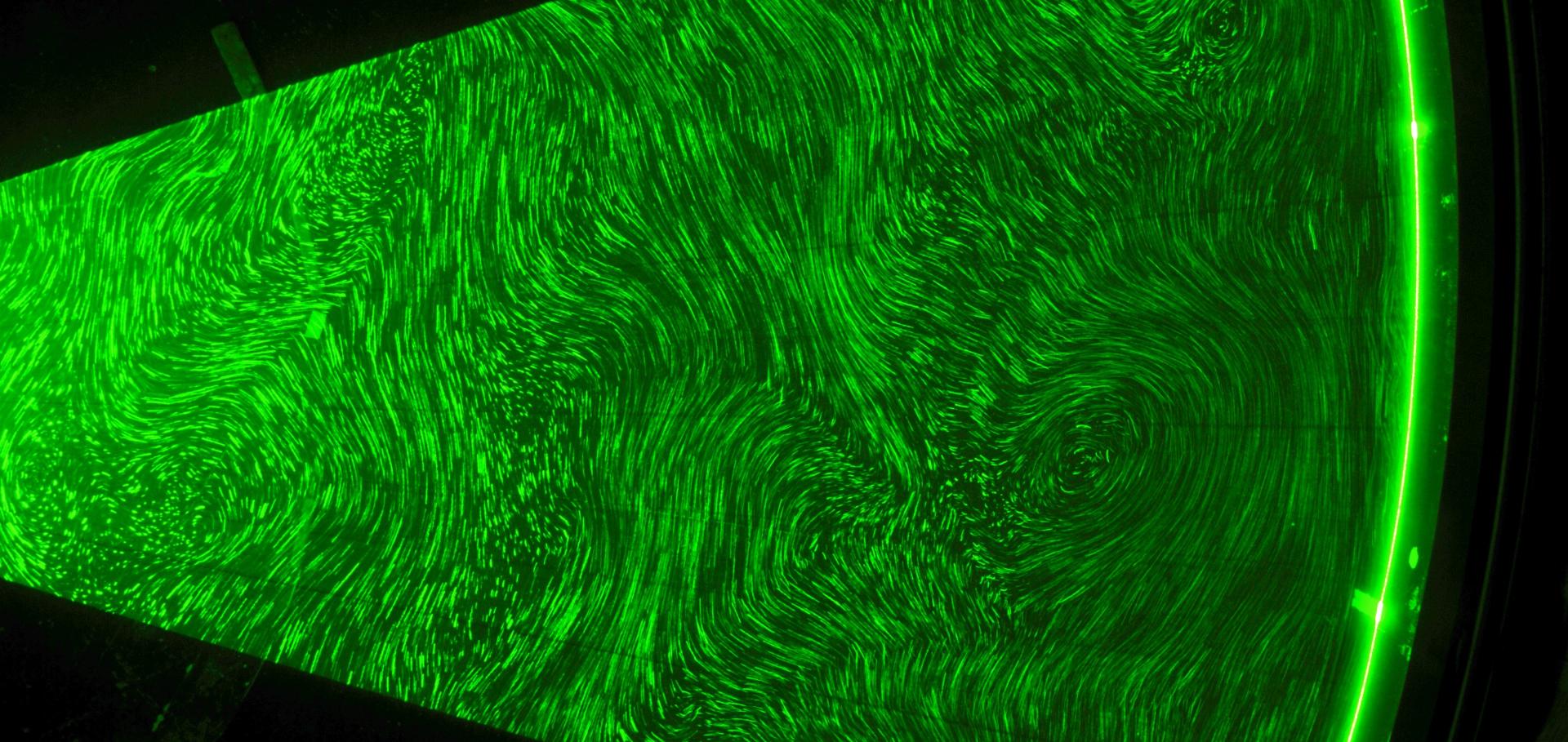
The circulation of the Earth’s atmosphere and those of many other planets is dominated by turbulent interactions in a baroclinically unstable, rotating, stratified flow. Even for the Earth, which has been well observed for many years, the energy spectrum and complex properties of the anisotropic and inhomogeneous turbulent cascades of energy and enstrophy remain poorly understood and difficult to model accurately. Here we measure geostrophic turbulence energised by baroclinic instability in a rotating, differentially heated fluid annulus in the laboratory, which is bounded by convectively-driven warm and cold flows at the outer and inner boundaries, respectively (see Fig. 1a). Horizontal velocity fields (Fig. 1b-c) are obtained via particle image velocimetry of neutrally buoyant particles suspended in the flow, while the temperature structure is sampled using a vertical array of thermocouples located in the middle of the channel. The horizontal kinetic energy spectra exhibit a wavenumber range at relatively large length scales which scales as k−3, where k denotes the horizontal wavenumber (see Fig. 1d-e). Moreover, the spectral amplitude is found to correlate with the square of the Brunt–Vaisala frequency N at the same heights as the velocity measurements. The observed turbulent state exhibits a net forward enstrophy cascade across all scales, along with bidirectional kinetic energy transfer, which is indicated by a reversal in the sign of the spectral energy flux. The change of sign of the kinetic energy cascade occurs at a scale proportional to the internal Rossby radius of deformation Ld. These findings highlight the role of baroclinic instability in shaping the distribution of energy across scales with implications for synoptic- and meso-scale turbulent flows in the atmospheres of the Earth and other terrestrial planet atmospheres and oceans.FIG. 1. (a) Schematic plot of the convective tank. Snapshots of vorticity ζ for thermal Rossby number RoT = 5.41 (b) and RoT = 0.03 (c). On the scale bar, Lid = 2.4 cm and Liid = 22.6 cm are the Rossby radius of deformation for (c) and (b), respectively. (d) Kinetic energy spectra, E(k), for various values of RoT. The arrow indicates the wave number kp corresponding to the peak of E(k) when RoT = 0.03. Inset: radial profiles of temporal- and zonal-averaged azimuthal velocity, Uθ. (e) Kinetic energy spectra compensated by k−3 and normalised by N2 versus LRk. The dashed line indicates the plateau segment for LRk ∈ [2, 10] and has a magnitude of ∼ 0.5. Data are for height h = 0.18 m.Emergence of Robust Zonal Jets in a Differentially Heated Rotating Annulus
Copernicus Publications (2026)
Abstract:
The midlatitude atmospheres of gas giant planets are characteristic of strong and persistent zonal jets; however, the processes governing their formation and the associated energy pathways remain less understood. To investigate these mechanisms, we conducted a laboratory study of zonal jets driven by thermal forcing in an annular cylindrical tank partially filled with distilled water as the working fluid. Heating is applied at the outer boundary, cooling at the inner boundary, the bottom is thermally insulated, and the top is a free surface. An array of laser diodes embedded in the inner cylinder generates an annular laser sheet, enabling the measurement of velocity fields at a fixed height using particle image velocimetry. By systematically varying the rotation rate and the imposed temperature contrast, we adjusted the steepness of the free surface, thus the topographic β effect, and the thermal forcing strength, respectively. The non-dimensional controlling parameter, thermal Rossby number, RoT, ranges from 0.0012 to 0.01 and Taylor number, Ta, from 2.3 × 10¹⁰ to1.7 × 1011. We discerned the emergence of robust zonal jets, of which the zonal-mean kinetic energy accounts for up to 70% of the total kinetic energy, corresponding to a zonostrophic index of 2.7. In this regime, two coherent and persistent prograde jets form near the inner and outer boundaries. The radial profile of the potential vorticity develops toward a pronounced staircase-like structure, consistent with previous numerical studies (Scott and Dritschel, J. Fluid Mech., 2012). Analysis of the inter-scale energy transfer reveals a dominant interaction between the zonal-mean flow and eddies, while the kinetic energy spectrum of the zonal-mean component exhibits k−5 (where k denotes the wavenumber), in agreement with the theory of zonostrophic turbulence (Sukoriansky and Galperin, PRL, 2002). Figure 1: A snapshot of azimuthal velocity contour for RoT = 7.1 × 10⁻³, Ta = 1.44 × 10¹¹ and β =49.7 m−1 s−1.Stratification-dependent enstrophy-controlled regime in geostrophic turbulence
Physical Review Letters American Physical Society (APS) (2026)
Experimental dataset of baroclinic-driven zonal jet flows
University of Oxford (2026)