

Efficient VUV sensitization of Eu3+ emission by Tb3+ in potassium rare-earth double phosphate
Physica Status Solidi - Rapid Research Letters 3:1 (2009) 13-15
Abstract:
The luminescence properties of K3Tb(PO4)2 activated by Eu3+ were studied at excitation over the 120-300 nm wavelength range. It is demonstrated that Tb3+ ions, exhibiting a strong absorption band in the vacuum-ultraviolet (VUV), can provide efficient sensitisation of Eu3+ emission in this wave length range, giving rise to intense red luminescence at 150 nm excitation. A proof is given for the concept of VUV sensitisation enabling the engineering of luminescence materials with enhanced conversion efficiency of VUV radiation into visible light. © 2009 WILEY-VCH Verlag GmbH&Co. KGaA, Weinheim.Eureca - The future of cryogenic dark matter detection in Europe
Eas Publications Series 36 (2009) 249-255
Abstract:
EURECA (European Underground Rare Event Calorimeter Array) is an astro-particle physics facility aiming to directly detect galactic dark matter. The Laboratoire Souterrain de Modane has been selected as host laboratory. The EURECA collaboration unites CRESST, EDELWEISS and the Spanish-French experiment ROSEBUD, thus concentrating and focussing effort on cryogenic detector research in Europe into a single facility. EURECA will use a target mass of up to one ton, enough to explore WIMP - nucleon scalar scattering cross sections in the region of 10-9 - 10-10 picobarn. A major advantage of EURECA is the planned use of more than just one target material (multi target experiment for WIMP identification). © EAS, EDP Sciences 2009.Searching for dark matter with CRESST
Proceedings of the 5th Patras Workshop on Axions, WIMPs and WISPs, PATRAS 2009 (2009) 11-15
Abstract:
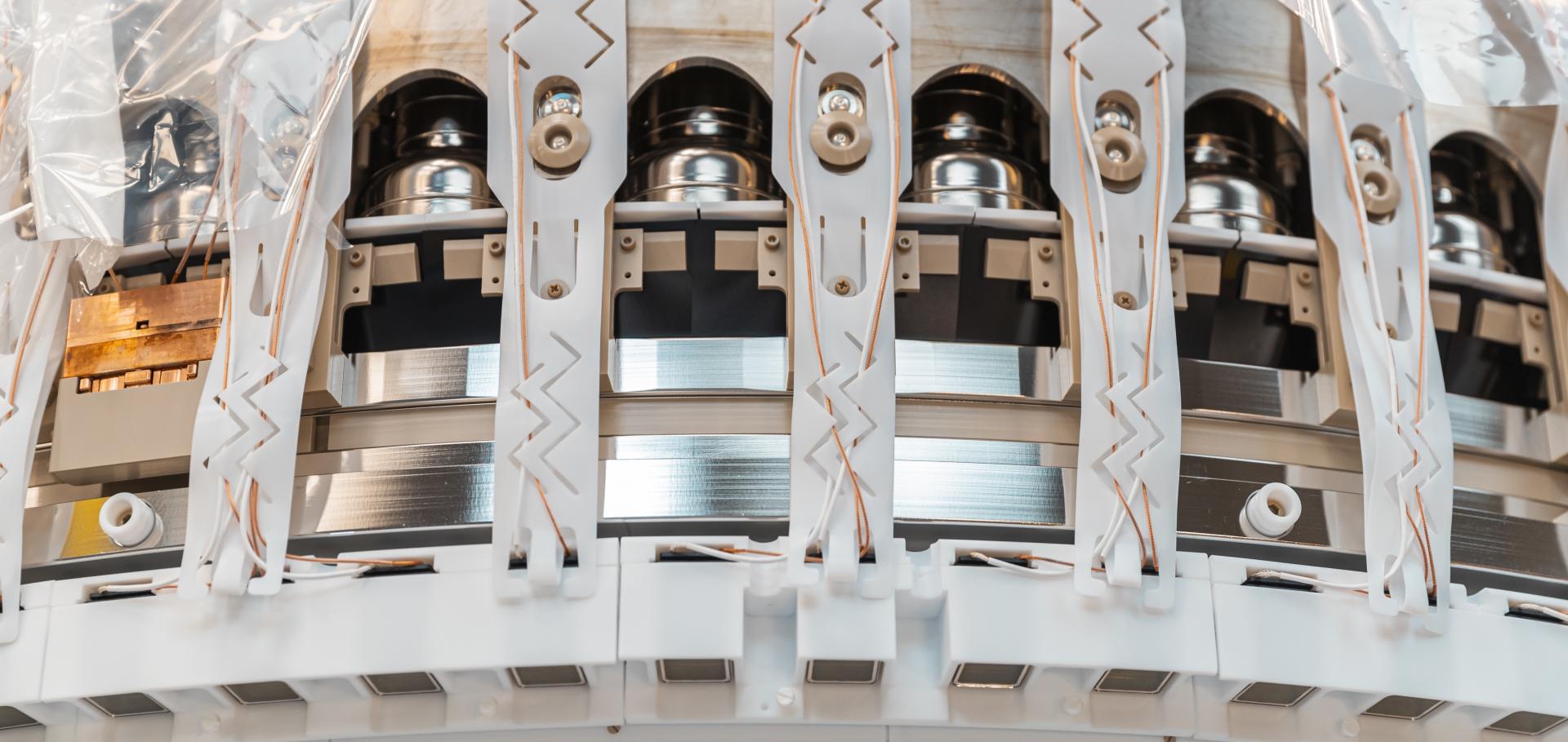
The CRESST II experiment is a dark matter search using cryogenic phonon-scintillation detectors, aiming to detect WIMP dark matter particle interactions. The detector consists of individual, modular and scintillating (CaWO4or ZnWO4) target crystals, each equipped with a phonon sensor for precise determination of the energy deposited in the crystals. Each module is further equipped with a separate cryogenic scintillation light detector, allowing event-by-event background discrimination. An extended commissioning run during 2007 has set an upper limit on theWIMP-nucleon scattering cross section. Attention is currently focussed on the interpretation of a few remaining nuclear recoils candidate events.Production of low-background CuSn6-bronze for the CRESST dark-matter-search experiment.
Appl Radiat Isot 67:1 (2009) 197-200
Abstract:
One of the most intriguing open questions in modern particle physics is the nature of the dark matter in our universe. As hypothetical weakly interacting massive particles (WIMPs) do interact with ordinary matter extremely rarely, their observation requires a very low-background detector environment regarding radioactivity as well as an advanced detector technique that allows for active discrimination of the still present radioactive contaminations. The CRESST experiment uses detectors operating at milli-Kelvin temperature. Energy deposition in the detectors is recorded via the simultaneous measurement of a phonon-mediated signal and scintillation emitted by the CaWO(4) crystal targets. The entire setup is made of carefully selected materials. In this note we report on the development of ultra-pure bronze (CuSn(6)) wire in small quantities for springs and clamps that are currently being used in the CRESST II setup.Oxide scintillators to search for dark matter and double beta decay
2008 IEEE NUCLEAR SCIENCE SYMPOSIUM AND MEDICAL IMAGING CONFERENCE (2008 NSS/MIC), VOLS 1-9 (2009) 2541-+