

What happened to rocky planets?
Abstract:
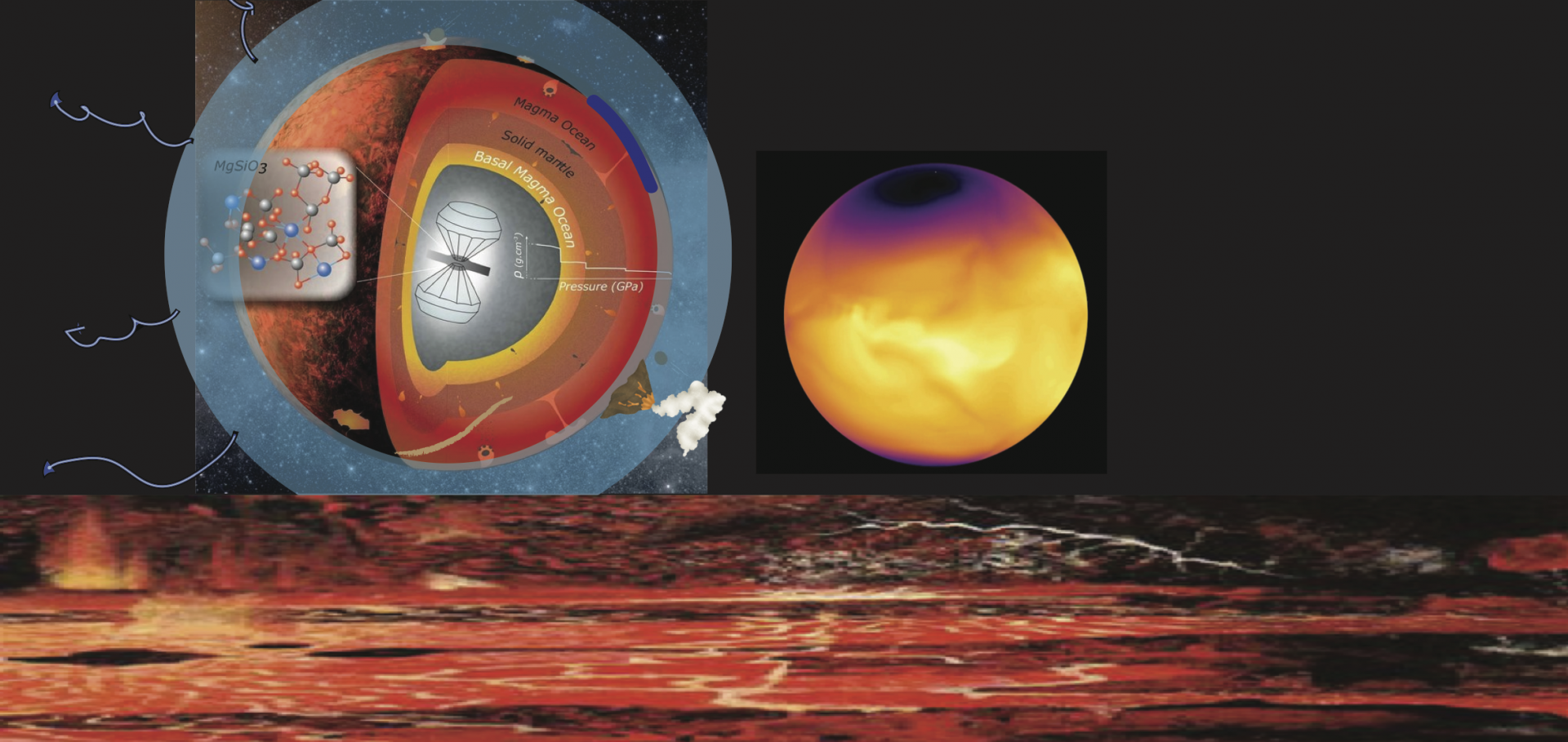
A satisfactory model describing why Earth, Venus, and Mars, differ so substantially is yet to be described; centuries of planetary science have yielded insightful - but incomplete - explanations. Meanwhile, observations of planets beyond the Solar System are revealing novel environments which raise challenges to our existing theories.Multiple lines of evidence suggest the presence of 'magma oceans' early in rocky planets' lifetimes. During these important natal periods, planet-scale feedbacks emerge via exchange of energy and material between mantles and atmospheres. Some magma oceans are sustained indefinitely; others solidify, providing initial conditions for solid-body geodynamics, secondary atmospheres, and the potential for habitability. Both scenarios are observable on exoplanets today.
I present a numerical framework for modelling planetary evolution over deep time, capturing the physics of mantle dynamics, tides, volatile partitioning, atmospheric chemistry, convection, radiative transfer, and escape. Applying this holistic model resolves the history of rocky (exo)planets from their birth to the present.
Diverse atmospheres are formed in equilibrium with deep magma oceans: from H2- to CO2-dominated compositions, beyond previously-adopted simplified mixtures. Corresponding radiative properties can sustain magma oceans for billions of years. Atmospheric temperature structure, tied to the efficacy of energy transport, regulates planet-scale evolution - including that of the deep interior. Tidal feedbacks, from interior-atmospheric coupling, further regulate magma ocean longevity. My simulations show that global physical-chemical interactions set exoplanets' observables, making a connection between measurable atmospheric properties and otherwise hidden processes. Evolution tracks of L 98-59 d (a case study) are consistent with recent JWST & TESS observations: L 98-59 d formed volatile-rich, with a substantial atmosphere and a reducing interior - a scenario inaccessible to simplified models, pointing to a continuum of atmospheric evolution scenarios.
Space missions, ground-based telescopes, and lab experiments are expanding the horizon of planetary science. The interdisciplinary modelling framework developed here provides a connection between these missions and experiments - yielding a comprehensive picture of the geological, chemical, physical, and climatic evolution of rocky planets in the Solar System and beyond.