Baroclinic and barotropic instabilities in planetary atmospheres - energetics, equilibration and adjustment

Authors:

Peter Read, Neil Lewis, Daniel Kennedy, Hélène Scolan, Fachreddin Tabataba-Vakili, Yixiong Wang, Susie Wright, Roland Young

Beyond runaway: initiation of the post-runaway greenhouse state on rocky exoplanets

Astrophysical Journal IOP Publishing

Authors:

Ryan Boukrouche, Tim Lichtenberg, Raymond Pierrehumbert

Abstract:

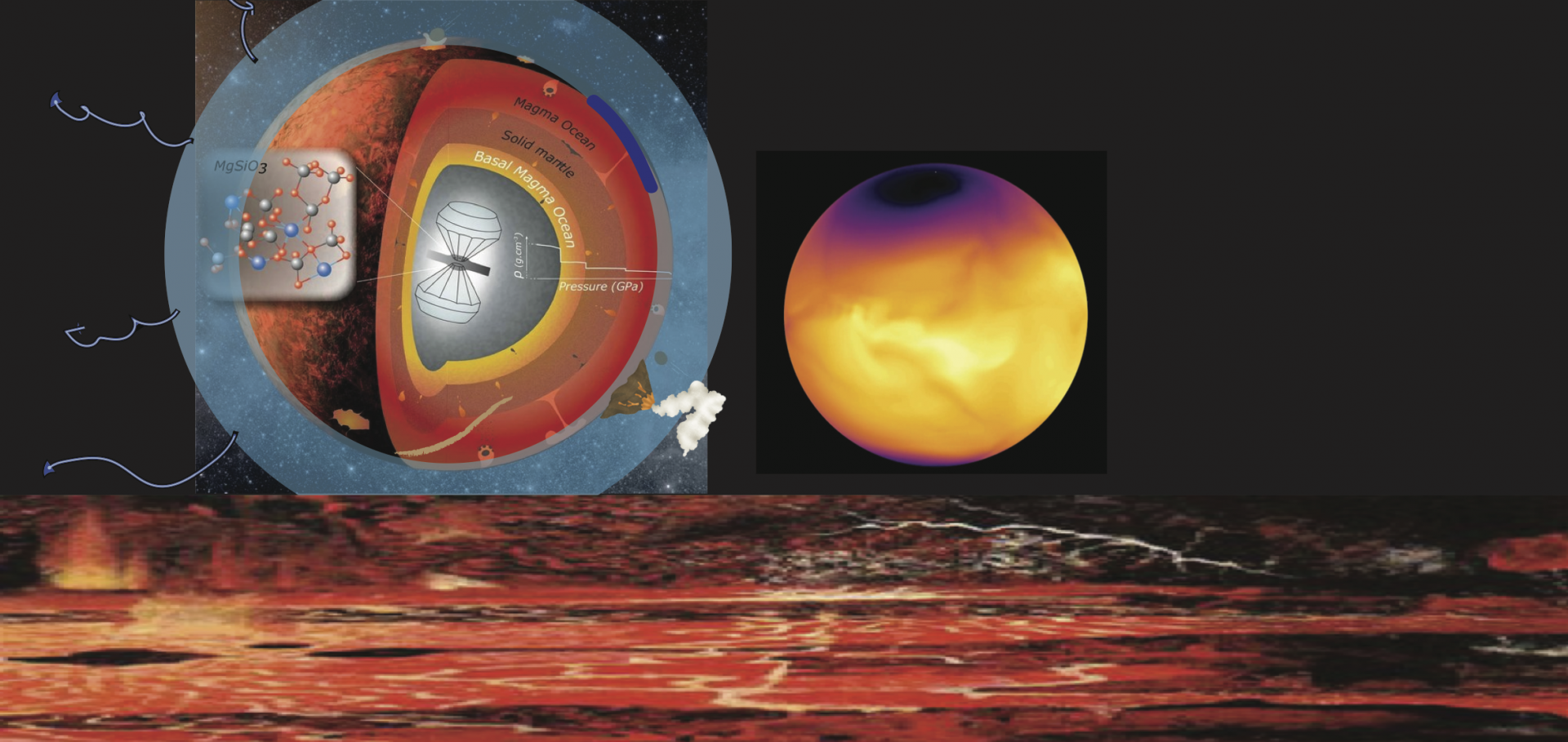
The runaway greenhouse represents the ultimate climate catastrophe for rocky, Earth-like worlds: when the incoming stellar flux cannot be balanced by radiation to space, the oceans evaporate and exacerbate heating, turning the planet into a hot wasteland with a steam atmosphere overlying a possibly molten magma surface. The equilibrium state beyond the runaway greenhouse instellation limit depends on the radiative properties of the atmosphere and its temperature structure. Here, we use 1-D radiative-convective models of steam atmospheres to explore the transition from the tropospheric radiation limit to the post-runaway climate state. To facilitate eventual simulations with 3-D global circulation models, a computationally efficient band-grey model is developed, which is capable of reproducing the key features of the more comprehensive calculations. We analyze two factors which determine the equilibrated surface temperature of post-runaway planets. The infrared cooling of the planet is strongly enhanced by the penetration of the dry adiabat into the optically thin upper regions of the atmosphere. In addition, thermal emission of both shortwave and near-IR fluxes from the hot lower atmospheric layers, which can radiate through window regions of the spectrum, is quantified. Astronomical surveys of rocky exoplanets in the runaway greenhouse state may discriminate these features using multi-wavelength observations.

Ice-shelf damming in the glacial Arctic Ocean: dynamical regimes of a basin-covering kilometre thick ice shelf

Authors:

Johan Nilsson, Martin Jakobsson, Chris Borstad, Nina Kirchner, Göran Björk, Raymond T Pierrehumbert, Christian Stranne

Large Interferometer For Exoplanets (LIFE): I. Improved exoplanet detection yield estimates for a large mid-infrared space-interferometer mission

Authors:

Life collaboration, Sp Quanz, M Ottiger, E Fontanet, J Kammerer, F Menti, F Dannert, A Gheorghe, O Absil, Vs Airapetian, E Alei, R Allart, D Angerhausen, S Blumenthal, J Cabrera, Ó Carrión-González, G Chauvin, Wc Danchi, C Dandumont, D Defrère, C Dorn, D Ehrenreich, S Ertel, M Fridlund, A García Muñoz, C Gascón, A Glauser, Jl Grenfell, G Guidi, J Hagelberg, R Helled, Mj Ireland, Rk Kopparapu, J Korth, S Kraus, A Léger, L Leedjärv, T Lichtenberg, J Lillo-Box, H Linz, R Liseau, J Loicq, V Mahendra, F Malbet, J Mathew, B Mennesson, Mr Meyer, L Mishra, K Molaverdikhani, L Noack

Abstract:

One of the long-term goals of exoplanet science is the atmospheric characterization of dozens of small exoplanets in order to understand their diversity and search for habitable worlds and potential biosignatures. Achieving this goal requires a space mission of sufficient scale. We seek to quantify the exoplanet detection performance of a space-based mid-infrared nulling interferometer that measures the thermal emission of exoplanets. For this, we have developed an instrument simulator that considers all major astrophysical noise sources and coupled it with Monte Carlo simulations of a synthetic exoplanet population around main-sequence stars within 20 pc. This allows us to quantify the number (and types) of exoplanets that our mission concept could detect over a certain time period. Two different scenarios to distribute the observing time among the stellar targets are discussed and different apertures sizes and wavelength ranges are considered. Within a 2.5-year initial search phase, an interferometer consisting of four 2 m apertures covering a wavelength range between 4 and 18.5 $\mu$m could detect up to ~550 exoplanets with radii between 0.5 and 6 R$_\oplus$ with an integrated SNR$\ge$7. At least ~160 of the detected exoplanets have radii $\le$1.5 R$_\oplus$. Depending on the observing scenario, ~25-45 rocky exoplanets (objects with radii between 0.5 and 1.5 $_{\oplus}$) orbiting within the empirical habitable zone (eHZ) of their host stars are among the detections. With four times 3.5 m aperture size, the total number of detections can increase to up to ~770, including ~60-80 rocky, eHZ planets. With four times 1 m aperture size, the maximum detection yield is ~315 exoplanets, including $\le$20 rocky, eHZ planets. In terms of predicted detection yield, such a mission can compete with large single-aperture reflected light missions. (abridged)

QUAGMIRE v1.3: a quasi-geostrophic model for investigating rotating fluids experiments

Authors:

PD Williams, TWN Haine, PL Read, SR Lewis, YH Yamazaki