

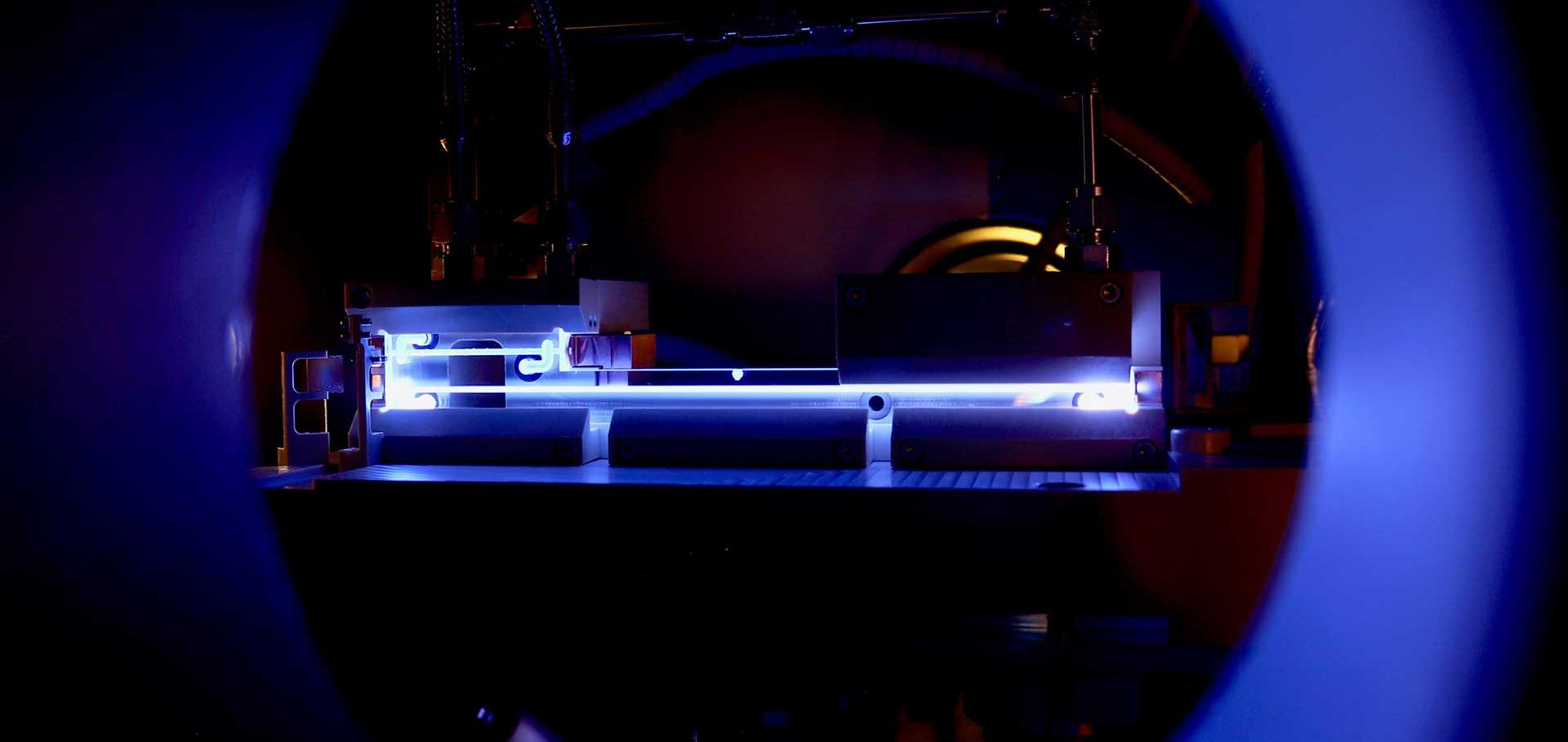
Status of the ral front end test stand
IPAC 2013: Proceedings of the 4th International Particle Accelerator Conference (2013) 3963-3965
Abstract:
The Front End Test Stand (FETS) under construction at RAL is a demonstrator for the front end systems of a future high power proton linac. Possible applications include a linac upgrade for the ISIS spallation neutron source, new future neutron sources, accelerator driven sub-critical systems, a neutrino factory etc. Designed to deliver a 60mA H-minus beam at 3MeV with a 10% duty factor, FETS consists of a high brightness ion source, magnetic low energy beam transport (LEBT), 4-vane 324MHz radio frequency quadrupole, medium energy beam transport (MEBT) containing a high speed beam chopper and non-destructive photo-detachment diagnostics. This paper describes the current status of the project and future plans.Beam-Line diagnostics at the front end Test Stand (FETS), rutherford appleton laboratory, OXFORDSHIRE, UK
IBIC 2013: Proceedings of the 2nd International Beam Instrumentation Conference (2013) 431-434
Abstract:
The H- ion source and beam-line at FETS will require the beam current and beam position to be continually monitored. Current transformer toroids will measure the beam current and beam position monitors (BPMs) will determine the beam position. The ion source delivers pulses at a rate of 50 Hz with a current up to 60 mA, each pulse is 2 ms long, and a 324 MHz micro-bunch structure imposed by the radio frequency quadrupole (RFQ) accelerating structure. The toroid outputs will be acquired on a fast oscilloscope. Two BPM designs are under consideration (shorted strip-line or button type) but the processing for both types is similar and has been designed, with simulated measurements made. Each BPM uses four pickups, at a frequency of 324 MHz, which are mixed using RF electronics to an intermediate frequency of 10.125 MHz. The resulting signals are then digitized at 40.500 MHz and processed in an FPGA to produce the position and phase of the beam at each BPM location, with a precision of better than 100 μm and 0.05 rad. The measurements from the toroids and BPMs will be available via EPICS servers at every pulse.Two-Pulse Ionization Injection into Quasilinear Laser Wakefields
Physical Review Letters American Physical Society (APS) 111:15 (2013) 155004
Measurement of charm fragmentation fractions in photoproduction at HERA
Journal of High Energy Physics 2013:9 (2013)
Abstract:
The production of D 0, D *+, D +, Ds+ and Λc+ charm hadrons and their antiparticles in ep scattering at HERA has been studied with the ZEUS detector, using a total integrated luminosity of 372 pb-1. The fractions of charm quarks hadronising into a particular charm hadron were derived. In addition, the ratio of neutral to charged D-meson production rates, the fraction of charged D mesons produced in a vector state, and the stangeness-suppression factor have been determined. The measurements have been performed in the photoproduction regime. The charm hadrons were reconstructed in the range of transverse momentum p T > 3.8 GeV and pseudorapidity |η| < 1.6. The charm fragmentation fractions are compared to previous results from HERA and from e + e - experiments. The data support the hypothesis that fragmentation is independent of the production process. © 2013 SISSA.Measurement of D ± production in deep inelastic ep scattering with the ZEUS detector at HERA
Journal of High Energy Physics 2013:5 (2013)