

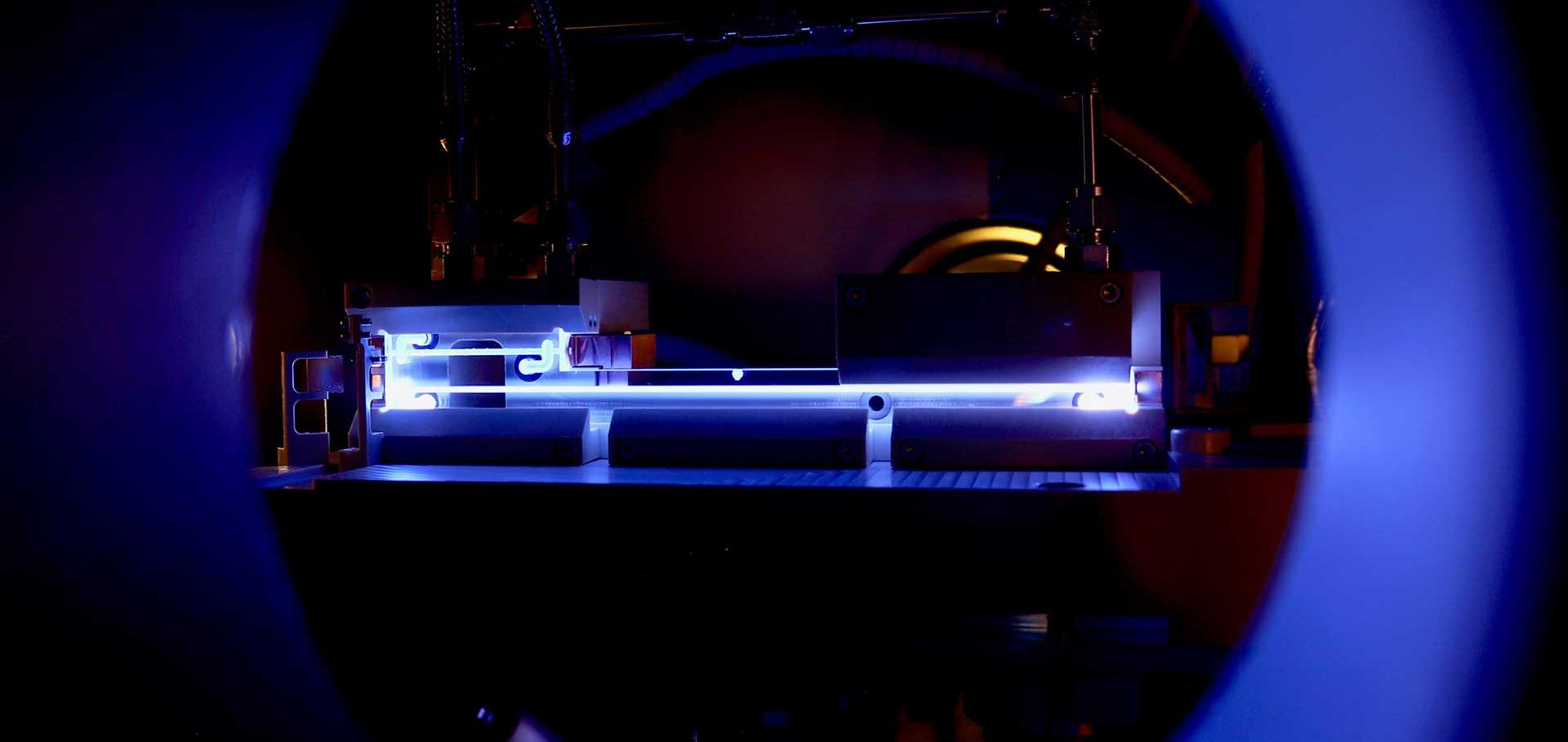
Investigation of GeV-scale electron acceleration in a gas-filled capillary discharge waveguide
New Journal of Physics IOP Publishing 15:4 (2013) 045024
First measurements of muon production rate using a novel pion capture system at MuSIC
Journal of Physics Conference Series IOP Publishing 408:1 (2013) 012079
Measurement of inelastic J/ψ and ψ′ photoproduction at HERA
Journal of High Energy Physics 2013:2 (2013) 1-30
Abstract:
The cross sections for inelastic photoproduction of J/ψ and ψ′ mesons have been measured in ep collisions with the ZEUS detector at HERA, using an integrated luminosity of 468 pb-1 collected in the period 1996-2007. The ψ′ to J/ψ cross section ratio was measured in the range 0.55 < z < 0.9 and 60 < W < 190 GeV as a function of W, z and pT. Here W denotes the photon-proton centre-of-mass energy, z is the fraction of the incident photon energy carried by the meson and p T is the transverse momentum of the meson with respect to the beam axis. The J/ψ cross sections were measured for 0.1 < z < 0.9, 60 < W < 240 GeV and pT > 1 GeV. Theoretical predictions within the non-relativistic QCD framework including NLO colour-singlet and colour-octet contributions were compared to the data, as were predictions based on the k T-factorisation approach. © 2013 SISSA.Production of the excited charm mesons D 1 and D 2 * at HERA
Nuclear Physics B 866:3 (2013) 229-254
Abstract:
The production of the excited charm mesons D 1(2420) and D2*(2460) in ep collisions has been measured with the ZEUS detector at HERA using an integrated luminosity of 373pb -1. The masses of the neutral and charged states, the widths of the neutral states, and the helicity parameter of D 1(2420) 0 were determined and compared with other measurements and with theoretical expectations. The measured helicity parameter of the D10 allows for some mixing of S- and D-waves in its decay to D *±π Π. The result is also consistent with a pure D-wave decay. Ratios of branching fractions of the two decay modes of the D2*(2460)0 and D2*(2460)± states were measured and compared with previous measurements. The fractions of charm quarks hadronising into D 1 and D2* were measured and are consistent with those obtained in e +e - annihilations. © 2012 Elsevier B.V.Production of Z0 bosons in elastic and quasi-elastic ep collisions at HERA
Physics Letters, Section B: Nuclear, Elementary Particle and High-Energy Physics 718:3 (2013) 915-921