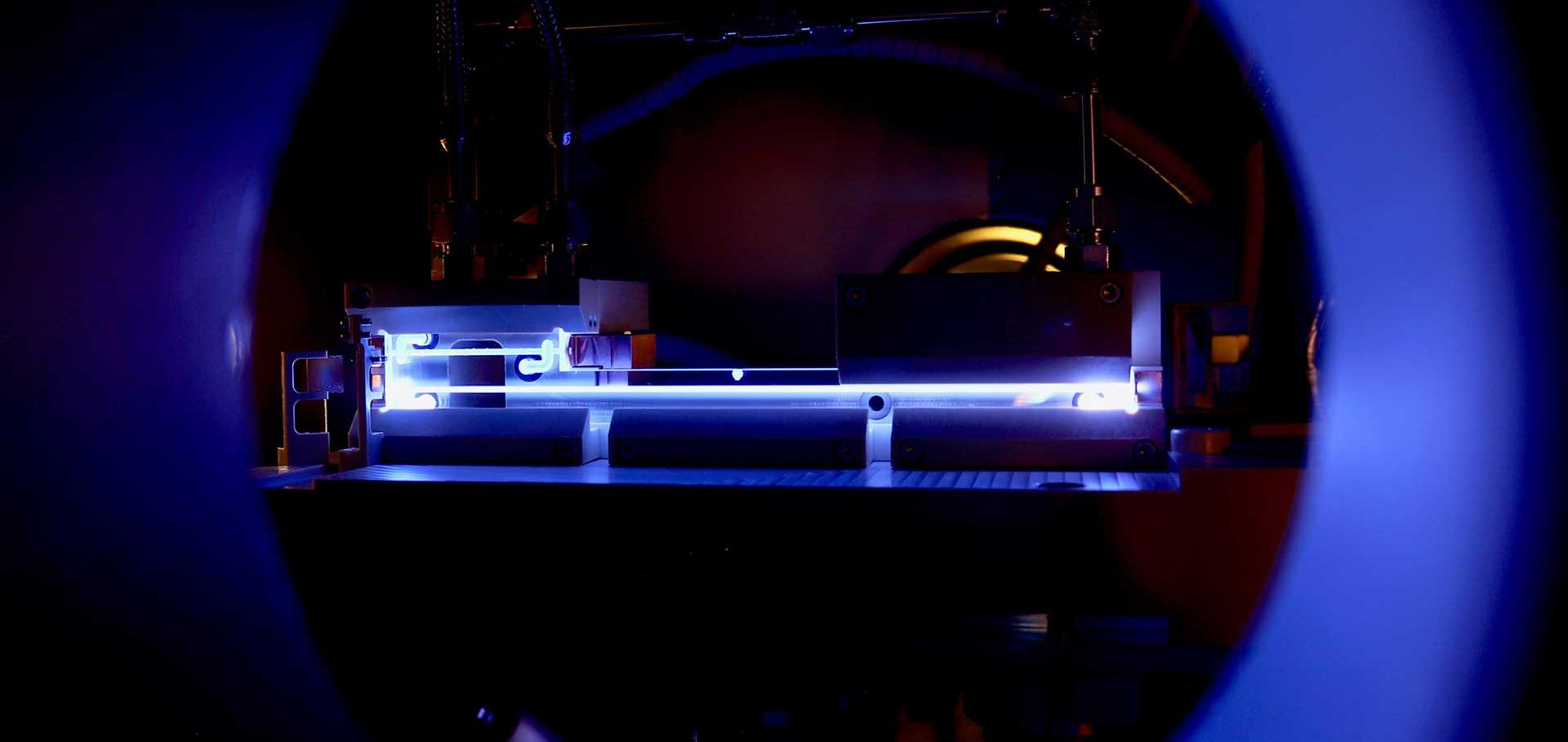
Characterization of discharge capillaries via benchmarked hydrodynamic plasma simulations

Physical Review Research American Physical Society (APS) 7:4 (2025) 043193

Authors:

SM Mewes, GJ Boyle, R D’Arcy, JM Garland, M Huck, H Jones, G Loisch, AR Maier, J Osterhoff, T Parikh, S Wesch, JC Wood, M Thévenet

Abstract:

Plasma accelerators utilize strong electric fields in plasma waves to accelerate charged particles, making them a compact alternative to radiofrequency technologies. Discharge capillaries are plasma sources used in plasma accelerator research to provide acceleration targets, or as plasma lenses to capture or focus accelerated beams. They have applications for beam-driven and laser-driven plasma accelerators and can sustain high repetition rates for extended periods of time. Despite these advantages, high-fidelity simulations of discharge capillaries remain challenging due to the range of mechanisms involved and the difficulty to diagnose them in experiments. In this work, we utilize hydrodynamic plasma simulations to examine the discharge process of a plasma cell and discuss implications for future accelerator systems. The simulation model is validated with experimental measurements in a 50-mm-long, 1-mm-wide plasma capillary operating a 12–27 kV discharge at 200–1200 Pa hydrogen pressure. For 20 kV at 870 Pa, the discharge is shown to deposit 178 mJ of energy in the plasma. Potential difficulties with the common density measurement method using H α emission spectroscopy are discussed. This simulation model enables investigations of repeatability, heat flow management, and fine tailoring of the plasma profile with discharges.

Experimental demonstration of a tomographic five-dimensional phase-space reconstruction

Physical Review Research 7:4 (2025)

Authors:

S Jaster-Merz, RW Assmann, J Beinortaitė, JB Svensson, R Brinkmann, F Burkart, P Craievich, H Dinter, P González Caminal, W Hillert, AL Kanekar, M Kellermeier, W Kuropka, F Mayet, J Osterhoff, B Stacey, M Stanitzki, T Vinatier, S Wesch, R D'Arcy

Abstract:

Detailed knowledge of particle-beam properties is of great importance to understand and push the performance of existing and next-generation particle accelerators. We recently proposed a phase-space tomography method to reconstruct the five-dimensional (5D) phase space, i.e., the charge density distribution in all three spatial directions and the two transverse momenta. Here, we present the first experimental demonstration of the method at the FLASHForward facility at DESY. This includes the reconstruction of the 5D phase-space distribution of a GeV-class electron bunch, the use of this measured phase space to create a particle distribution for simulations, and the extraction of the transverse 4D slice emittance.

Status of and upgrade concepts for HALHF: the hybrid, asymmetric, linear Higgs factory

Journal of Physics: Conference Series IOP Publishing 3124:1 (2025) 012001

Authors:

CA Lindstrøm, R D’Arcy, B Foster

Abstract:

This contribution outlines the HALHF concept, which combines the high gradients achievable in plasma-wakefield acceleration with conventional radio-frequency acceleration. In HALHF, beam-driven plasma-wakefield cells are used to accelerate electrons to high energy. Because plasma-based acceleration of positrons is problematic, conventional RF acceleration is used but to much lower energy. The HALHF concept utilises not only asymmetric energies but also asymmetric bunch charges and asymmetric transverse emittances, leading to comparable luminosity to conventional facilities but much lower capital cost. Possible upgrades to the HALHF facility are discussed, in particular to the tt− threshold and to 550 GeV, where the Higgs self-coupling and tt−H coupling can be measured. Other upgrades include the provision of two interaction points, to implement a γ.γ collider of two possible types and finally a symmetric high-energy collider if the problem of plasma-based positron acceleration can be solved.

Proceedings of the Erice workshop: A new baseline for the hybrid, asymmetric, linear Higgs factory HALHF

Physics Open Elsevier 23 (2025) 100261

Authors:

Brian Foster, Erik Adli, Timothy L Barklow, Mikael Berggren, Stewart Boogert, Jian Bin Ben Chen, Richard D’Arcy, Pierre Drobniak, Sinead Farrington, Spencer Gessner, Mark J Hogan, Daniel Kalvik, Antoine Laudrain, Carl A Lindstrøm, Benno List, Jenny List, Xueying Lu, Gudrid Moortgat Pick, Kristjan Põder, Andrei Seryi, Kyrre Sjobak, Maxence Thévenet, Nicholas J Walker, Jonathan Wood

The azimuthal correlation between the leading jet and the scattered lepton in deep inelastic scattering at HERA

European Physical Journal C Springer Nature 84:12 (2024) 1334

Authors:

I Abt, R Aggarwal, V Aushev, O Behnke, A Bertolin, I Bloch, I Brock, NH Brook, R Brugnera, A Bruni, PJ Bussey, A Caldwell, CD Catterall, J Chwastowski, J Ciborowski, R Ciesielski, AM Cooper-Sarkar, M Corradi, RK Dementiev, S Dusini, J Ferrando, B Foster, E Gallo, D Gangadharan, A Garfagnini, A Geiser, G Grzelak, C Gwenlan, D Hochman, NZ Jomhari, I Kadenko, U Karshon, P Kaur, R Klanner, U Klein, IA Korzhavina, N Kovalchuk, M Kuze, BB Levchenko, A Levy, B Löhr, E Lohrmann, A Longhin, F Lorkowski, E Lunghi, I Makarenko, J Malka, S Masciocchi, K Nagano, JD Nam, Yu Onishchuk, E Paul, I Pidhurskyi, A Polini, M Przybycień, A Quintero, M Ruspa, U Schneekloth, T Schörner-Sadenius, I Selyuzhenkov, M Shchedrolosiev, LM Shcheglova, N Sherrill, IO Skillicorn, W Słomiński, A Solano, L Stanco, N Stefaniuk, B Surrow, K Tokushuku, O Turkot, T Tymieniecka, A Verbytskyi, WAT Wan Abdullah, K Wichmann, M Wing, S Yamada, Y Yamazaki, AF Żarnecki, O Zenaiev