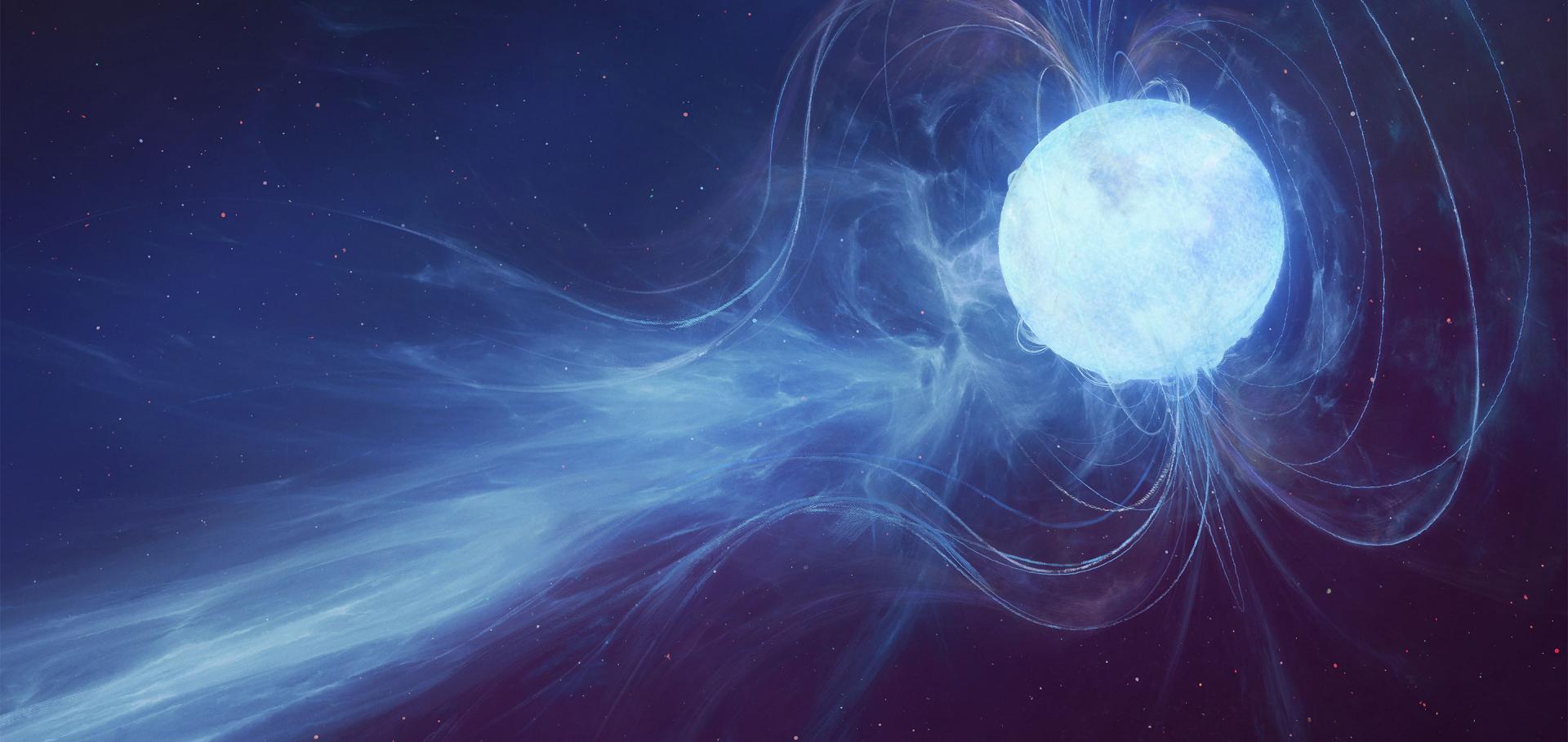
Rapid radio flaring during an anomalous outburst of SS Cyg

Monthly Notices of the Royal Astronomical Society: Letters Oxford University Press 467:1 (2017) L31-L35

Authors:

Kunal P Mooley, James CA Miller-Jones, Robert Fender, Gregory R Sivakoff, Clare Rumsey, Yvette Perrott, David Titterington, Keith Grainge, Thomas D Russell, Steven H Carey, Jack Hickish, Nima Razavi-Ghods, Anna Scaife, Paul Scott, Elisabeth O Waagen

Abstract:

The connection between accretion and jet production in accreting white dwarf binary systems, especially dwarf novae, is not well understood. Radio wavelengths provide key insights into the mechanisms responsible for accelerating electrons, including jets and outflows. Here we present densely-sampled radio coverage, obtained with the Arcminute MicroKelvin Imager Large Array, of the dwarf nova SS Cyg during its February 2016 anomalous outburst. The outburst displayed a slower rise (3 days mag^-1) in the optical than typical ones, and lasted for more than 3 weeks. Rapid radio flaring on timescales <1 hour was seen throughout the outburst. The most intriguing behavior in the radio was towards the end of the outburst where a fast, luminous (“giant”), flare peaking at ~20 mJy and lasting for 15 minutes was observed. This is the first time that such a flare has been observed in SS Cyg, and insufficient coverage could explain its non-detection in previous outbursts. These data, together with past radio observations, are consistent with synchrotron emission from plasma ejection events as being the origin of the radio flares. However, the production of the giant flare during the declining accretion rate phase remains unexplained within the standard accretion-jet framework and appears to be markedly different to similar patterns of behavior in X-ray binaries.

The gamma-ray Cherenkov telescope for the Cherenkov telescope array

6th International Meeting on High Energy Gamma-Ray Astronomy American Instiute of Physics (2017)

Authors:

L Tibaldo, PM Chadwick, H Costantini, Garret Cotter, MK Daniels, Andrea De Franco, F De Frondat, J-L Dournaux, D Dumas, J-P Ernenwein, G Fasola, S Funk, J Gironnet, JA Graham, T Greenshaws, O Hervet, N Hidaka, J-M Huet, D Jankowsky, I Jegouzo, T Jogler, M Kraus, JS Lapington, P Laporte, S Markoff

Abstract:

The Cherenkov Telescope Array (CTA) is a forthcoming ground-based observatory for very-high-energy gamma rays. CTA will consist of two arrays of imaging atmospheric Cherenkov telescopes in the Northern and Southern hemispheres, and will combine telescopes of different types to achieve unprecedented performance and energy coverage. The Gamma-ray Cherenkov Telescope (GCT) is one of the small-sized telescopes proposed for CTA to explore the energy range from a few TeV to hundreds of TeV with a field of view ≳ 8° and angular resolution of a few arcminutes. The GCT design features dual-mirror Schwarzschild-Couder optics and a compact camera based on densely-pixelated photodetectors as well as custom electronics. In this contribution we provide an overview of the GCT project with focus on prototype development and testing that is currently ongoing. We present results obtained during the first on-telescope campaign in late 2015 at the Observatoire de Paris-Meudon, during which we recorded the first Cherenkov images from atmospheric showers with the GCT multi-anode photomultiplier camera prototype. We also discuss the development of a second GCT camera prototype with silicon photomultipliers as photosensors, and plans toward a contribution to the realisation of CTA.

Accretion Disc Winds

Chapter in DISC WINDS MATTER: MODELLING ACCRETION AND OUTFLOWS ON ALL SCALES, (2017) 39-75

Disc Winds Matter Modelling Accretion and Outflows on All Scales Introduction

Chapter in DISC WINDS MATTER: MODELLING ACCRETION AND OUTFLOWS ON ALL SCALES, (2017) 1-38

Disc Winds Matter Modelling Accretion and Outflows on All Scales Conclusions and Future Work

Chapter in DISC WINDS MATTER: MODELLING ACCRETION AND OUTFLOWS ON ALL SCALES, (2017) 197-205