

X-ray emission around the z=4.1 radio galaxy TNJ1338-1942 and the potential role of far-infrared photons in AGN Feedback
ArXiv 1307.1594 (2013)
Abstract:
We report the discovery in an 80-ks observation of spatially-extended X-ray emission around the high-redshift radio galaxy TNJ1388-1942 (z=4.11) with the Chandra X-ray Observatory. The X-ray emission extends over a ~30-kpc diameter region and although it is less extended than the GHz-radio lobes, it is roughly aligned with them. We suggest that the X-ray emission arises from Inverse Compton (IC) scattering of photons by relativistic electrons around the radio galaxy. At z=4.11 this is the highest redshift detection of IC emission around a radio galaxy. We investigate the hypothesis that in this compact source, the Cosmic Microwave Background (CMB), which is ~700x more intense than at z~0 is nonetheless not the relevant seed photon field for the bulk of the IC emission. Instead, we find a tentative correlation between the IC emission and far-infrared luminosities of compact, far-infrared luminous high-redshift radio galaxies (those with lobe lengths of <100kpc). Based on these results we suggest that in the earliest phases of the evolution of radio-loud AGN at very high redshift, the far-infrared photons from the co-eval dusty starbursts occuring within these systems may make a significant contribution to their IC X-ray emission and so contribute to the feedback in these massive high-redshift galaxies.X-ray emission around the z=4.1 radio galaxy TNJ1338-1942 and the potential role of far-infrared photons in AGN Feedback
(2013)
On the detectability of extragalactic fast radio transients
ArXiv 1307.12 (2013)
Abstract:
Recent discoveries of highly dispersed millisecond radio bursts by Thornton et al. in a survey with the Parkes radio telescope at 1.4 GHz point towards an emerging population of sources at cosmological distances whose origin is currently unclear. Here we demonstrate that the scattering effects at lower radio frequencies are less than previously thought, and that the bursts could be detectable at redshifts out to about $z=0.5$ in surveys below 1 GHz. Using a source model in which the bursts are standard candles with bolometric luminosities $\sim 8 \times 10^{44}$ ergs/s uniformly distributed per unit comoving volume, we derive an expression for the observed peak flux density as a function of redshift and use this, together with the rate estimates found by Thornton et al. to find an empirical relationship between event rate and redshift probed by a given survey. The non-detection of any such events in Arecibo 1.4 GHz survey data by Deneva et al., and the Allen Telescope Array survey by Simeon et al. is consistent with our model. Ongoing surveys in the 1--2 GHz band should result in further discoveries. At lower frequencies, assuming a typical radio spectral index $α=-1.4$, the predicted peak flux densities are 10s of Jy. As a result, surveys of such a population with current facilities would not necessarily be sensitivity limited and could be carried out with small arrays to maximize the sky coverage. We predict that sources may already be present in 350-MHz surveys with the Green Bank Telescope. Surveys at 150 MHz with 30 deg$^2$ fields of view could detect one source per hour above 30 Jy.Ripple effects and oscillations in the broad Fe Kα line as a probe of massive black hole mergers
Monthly Notices of the Royal Astronomical Society Oxford University Press (OUP) 432:2 (2013) 1468-1482
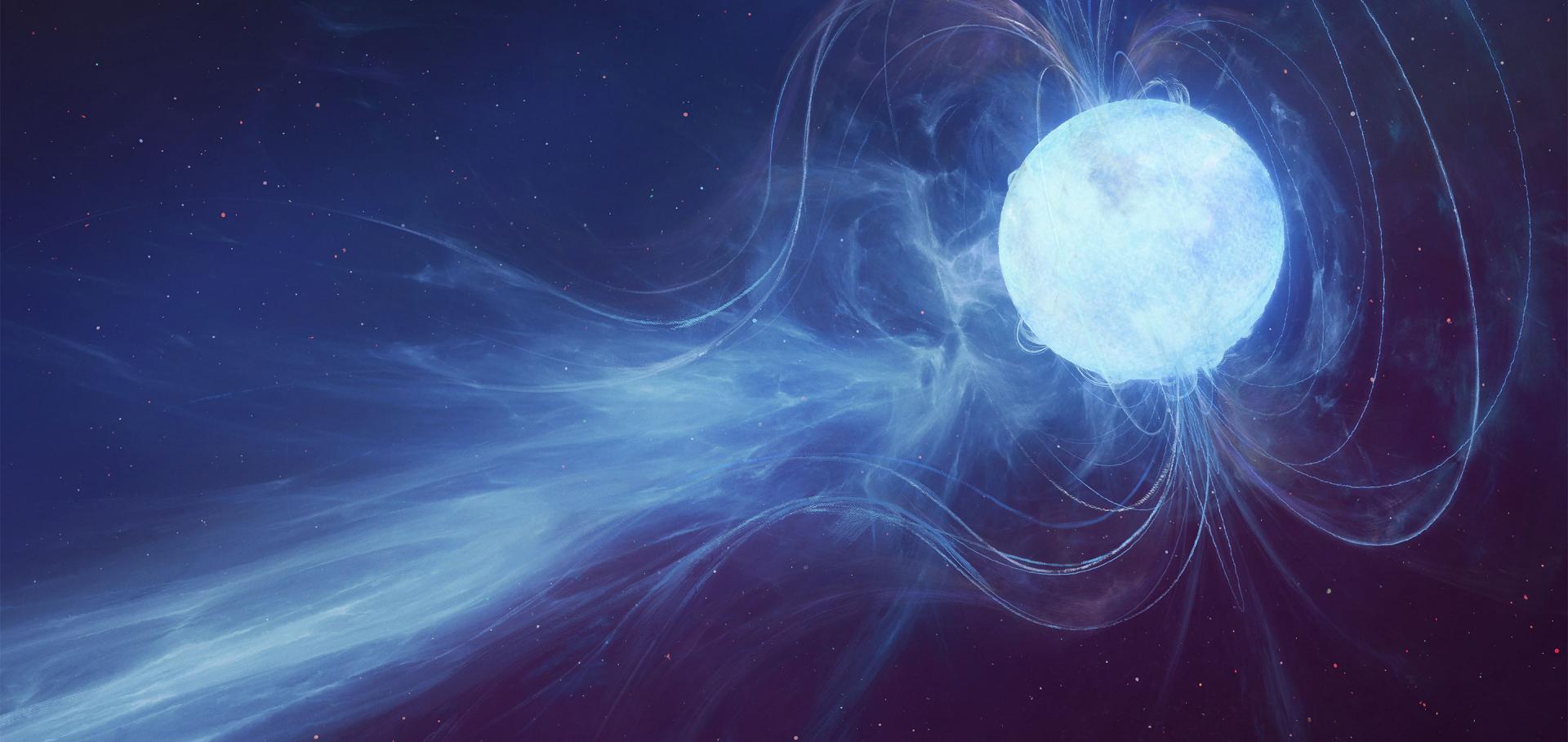
SUPER-LUMINOUS TYPE Ic SUPERNOVAE: CATCHING A MAGNETAR BY THE TAIL
The Astrophysical Journal American Astronomical Society 770:2 (2013) 128