

NICER Timing of the X-Ray Thermal Isolated Neutron Star RX J0806.4–4123
The Astrophysical Journal American Astronomical Society 972:2 (2024) 197
Abstract:
The X-ray thermal isolated neutron star (XTINS) RX J0806.4–4123 shows interesting multiwavelength properties that seemingly deviate from those of similar neutron stars. An accurate determination of the spin frequency change over time can assist in interpreting RX J0806.4–4123's properties in comparison to those of other XTINSs and the wider pulsar population. From 2019 to 2023 we carried out a tailored X-ray timing campaign of RX J0806.4–4123 with the NICER instrument. We used statistical properties of the Fourier coefficients and the Z K 2 test for phase connecting separate observations and finding a timing solution for the entire data set. We also developed a simple and universal method for estimating the uncertainties of the frequency ν and its derivative ν̇ from the empirical dependencies of Z K 2 on trial values of these parameters, with account of all significant harmonics of the frequency. Applying this method, we determined a spin-down rate ν̇=−7.3(1.2)×10−17Hzs−1 . The resulting spin-down power Ė=2.6×1029 erg s−1 is the lowest among the XTINSs, and it is a factor of 60 lower than the X-ray luminosity of this neutron star. RX J0806.4–4123 is also among the pulsars with the lowest measured Ė in general.Rocking the BOAT: the ups and downs of the long-term radio light curve for GRB 221009A
Monthly Notices of the Royal Astronomical Society Oxford University Press (OUP) 533:4 (2024) 4435-4449
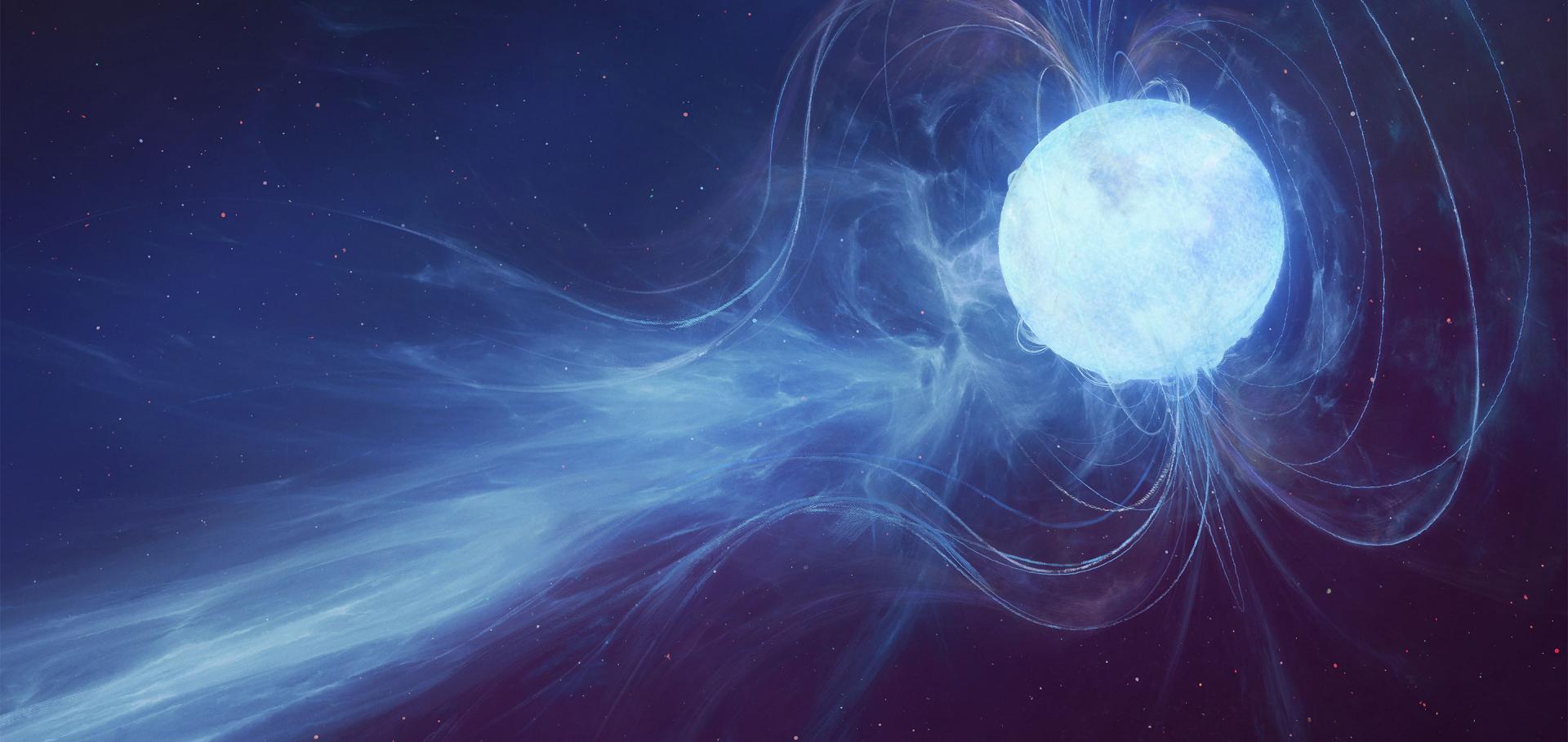
Probing the Spectrum of the Magnetar 4U 0142+61 with JWST
The Astrophysical Journal American Astronomical Society 972:2 (2024) 176
Abstract:
JWST observed the magnetar 4U 0142+61 with the Mid-Infrared Instrument (MIRI) and Near Infrared Camera (NIRCam) instruments within a 77 minute time interval on 2022 September 20–21. The low-resolution MIRI spectrum and NIRCam photometry show that the spectrum in the wavelength range 1.4–11 μm range can be satisfactorily described by an absorbed power-law (PL) model, f ν ∝ ν −α , with a spectral slope α = 0.96 ± 0.02, interstellar extinction A V = 3.9 ± 0.2, and normalization f 0 = 59.4 ± 0.5 μJy at λ = 8 μm. These observations do not support the passive disk model proposed in 2006 by Wang, Chakrabarty and Kaplan, based on Spitzer photometry, which was interpreted as evidence for a fallback disk from debris formed during the supernova explosion. We suggest a nonthermal origin for this emission and source variability as the most likely cause of discrepancies between the JWST data and other IR-optical observing campaigns. However, we cannot firmly exclude the presence of a large disk with a different dependence of the effective disk temperature on distance from the magnetar. Comparison with the PL fit to the hard X-ray spectrum above 10 keV, measured by the NuSTAR contemporaneously with JWST, shows that the X-ray spectrum is significantly harder. This may imply that the X-ray and IR nonthermal emission come from different sites in the magnetosphere of the magnetar.The fast transient AT 2023clx in the nearby LINER galaxy NGC 3799 as a tidal disruption of a very low-mass star
Astronomy & Astrophysics EDP Sciences 689 (2024) a350
Constraining the physical properties of large-scale jets from black hole X-ray binaries and their impact on the local environment with blast-wave dynamical models
Monthly Notices of the Royal Astronomical Society Oxford University Press 533:4 (2024) 4188-4209