The Sudden Death of the Nearest Quasar

ArXiv 1011.0427 (2010)

Authors:

Kevin Schawinski, Daniel A Evans, Shanil Virani, C Megan Urry, William C Keel, Priyamvada Natarajan, Chris J Lintott, Anna Manning, Paolo Coppi, Sugata Kaviraj, Steven P Bamford, Gyula IG Jozsa, Michael Garrett, Hanny van Arkel, Pamela Gay, Lucy Fortson

Abstract:

Galaxy formation is significantly modulated by energy output from supermassive black holes at the centers of galaxies which grow in highly efficient luminous quasar phases. The timescale on which black holes transition into and out of such phases is, however, unknown. We present the first measurement of the shutdown timescale for an individual quasar using X-ray observations of the nearby galaxy IC 2497, which hosted a luminous quasar no more than 70,000 years ago that is still seen as a light echo in `Hanny's Voorwerp', but whose present-day radiative output is lower by at least 2 and more likely by over 4 orders of magnitude. This extremely rapid shutdown provides new insights into the physics of accretion in supermassive black holes, and may signal a transition of the accretion disk to a radiatively inefficient state.

Herschel-ATLAS: the far-infrared-radio correlation at z \lt 0.5

\mnras 409 (2010) 92-101-92-101

Authors:

MJ Jarvis, DJB Smith, DG Bonfield, MJ Hardcastle, JT Falder, JA Stevens, RJ Ivison, R Auld, M Baes, IK Baldry, SP Bamford, N Bourne, S Buttiglione, A Cava, A Cooray, A Dariush, G de Zotti, JS Dunlop, L Dunne, S Dye, S Eales, J Fritz, DT Hill, R Hopwood, DH Hughes, E Ibar, DH Jones, L Kelvin, A Lawrence, L Leeuw, J Loveday, SJ Maddox, MJ Micha lowski, M Negrello, P Norberg, M Pohlen, M Prescott, EE Rigby, A Robotham, G Rodighiero, D Scott, R Sharp, P Temi, MA Thompson, P van der Werf, E van Kampen, C Vlahakis, G White

Herschel -ATLAS: Extragalactic number counts from 250 to 500 microns

Astronomy and Astrophysics 518:4 (2010)

Authors:

DL Clements, E Rigby, S Maddox, L Dunne, A Mortier, C Pearson, A Amblard, R Auld, M Baes, D Bonfield, D Burgarella, S Buttiglione, A Cava, A Cooray, A Dariush, G De Zotti, S Dye, S Eales, D Frayer, J Fritz, JP Gardner, J Gonzalez-Nuevo, D Herranz, E Ibar, R Ivison, MJ Jarvis, G Lagache, L Leeuw, M Lopez-Caniego, M Negrello, E Pascale, M Pohlen, G Rodighiero, S Samui, S Serjeant, B Sibthorpe, D Scott, DJB Smith, P Temi, M Thompson, I Valtchanov, P Van Der Werf, A Verma

Abstract:

Aims. The Herschel-ATLAS survey (H-ATLAS) will be the largest area survey to be undertaken by the Herschel Space Observatory. It will cover 550 sq. deg. of extragalactic sky at wavelengths of 100, 160, 250, 350 and 500 μm when completed, reaching flux limits (5σ) from 32 to 145 mJy. We here present galaxy number counts obtained for SPIRE observations of the first ∼14 sq. deg. observed at 250, 350 and 500 μm. Methods. Number counts are a fundamental tool in constraining models of galaxy evolution. We use source catalogs extracted from the H-ATLAS maps as the basis for such an analysis. Correction factors for completeness and flux boosting are derived by applying our extraction method to model catalogs and then applied to the raw observational counts. Results. We find a steep rise in the number counts at flux levels of 100-200 mJy in all three SPIRE bands, consistent with results from BLAST. The counts are compared to a range of galaxy evolution models. None of the current models is an ideal fit to the data but all ascribe the steep rise to a population of luminous, rapidly evolving dusty galaxies at moderate to high redshift. © 2010 ESO.

Herschel -ATLAS: The dust energy balance in the edge-on spiral galaxy UGC 4754

Astronomy and Astrophysics 518:8 (2010)

Authors:

M Baes, J Fritz, DA Gadotti, DJB Smith, L Dunne, E Da Cunha, A Amblard, R Auld, GJ Bendo, D Bonfield, D Burgarella, S Buttiglione, A Cava, D Clements, A Cooray, A Dariush, G De Zotti, S Dye, S Eales, D Frayer, J Gonzalez-Nuevo, D Herranz, E Ibar, R Ivison, G Lagache, L Leeuw, M Lopez-Caniego, M Jarvis, S Maddox, M Negrello, M Michałowski, E Pascale, M Pohlen, E Rigby, G Rodighiero, S Samui, S Serjeant, P Temi, M Thompson, P Van Der Werf, A Verma, C Vlahakis

Abstract:

We use Herschel PACS and SPIRE observations of the edge-on spiral galaxy UGC 4754, taken as part of the H-ATLAS SDP observations, to investigate the dust energy balance in this galaxy. We build detailed SKIRT radiative models based on SDSS and UKIDSS maps and use these models to predict the far-infrared emission. We find that our radiative transfer model underestimates the observed FIR emission by a factor of two to three. Similar discrepancies have been found for other edge-on spiral galaxies based on IRAS, ISO, and SCUBA data. Thanks to the good sampling of the SED at FIR wavelengths, we can rule out an underestimation of the FIR emissivity as the cause for this discrepancy. Instead we support highly obscured star formation that contributes little to the optical extinction as a more probable explanation. © 2010 ESO.

The LSST camera corner raft conceptual design: A front-end for guiding and wavefront sensing

Proceedings of SPIE - The International Society for Optical Engineering 7736:PART 1 (2010)

Authors:

K Arndt, V Riot, E Alagoz, A Biccum, A Bohn, J Clampif, T Coiro, W Cui, L Hoffman, A Lichti, D Skaggs, I Shipsey, M Triano, B Xin, K Ziegler, J Oliver, R Van Berg, G Haller, L Sapozhnikov, S Olivier

Abstract:

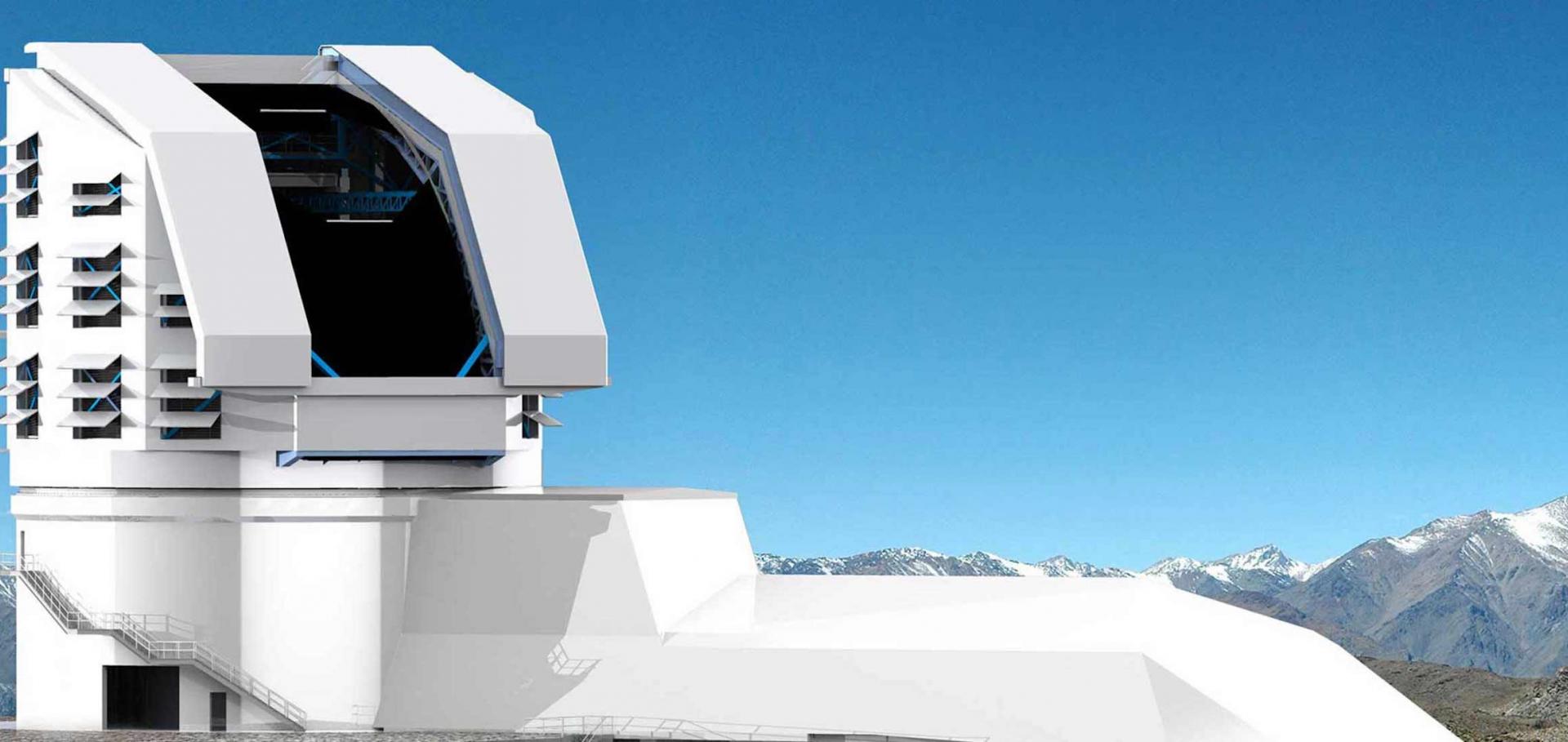
The Large Synoptic Survey Telescope (LSST) is a proposed ground based telescope that will perform a comprehensive astronomical survey by imaging the entire visible sky in a continuous series of short exposures. Four special purpose rafts, mounted at the corners of the LSST science camera, contain wavefront sensors and guide sensors. Wavefront measurements are accomplished using curvature sensing, in which the spatial intensity distribution of stars is measured at equal distances on either side of focus by CCD detectors. The four Corner Rafts also each hold two guide sensors. The guide sensors monitor the locations of bright stars to provide feedback that controls and maintains the tracking of the telescope during an exposure. The baseline sensor for the guider is a Hybrid Visible Silicon hybrid-CMOS detector. We present here a conceptual mechanical and electrical design for the LSST Corner Rafts that meets the requirements imposed by the camera structure, and the precision of both the wavefront reconstruction and the tracking. We find that a single design can accommodate two guide sensors and one split-plane wavefront sensor integrated into the four corner locations in the camera. © 2010 SPIE.