

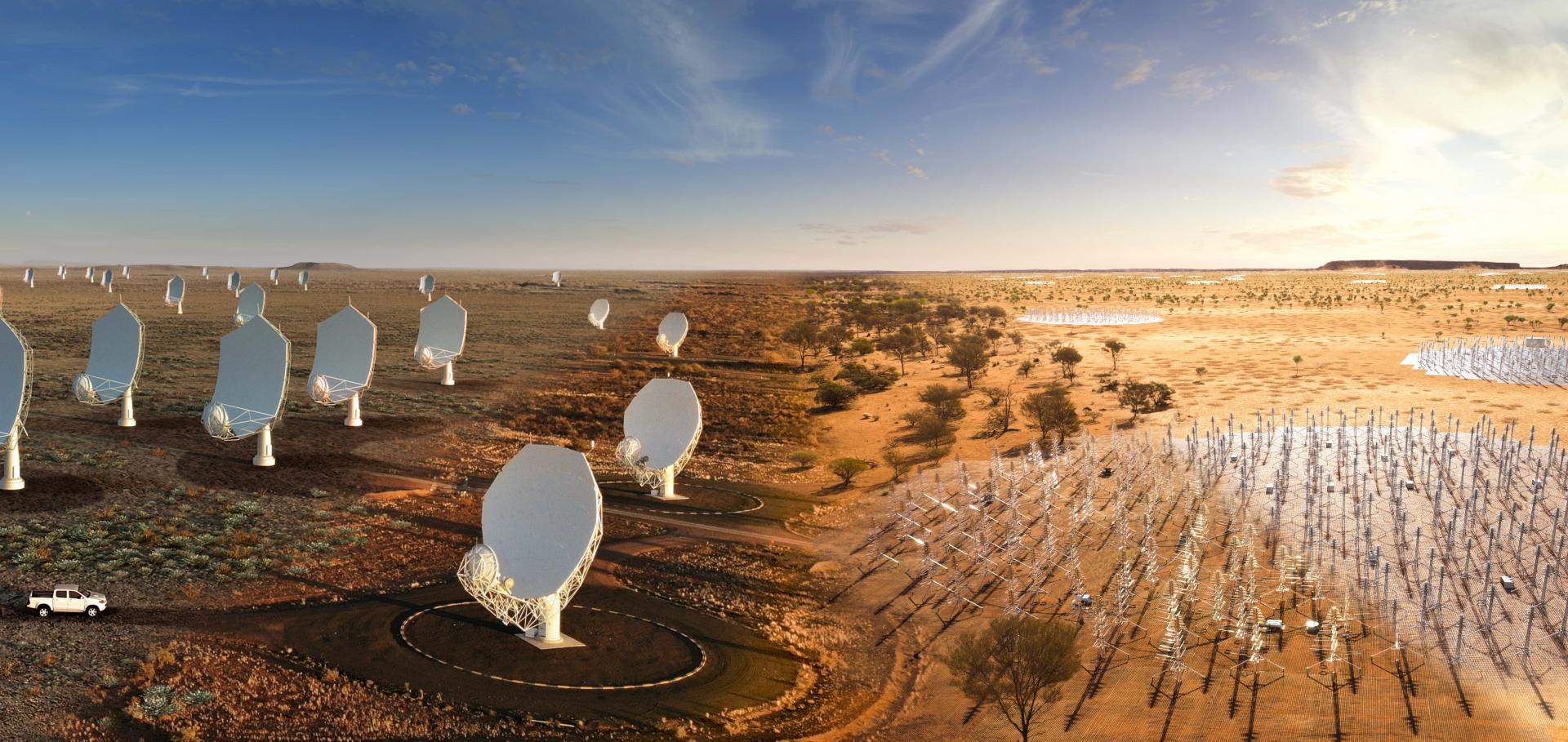
ThunderKAT: The MeerKAT Large Survey Project for Image-Plane Radio Transients
Sissa Medialab Srl (2018) 013
A compact quad-ridge orthogonal mode transducer with wide operational bandwidth
IEEE Antennas and Wireless Propagation Letters Institute of Electrical and Electronics Engineers 17:3 (2018) 422-425
Abstract:
We present the design and the measured performance of a compact quad-ridge orthomode transducer (OMT) operating in C-band with more than 100% fractional bandwidth. The OMT comprises two sets of identical orthogonal ridges mounted in a circular waveguide. The profile of these ridges was optimised to reduce significantly the transition length, while retaining the wide operational bandwidth of the quad-ridge OMT. In this letter, we show that the optimised compact OMT has better than -15dB return loss with the cross-polarisation well below -40dB in the designated 4.0-8.5GHz band.Long-term radio and X-ray evolution of the tidal disruption event ASASSN-14li
Monthly Notices of the Royal Astronomical Society Oxford University Press 475:3 (2018) 4011-4019
Abstract:
We report on late time radio and X-ray observations of the tidal disruption event candidate ASASSN-14li, covering the first 1000 days of the decay phase. For the first $\sim200$ days the radio and X-ray emission fade in concert. This phase is better fit by an exponential decay at X-ray wavelengths, while the radio emission is well described by either an exponential or the canonical $t^{-5/3}$ decay assumed for tidal disruption events. The correlation between radio and X-ray emission during this period can be fit as $L_{R}\propto L_{X}^{1.9\pm0.2}$. After 400 days the radio emission at $15.5\,\textrm{GHz}$ has reached a plateau level of $244\pm8\,\mu\textrm{Jy}$ which it maintains for at least the next 600 days, while the X-ray emission continues to fade exponentially. This steady level of radio emission is likely due to relic radio lobes from the weak AGN-like activity implied by historical radio observations. We note that while most existing models are based upon the evolution of ejecta which are decoupled from the central black hole, the radio : X-ray correlation during the declining phase is also consistent with core jet emission coupled to a radiatively efficient accretion flow.LOFAR/H-ATLAS: the low-frequency radio luminosity–star formation rate relation
Monthly Notices of the Royal Astronomical Society Oxford University Press 475:3 (2018) 3010-3028
Abstract:
Radio emission is a key indicator of star formation activity in galaxies, but the radio luminosity–star formation relation has to date been studied almost exclusively at frequencies of 1.4 GHz or above. At lower radio frequencies, the effects of thermal radio emission are greatly reduced, and so we would expect the radio emission observed to be completely dominated by synchrotron radiation from supernova-generated cosmic rays. As part of the LOFAR Surveys Key Science project, the Herschel-ATLAS NGP field has been surveyed with LOFAR at an effective frequency of 150 MHz. We select a sample from the MPA-JHU catalogue of Sloan Digital Sky Survey galaxies in this area: the combination of Herschel, optical and mid-infrared data enable us to derive star formation rates (SFRs) for our sources using spectral energy distribution fitting, allowing a detailed study of the low-frequency radio luminosity–star formation relation in the nearby Universe. For those objects selected as star-forming galaxies (SFGs) using optical emission line diagnostics, we find a tight relationship between the 150 MHz radio luminosity (L150) and SFR. Interestingly, we find that a single power-law relationship between L150 and SFR is not a good description of all SFGs: a broken power-law model provides a better fit. This may indicate an additional mechanism for the generation of radio-emitting cosmic rays. Also, at given SFR, the radio luminosity depends on the stellar mass of the galaxy. Objects that were not classified as SFGs have higher 150-MHz radio luminosity than would be expected given their SFR, implying an important role for low-level active galactic nucleus activity.Long-term radio and X-ray evolution of the tidal disruption event ASASSN-14li
(2018)