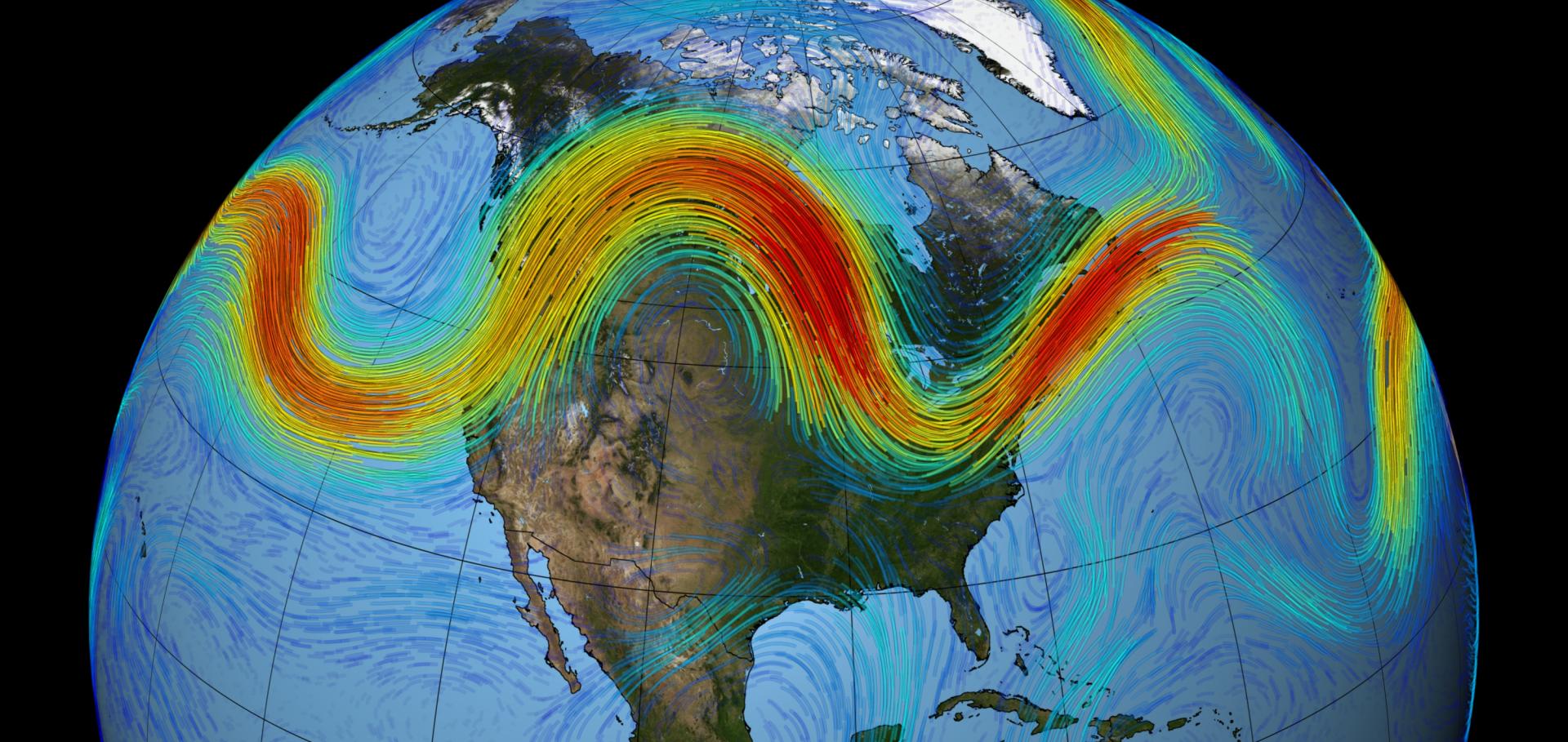
A weather feature perspective on jet dynamics

(2026)

Authors:

Thomas Spengler, Clemens Spensberger, Kjersti Konstali, Henrik Auestad, Andrea Marcheggiani, Orli Lachmy

Abstract:

When decomposing the atmospheric flow into a basic state and perturbations, the perturbations are generally interpreted as the contribution from chaotic non-linear weather. We explore the link between day-to-day weather and the climatological zonal mean perspective on zonal momentum in more detail by systematically linking eddy momentum fluxes to weather events. Specifically, we first decompose the full momentum flux divergence into contributions from mean flow and perturbations both in the time and zonal direction as well as their combinations, and then systematically relate synoptic jets, cyclones, and Rossby wave breaking events to the instantaneous momentum fluxes. We thus construct a step-by-step link between the time-zonal mean perspective on momentum flux convergence and the synoptic perspective.With this approach, we show that both the time and zonal averaging are a residual of a large compensation of momentum flux convergence and divergence. In both dimensions, the mean must be regarded as a residual that is at least an order of magnitude smaller than the original signal. Further, a large fraction of eddy momentum flux convergence and divergence occurs in association with weather features, with synoptic jets alone accounting for 60-80% of the convergence from the subtropics throughout the mid-latitudes. Rossby wave breaking, on the other hand, only features less than 30% of the momentum flux convergence in the midlatitudes.Finally, the attribution of the full-field momentum flux convergence is nearly indistinguishable from the attribution of eddy-momentum flux convergence, irrespective of whether the eddies are defined as perturbations in time, zonal direction, or the combination of both. The effect of stationary waves to the momentum fluxes is thus implicitly included in the selected transient weather events.

Climate impacts of tropical Pacific SST trends in boreal winter

Copernicus Publications (2026)

Authors:

Rhidian Thomas, Joonsuk Kang, Nick Dunstone, Tiffany Shaw, Tim Woollings

Abstract:

Sea surface temperature (SST) trends over the satellite era show a pronounced cooling over the tropical south-eastern Pacific and enhanced warming over the West Pacific warm pool. By contrast, climate models tend to warm across all longitudes in the tropical Pacific. What does this discrepancy mean for climate model trends outside the tropical Pacific? Does capturing the observed pattern of tropical Pacific SST warming help to resolve other trend discrepancies in models? We use two complementary methods to constrain boreal winter SST trends in coupled models: pacemaker experiments, and conditioned near-term climate predictions (hindcasts). We find that the global response to constraining tropical Pacific SST trends resembles the interannual La Niña response. The Pacific SST trend explains 33-39% of the poleward zonal-mean jet shift seen in the models, and is associated with robustly reduced tropical tropospheric warming trends consistent with reanalyses. It also improves surface air temperature and precipitation trends in ENSO-sensitive regions, such as the South Asia, southern Africa, and the Americas. Our results highlight the importance of resolving discrepancies in the tropical Pacific for building confidence in climate model trends globally.

Latent heating contribution to storm intensification across seasons and climates - A potential vorticity approach

Copernicus Publications (2026)

Authors:

Abel Shibu, Henrik Auestad, Paulo Ceppi, Tim Woollings

Abstract:

Extratropical cyclones are expected to be more diabatically driven in a warmer world, in line with the 6-7% increase in precipitable water per degree of global-mean surface temperature increase. This leads to a preferential strengthening of the most intense cyclones in a warmer climate as a result of increased latent heating (LH), accompanied by a decrease in the strength of weaker cyclones. In this study, using data from new CESM model experiments, and employing a storm-centric potential vorticity (PV) budget, we estimate the contribution of LH to storm intensification across height and storm lifecycle. We use an objective algorithm to track the cyclones, and a suitable storm-compositing method to compute the spatial and temporal patterns of PV generated from diabatic and adiabatic processes. To isolate the intensification of storms due to PV generation from other processes like storm propagation, we develop a novel storm-averaging methodology.  Using this methodology, we investigate how the magnitude and pattern of PV produced from LH are modified when the sea surface temperature is uniformly increased by 4K. Focusing on the strongest cyclones in the southern hemisphere, we show that the increase in low-level PV generated in cyclones in the warmer model run can be almost entirely attributed to changes in the strength and pattern of LH. By also comparing winter and summer cyclones in our model runs, we obtain a consistent pattern of how the LH contribution to cyclone intensification changes from a cooler to a warmer environment. Finally, we show that our methodology also works well for cyclones in reanalysis data (MERRA2). Given the socio-economic impacts of severe storms, this study provides valuable insights into the processes that govern cyclone intensification, and how they are expected to change in a warmer world. We also quantify the increase in cyclone strength with warming, which can support policymakers in anticipating and mitigating the effects of these events.

Redox processes of slightly-carbon-rich rocky planets

(2026)

Authors:

Claire Marie Guimond, Oliver Shorttle, Raymond Pierrehumbert

Abstract:

Whether a planet's volcanic gas is oxidising or reducing is inherited from redox conditions in the planet's mantle. It is often presumed that reactions between iron species control mantle oxygen fugacity. However, iron alone need not be the sole dictator of how oxidising the interior of a planet is. Carbon is a powerful redox element, with great potential to feed back upon the mantle redox state as it melts. Despite Earth being carbon-poor, it has been proposed that the oxygen fugacity of Earth's upper mantle is in part controlled by carbon (Holloway et al., 1992; Stagno et al., 2013); a slightly-higher volatile endowment could make carbon-powered geochemistry inescapable. Indeed, a number of known rocky exoplanets are predicted to have formed with carbon contents greater than Earth (Bergin et al., 2023). We offer a framework for how carbon is transported from solid planetary interior to atmosphere, tracking redox couplings between carbon and iron. We also incorporate a coupled 1D energy- and mass-balance model to provide first-order predictions of the rate of volcanism. We show that carbon-iron redox coupling would maintain interior oxygen fugacity in a narrow range: more reducing than Earth magma, but not reducing enough to prevent CO2 outgassing entirely.Bergin, E. A., Kempton, E. M.-R., Hirschmann, M., Bastelberger, S. T., Teal, D. J., Blake, G. A., Ciesla, F. J., & Li, J. (2023). Exoplanet Volatile Carbon Content as a Natural Pathway for Haze Formation. The Astrophysical Journal, 949, L17. Holloway, J. R., Pan, V., & Gudmundsson, G. (1992). High-pressure fluid-absent melting experiments in the presence of graphite: Oxygen fugacity, ferric/ferrous ratio and dissolved CO2. European Journal of Mineralogy, 4(1), 105–114. Stagno, V., Ojwang, D. O., McCammon, C. A., & Frost, D. J. (2013). The oxidation state of the mantle and the extraction of carbon from Earth’s interior. Nature, 493(7430).

Stratospheric composition Limb observations to improve NWP forecasts and (re)analyses

Copernicus Publications (2026)

Authors:

Beatriz Monge-Sanz, Antje Inness, Quentin Errera, Björn-Martin Sinnhuber

Abstract:

This work assesses the impact that the assimilation of ozone profiles has on meteorological fields in NWP simulations of recent weather events that were influenced by stratosphere-troposphere interactions.We use the European Centre for Medium-Range Weather Forecasts (ECMWF) IFS model with CAMS configurations, focusing on Northern Hemisphere winters within the period 2020-2023. We investigate the impact of Microwave Limb Sounder (MLS) ozone profiles, as MLS on the Aura satellite has been providing essential observations of ozone for the stratosphere and the upper troposphere-lower stratosphere (UTLS) regions.Chemistry-dynamics interactions in these regions are key for winter weather and climate patterns, and for the coupling between troposphere and stratosphere. Our work highlights the capacity of MLS O3 to enhance weather forecasting and shows the need for alternatives once MLS is decommissioned.Our study also explores alternatives to be used after MLS data will stop being available. And it shows the need for future observation platforms similar to the ESA-CAIRT EE11 candidate instrument, to provide atmospheric composition measurements that would enable better representation of stratospheric and UTLS processes and enhance stratosphere-troposphere coupling in weather forecast systems and reanalyses.