

A Thick Volatile Atmosphere on the Ultrahot Super-Earth TOI-561 b
The Astrophysical Journal Letters American Astronomical Society 995:2 (2025) L39
Abstract:
Ultrashort-period (USP) exoplanets—with Rp ≤ 2R⊕ and periods ≤1 day—are expected to be stripped of volatile atmospheres by intense host star irradiation, which is corroborated by their nominal bulk densities and previous eclipse observations, consistent with bare-rock surfaces. However, a few USP planets appear anomalously underdense relative to an Earth-like composition, suggesting an exotic interior structure (e.g., coreless) or a volatile-rich secondary atmosphere increasing their apparent radius. Here, we present the first dayside emission spectrum of the low-density (4.3 ± 0.4 g cm−3) USP planet TOI-561 b, which orbits an iron-poor, alpha-rich, ∼10 Gyr old thick-disk star. Our 3–5 μm JWST/NIRSpec observations demonstrate the dayside of TOI-561 b is inconsistent with a bare-rock surface at high statistical significance, suggesting instead a thick volatile envelope that is cooling the dayside to well below the ∼3000 K expected in the bare-rock or thin-atmosphere case. These results reject the popular hypothesis of complete atmospheric desiccation for highly irradiated exoplanets and support predictions that planetary-scale magma oceans can retain substantial reservoirs of volatiles, opening up the geophysical study of ultrahot super-Earths through the lenses of their atmospheres.3D Modeling of Moist Convective Inhibition in Idealized Sub-Neptune Atmospheres
The Astrophysical Journal American Astronomical Society 995:1 (2025) 41
Abstract:
Atmospheric convection behaves differently in hydrogen-rich atmospheres compared to higher mean molecular weight atmospheres due to compositional gradients of tracers. Previous 1D studies predict that when a condensable tracer exceeds a critical mixing ratio in H2-rich atmospheres, convection is inhibited, leading to the formation of radiative layers where the temperature decreases faster with height than in convective profiles. We use 3D convection-resolving simulations to test whether convection is inhibited in H2-rich atmospheres when the tracer mixing ratio exceeds the critical threshold, while including processes neglected in 1D, e.g., turbulent mixing and evaporation. We run two sets of simulations. First, we perform simulations initialized on saturated isothermal states and find that compositional gradients can destabilize isothermal atmospheres. Second, we perform simulations initialized on adiabatic profiles, which show distinct, stable inhibition layers form when the condensable tracer exceeds the critical threshold. Within the inhibition layer, only a small amount of energy is carried by latent heat flux, and turbulent mixing transports a small amount of tracer upward, but both are generally too weak to sustain substantial tracer or heat transport. The thermal profile gradually relaxes to a steep radiative state, but radiative relaxation timescales are long. Our results suggest stable layers driven by condensation-induced convective inhibition form in H2-rich atmospheres, including those of sub-Neptune exoplanets.Seasonal and regional jet stream changes and drivers
Nature Reviews Earth & Environment Springer Nature 6:12 (2025) 824-842
Abstract:
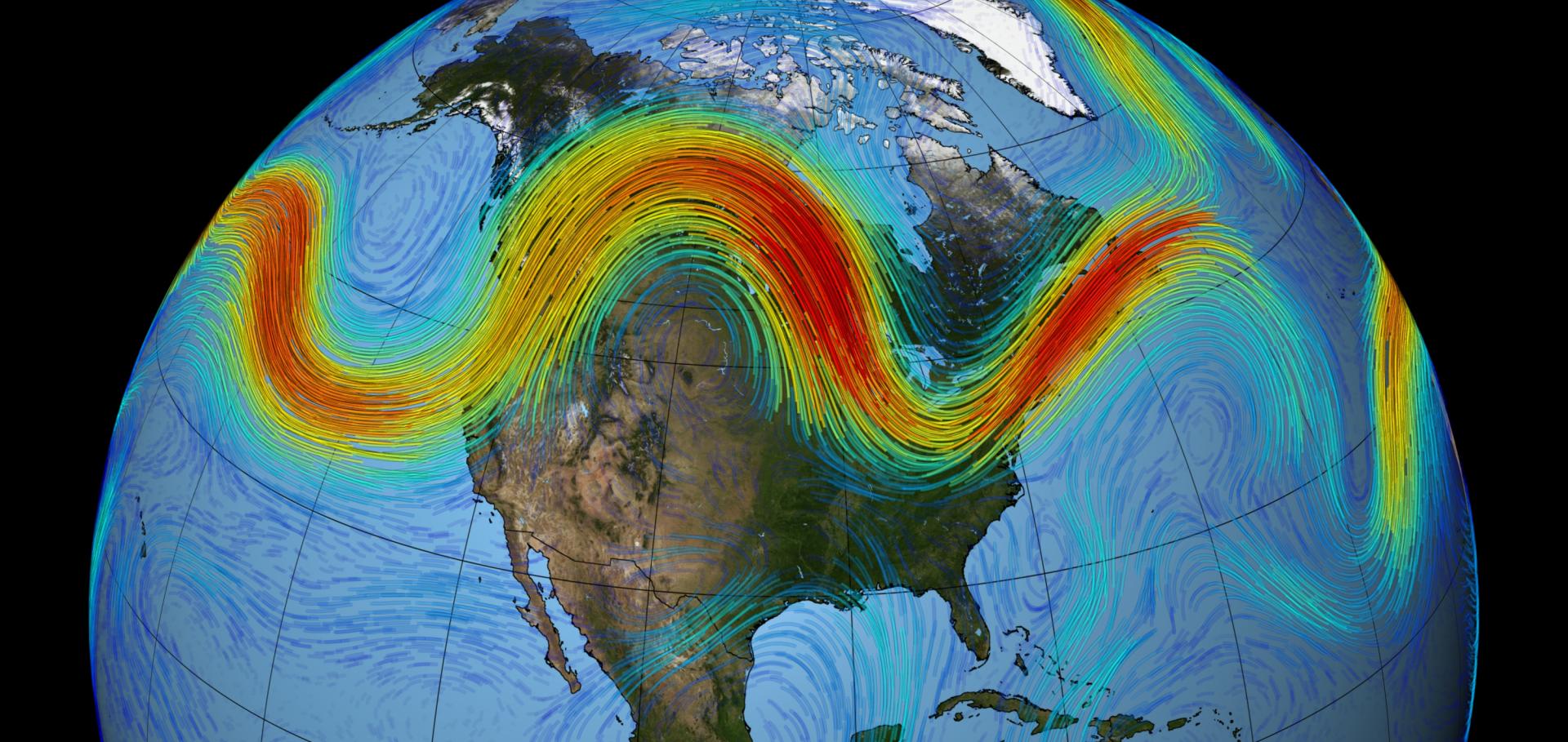
The eddy-driven jet streams, which are regions of strong westerly wind in the mid-latitudes of both hemispheres, exert a leading influence on regional climate. In this Review, we outline the seasonally and regionally varying drivers, characteristics and changes in the jet streams. State-of-the-art models commonly predict a future polewards shift of the zonal-mean and annual-mean jet streams, typically ranging between 0° and 2° latitude by the end of the century under a high-emissions scenario, but with large model-to-model uncertainty. Furthermore, regional and seasonal projections can deviate substantially from the annual-mean and zonal-mean picture, and the drivers of these projected changes are not fully understood. Jet trends have emerged in the reanalysis record since 1979, of which a polewards shift of the summertime austral jet of ~0.3°/ decade is the trend most clearly attributable to anthropogenic forcing. Although other trends have been observed, potentially large internal variability and incomplete understanding of the drivers of these trends precludes clear anthropogenic attribution at this point. Research is unevenly distributed across regions and seasons, with winter receiving the most attention, particularly in the North Atlantic. To support physical understanding and impact assessments, future research should provide a more complete picture of the seasonally and regionally varying jet stream drivers, and their changes, especially in spring and autumn.On complex network techniques for atmospheric flow analysis: a polar vortex case study
Journal of Physics: Complexity IOP Publishing (2025)
Abstract:
<jats:title>Abstract</jats:title> <jats:p>Atmospheric flow underpins virtually all meteorological and climatological phenomena, yet extracting meaningful features from its dynamics remains a major scientific challenge due to its high dimensionality, multi-scale behaviour, and inherent nonlinearity. In this study, we investigate the potential of a network-based framework to reveal the relationships between distinct flow structures. Specifically, we apply three techniques, independent of any particular phenomenon or model, to explore patterns of coherence and information transfer, vortical interactions, and Lagrangian coherent structures. We assess their utility using a rotating shallow-water model of the stratospheric polar vortex, which reproduces key aspects of wintertime dynamics, including sudden stratospheric warming split events. Our results support three central claims. First, the transformation of fluid flow data into a network representation preserves essential dynamical information. Second, this representation enables a more accessible and structured analysis of the underlying dynamical structures. Third, multiple types of networks can be constructed from atmospheric flow data, each offering distinct yet complementary insights into the system’s collective behaviour. Together, these findings highlight the potential of network-based approaches as valuable tools in atmospheric research.</jats:p>QBOi El Niño–Southern Oscillation experiments: teleconnections of the QBO
Weather and Climate Dynamics Copernicus Publications 6:4 (2025) 1419-1442