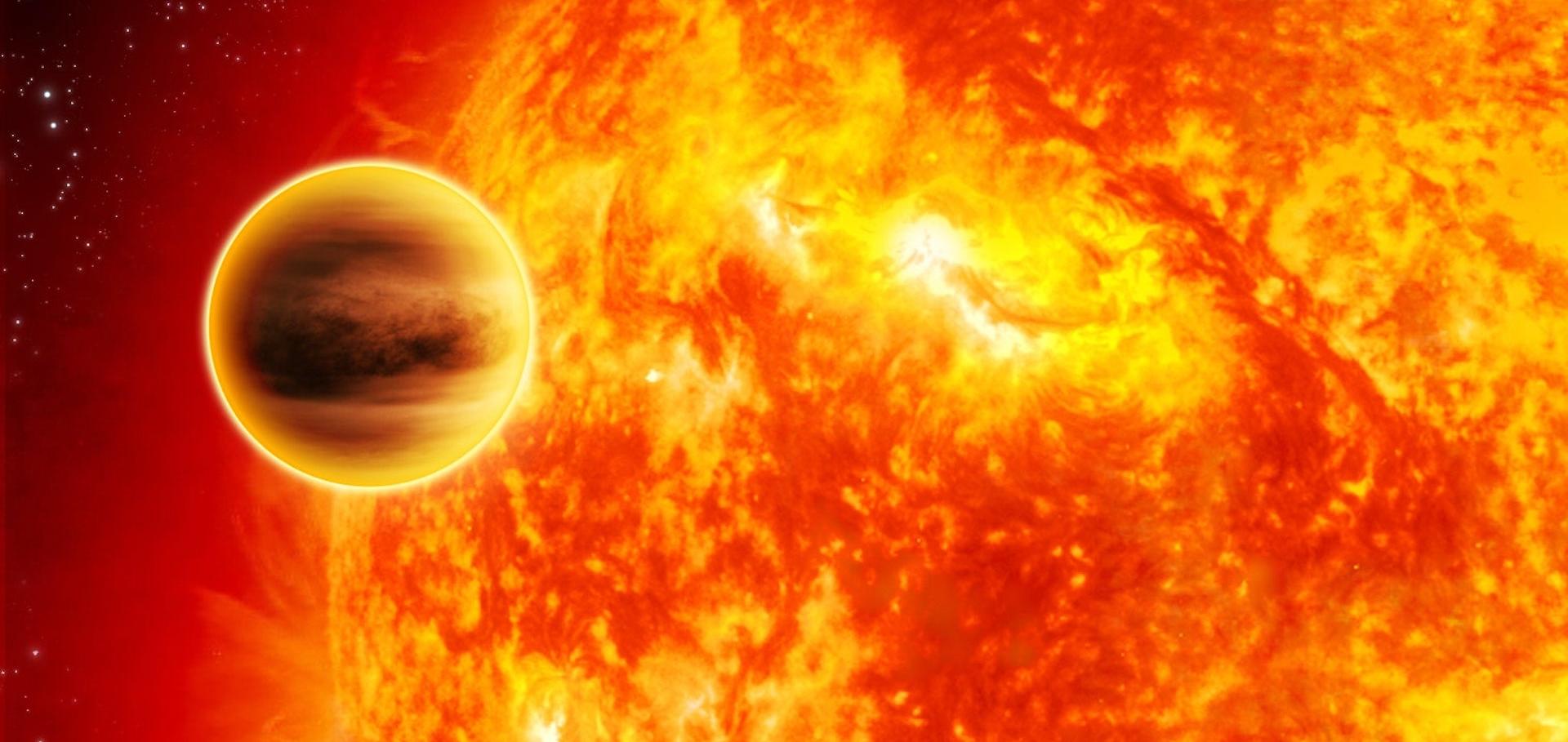
Horizontal transport as a source of disequilibrium chemistry on the nightside of a hot exoplanet

Nature Astronomy Springer Nature (2026) 1-9

Authors:

Vivien Parmentier, Kevin B Stevenson, Luis Welbanks, Jake Taylor, Everett Schlawin, Louis-Philippe Coulombe, Yao Tang, Mike Line, Hinna Shivkumar, Xianyu Tan, Jacob L Bean, Jean-Michel Désert, Jonathan J Fortney, Peter Gao, Mark Hammond, Eliza M-R Kempton, Thaddeus D Komacek, Megan Weiner Mansfield

Abstract:

Hot Jupiters have temperature gradients of several hundreds of degrees between their permanent daysides and nightsides. Such a strong gradient creates winds with speeds of the order of kilometres per second, which advect chemical species over the whole planet. When this transport is faster than the time needed for chemical species to react, it holds back the chemical equilibration of the atmospheric carbon reservoir, which would otherwise transition from CO on the dayside to CH4 on the nightside. Direct evidence of this process has remained elusive so far, as it is often degenerate with other atmospheric processes, such as vertical mixing or non-stellar elemental abundances. Here we present observational evidence for such a fast day-to-night horizontal transport of chemical species by observing the full 18-h orbit of the exoplanet NGTS-10A b with the JWST/NIRSpec instrument. We show that the carbon chemistry is dominated by CO in both the dayside and the nightside of the planet, with a strong depletion of CH4 on the nightside compared with expectations from chemical equilibrium. By measuring the atmospheric abundances of all the main carbon and oxygen molecules, we further demonstrate that the lack of CH4 on the planetary nightside cannot be attributed to non-solar elemental abundances or to vertical mixing mechanisms and must, therefore, be due to fast horizontal transport. Our study shows the fundamental role that atmospheric transport plays in shaping the distribution of chemical species on exoplanet atmospheres.

Supersolar Metallicity and Tentative Evidence for Photochemistry on WASP-96 b from JWST and Ground-based VLT Transmission Spectroscopy

The Astronomical Journal IOP Publishing 171:5 (2026) 314

Authors:

Michael Radica, Jake Taylor, Yoav Rotman, Jasmina Blecic, Luis Welbanks, Eva-Maria Ahrer, Duncan Christie, Louis-Philippe Coulombe, Gillis Lowry, Matthew M Murphy, Adina D Feinstein, David Lafrenière, Ryan J MacDonald, Nathan J Mayne, Shang-Min Tsai, Maria Zamyatina

Abstract:

With its expanded wavelength coverage and increased precision compared to previous space-based observatories, JWST provides the opportunity to revisit benchmark planets and view them in a new light. Here, we conduct an in-depth study of the atmosphere of the hot-Saturn WASP-96 b combining a new JWST NIRSpec/G395H transit with archival NIRISS/SOSS and Very Large Telescope/FORS2 transmission spectra. The combined spectrum shows clearly visible features from H2O, CO2, and Na. CO, though, remains unconstrained, precluding a firm metallicity derivation from free retrievals alone. However, self-consistent grids yield a broadly superstellar atmospheric metallicity of 2–6× stellar. When combined with a roughly stellar C/O ratio ( 0.41−0.09+0.10 from self-consistent grids), we find that WASP-96 b potentially formed via core-accretion beyond the H2O snowline and subsequently accreted volatile-rich material. Free retrievals also find a moderate preference ( lnB = 2.69) for models with SO2 versus without. WASP-96 b falls directly on the proposed “SO2 shoreline” and the retrieved SO2 abundance is well-matched to predictions from photochemical models. Our combined spectrum displays an optical slope, which our models fit with opacity from scattering aerosols—either small-particle condensate clouds or photochemical hazes—though we cannot completely rule out the broad wings of Na or the effects of stellar contamination. Future observations are necessary to disentangle these effects. Finally, we explore the possibility for limb asymmetry in WASP-96 b’s transmission spectrum and provide several tests to identify asymmetries in our data. We encourage the community to prioritize the development of a robust pathway to quantify the presence of limb asymmetry—particularly for low signal-to-noise cases.

Decoupling the AGN outflow and star-forming disc kinematics in the nuclear region of NGC 7582 with JWST NIRSpec and MIRI/MRS

Monthly Notices of the Royal Astronomical Society Oxford University Press 548:4 (2026) stag785

Authors:

Oscar Veenema, Niranjan Thatte, Dimitra Rigopoulou, Ismael García-Bernete, Almudena Alonso-Herrero, Miguel Pereira-Santaella, Anelise Audibert, Enrica Bellocchi, Andrew J Bunker, Steph Campbell, Francoise Combes, Richard I Davies, Fergus R Donnan, Santiago García-Burillo, Omaira Gonzalez Martin, Laura Hermosa Muñoz, Erin KS Hicks, Sebastian F Hoenig, Alvaro Labiano, Nancy A Levenson, Chris Packham, Cristina Ramos Almeida, Claudio Ricci, Rogemar A Riffel, David Rosario

Abstract:

We present a detailed study of the inner regions of NGC 7582, a nearby Seyfert 2 galaxy, from the Galaxy Activity, Torus, and Outflow Survey (GATOS). The galaxy hosts a circumnuclear star-forming disc and an active galactic nucleus (AGN)-driven biconical ionized outflow. Using James Webb Space Telescope Near-Infrared Spectrograph (NIRSpec) and Mid-Infrared Instrument/Medium-Resolution Spectrometer (MIRI/MRS) integral-field spectroscopy, we analyse ionic emission lines spanning a wide range of ionization potentials (IPs, –126 eV). Gaussian line-profile fitting reveals kinematic stratification: low-IP species ( eV; e.g. [Fe ii], [Ar ii], and [Ne ii]) trace ordered disc rotation with PA , while high-IP species ( eV; e.g. [O iv], [Mg iv], and [Ne v]) follow the outflow with PA . Outflowing gas exhibits systematically higher velocity dispersions ( km s−1) than the disc ( km s−1), consistent with turbulent or bulk motions. Intermediate-IP lines, [S iii], [Ar iii], and [Ne iii], show contributions from both components, with the outflow characterized by higher dispersion, lower amplitude, and higher velocities in double-Gaussian fits. For these lines, a thin inclined disc plus 1D outflow model enables robust separation and quantification of the disc and outflow velocity fields. The outflow is consistent with a hollow bicone capable of accelerating gas beyond the local escape velocity, implying most material is unlikely to be re-accreted. The ionization cone opening angle shows no dependence on IP, indicating the AGN torus polar regions are largely unobscured. Our study provides new insights into AGN-driven outflows and circumnuclear disc dynamics, offering a framework to disentangle overlapping interstellar medium kinematics in nearby active galaxies.

Assessment of PLATO Science Performance

(2026)

Authors:

Juan Cabrera, Heike Rauer, Reza Samadi, Valerio Nascimbeni, Anko Boerner, Denis Grießbach, Carsten Paproth, Martin Pertenaıs, Sami-M Niemi, Szilard Csizmadia, Asier Abreu, Conny Aerts, Suzanne Aigrain, Matthias Ammler-von Eiff, Beatriz Aparicio del Moral, Thierry Appourchaux, David J Armstrong, Ann Baeke, Gabor G Balazs, Kevin Belkacem, Aaron Birch, Paz Bluhm, Tobias Boenke, Fabrice Boquet, Sam Bowling, David JA Brown, Claude Catala, William J Chaplin, Margarida S Cunha, Cilia Daminani, Guy R Davies, Jeanne Davoult, Francesca De Angeli, Joris De Ridder, Magali Deleuil, Jean-Michel Desert, Jose Javier Diaz Garcia, Anna M Di Giorgio, Lauren Doyle, Billy Edwards, Philipp Eigmueller, Johannes Eising, Anders Erikson, Yoshi Emilia Nike Eschen, Lorenza Ferrari, Dominic C Ford, Hugo Garcia Vazquez, Laurent Gizon, Juan Manuel Gomez Lopez, Nicolas Gorius, Marie-jo Goupil, Valentina Granata, John Lee Grenfell, Emmanuel Grolleau, Sascha Grziwa, Tristan Guillot, Diana L Harrison, Rene Heller, Ana M Heras, Simon T Hodgkin, Rik Huygen, Nicholas Jannsen, David Kappel, Peter Klagyivik, Alexander Koncz, Diana Kossakowska, Alvaro Labiano, Kristine Lam, Antonino Francesco Lanza, Monika Lendl, Yves Levillain, Francisco A Lobon Villanueva, Demetrio Magrin, Luca Malavolta, Silvia Marinoni, Paola Marrese, Cesar Martin Garcia, Miguel Mas Hesse, Pierre Maxted, James McCormac, Andrea Miglio, Marco Montalto, Thierry Morel, Alvaro Morena, Andres Moya, Matteo Munari, Martin B Nielsen, Rhita-Maria Ouazzani, Isabella Pagano, Carmen Pastor Morales, Gisbert Peter, Jordan Philidet, Giampaolo Piotto, Philippe Plasson, Don Pollacco, Elena Puga, Roberto Ragazzoni, Gonzalo Ramos Zapata, Sara Regibo, Guy T Rixon, Nicolas Robles Muñoz, Julio Rodriguez Gomez, Pierre Royer, Miguel Andres Sanchez Carrasco, Rosario Sanz Mesa, Gabriel Schwarzkopf, Dries Seynaeve, Alan Smith, Alexis MS Smith, Leigh C Smith, Sophia Sulis, Geert Jan J Talens, Ruth Titz-Weider, Stephane Udry, Bart Vandenbussche, Ivan Valtchanov, Peter Verhoeve, Dave Walton, Nicholas A Walton, Thomas G Wilson, Ulrike Witteck, David Wolter, Claas Ziemke, Konstanze Zwintz

HATPI Preperihelion Time-series Photometry of the Interstellar Comet 3I/ATLAS

The Astronomical Journal IOP Publishing 171:5 (2026) 270

Authors:

Joel D Hartman, Gáspár Á Bakos, Andrés Jordán, Sarah Thiele, Zoltán Csubry, Geert Jan Talens, Attila Bódi, Sándor Pigai, István Domsa, Anthony Keyes, Vincent Suc, Adriana Gaitan, Antoine Thibault

Abstract:

The Hungarian-made Automated Telescope PI Steradians (HATPI) is a recently commissioned time-domain facility at Las Campanas Observatory, Chile, that uses 64 wide-angle, 9.6 cm diameter lenses and back-illuminated CCDs, yielding a mosaic field-of-view of 7100 square arcdegrees, observing the night sky at a cadence of 45 s and a spatial scale of 19 .″ 7 pixel−1. In this paper, we present moving object time-series photometry with this facility, focusing on the interstellar comet 3I/ATLAS, which was first robustly recovered by HATPI on the night of 2025 July 2 (one night after its discovery) at a Gaia G-band magnitude of G = 17.796 ± 0.082 mag (±0.030 mag systematic uncertainty). The comet then increased in brightness to G = 14.071 ± 0.073 mag ± 0.030 mag by 2025 September 13, after which it became unobservable by HATPI as it approached perihelion. Before 3I/ATLAS achieved a brightness of G = 16.396 ± 0.029 mag ± 0.030 mag on 2025 August 6, it could be detected when stacking all HATPI observations from a single night, while after this date it is sufficiently bright to detect in individual 45 s exposures. We do not detect evidence for significant short-time-scale variations in the brightness of 3I/ATLAS after August 6. Compared to other light curves in the literature, the HATPI photometry exhibits a somewhat steeper rise in brightness with decreasing heliocentric distance, rH. The HATPI magnitudes are well-fit as a power law function of rH, with an exponential index of n = 5.167 ± 0.095, over the range 2.14 au