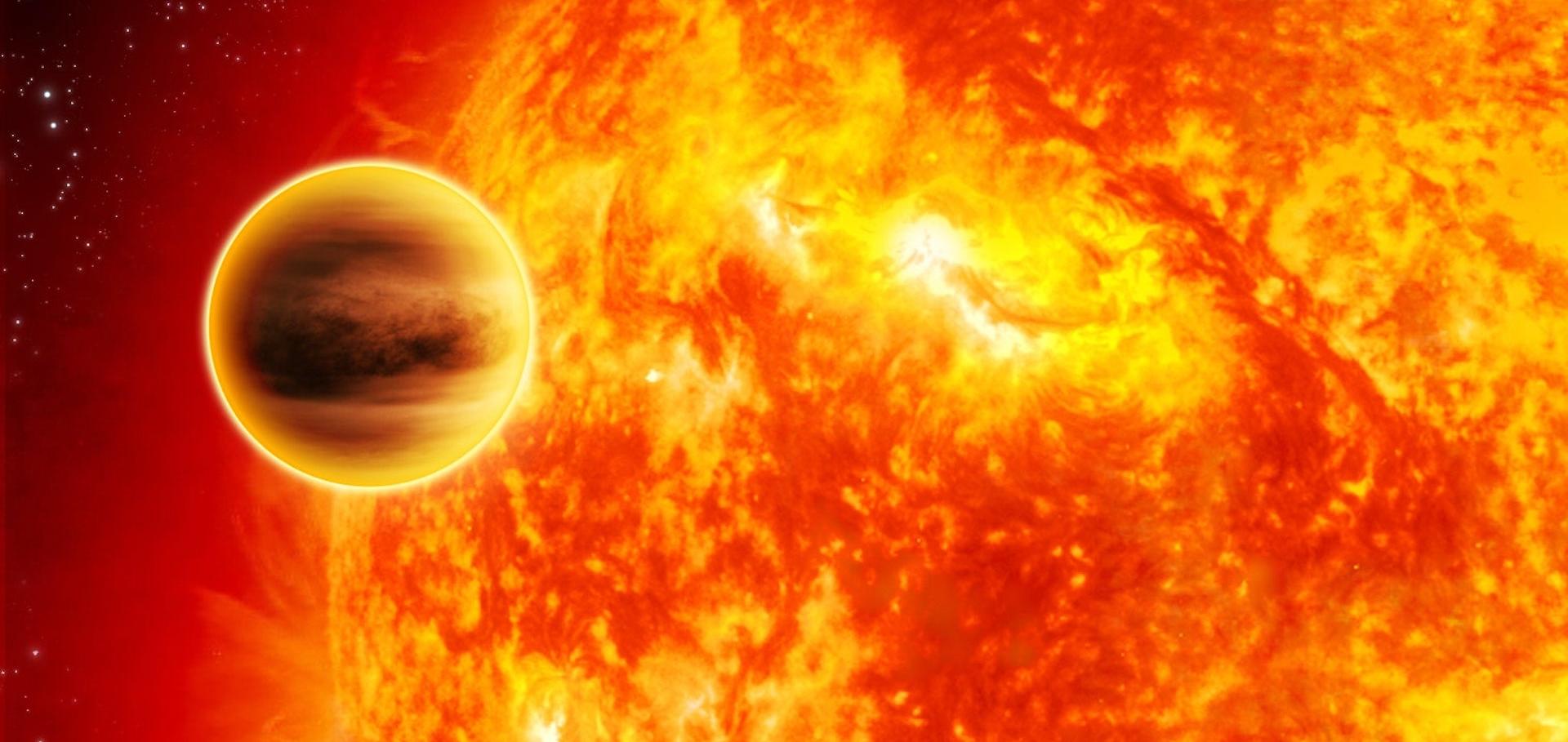
HAT-P-70b through the Eyes of MAROON-X: Constraining Elemental Abundances of Metals and Insights on Atmosphere Dynamics

The Astronomical Journal IOP Publishing 172:1 (2026) 9-9

Authors:

SL Sun, S Pelletier, B Benneke, B Prinoth, V Parmentier, JL Bean, JP Wardenier, Y Chachan, V Vaulato

Abstract:

Ultrahot Jupiters (UHJs) are exceptional laboratories for studying planetary atmospheres under extreme irradiation conditions. With close-in tidally locked orbits, these planets can have daysides hot enough for metals to be significantly ionized while still maintaining nightsides cold enough for refractory species to potentially condense. We present an analysis of the UHJ HAT-P-70b taken with the MAROON-X high-resolution spectrograph. Using cross correlations, we detect 14 neutral and singly ionized species, including Fe I, Fe II, Ti I, Ca I, Ca II, Cr I, Na I, V I, Mn I, Ni I, Mg I, Ba II, O I, and Sr I, with tentative evidence for H I, Co I, and K I. The absorption signals exhibit blueshifts on the order of a few kilometers per second, consistent with day-to-night winds. We further constrain relative abundances with atmospheric retrievals and demonstrate that some inferred elemental abundance ratios depend strongly on modeling assumptions. In particular, we show that a well-mixed retrieval approach neglecting ionization can strongly bias highly ionizable elements such as Ca and Ti. Accounting for the effects of equilibrium chemistry and thermal ionization generally results in inferred elemental abundance ratios that are closer to expectations for a solar-like composition, although not in all cases. Interestingly, we find a distinct nickel enrichment on HAT-P-70b, adding to the growing number of UHJ studies where the Ni abundance is seemingly enhanced. Our results underline the importance of considering physical and chemical atmospheric processes such as ionization when interpreting high-resolution transmission spectra of UHJs.

Upper limits on exosatellites around $β$ Pictoris b

(2026)

Authors:

MA Kenworthy, R Landman, A Vanderburg, JE Rodriguez, JL Birkby, I Macias, D González Picos, SA Jenkins, E Kleisioti, T Stolker, I Koutalios

Magnetic field strengths of hot giant exoplanets consistent with Solar System values

Nature Astronomy Springer Nature (2026) 1-12

Authors:

Julia V Seidel, Vivien Parmentier, Bibiana Prinoth, Thea Hood, Nishil Mehta, Valentin De Lia, Konstantin Batygin, Tristan Guillot, Ragnar Van den Broeck, Hayley Beltz, Brian Thorsbro, Florian Debras, Daniel DB Koll, Thaddeus D Komacek, Emily Rauscher, Lorenzo Pino, Matteo Brogi, Joost P Wardenier, Jacob L Bean, Björn Benneke, Jean-Michel LB Désert, Pablo Drake, Siddharth Gandhi, Mark Hammond, David Kasper, Michael R Line, Elspeth KH Lee, Stefan Pelletier, Andreas Seifahrt, Adrien Simonnin, Peter CB Smith, Kevin B Stevenson

Abstract:

Magnetic fields are a key factor in the evolution of planets and their atmospheres, but they are still poorly constrained for exoplanets owing to limited direct observations. Ultra-hot Jupiters provide a new avenue to probe magnetic effects, as the circulation of their highly ionized atmospheres could be directly sensitive to the atmospheric magnetic field. However, it remains unclear whether the impact of these magnetic effects can be observed directly and used to constrain the magnetic field strength. With high spectral resolution observations targeting the planetary iron lines, we measure the Doppler shift and thus the wind speed of seven transiting ultra-hot Jupiters. Here we find a clear decrease of wind speed with increasing planetary temperature, which is a trend inconsistent with purely hydrodynamic mechanisms but naturally reproduced by magnetic drag. From this relationship, we estimate the possible strength of magnetic fields of hot giant planets to at most a few gauss, which is comparable with the Jovian equatorial field. Our results support the idea that magnetic fields affect the atmospheric circulation of ultra-hot Jupiters and could provide a crucial benchmark for scaling laws used to predict magnetic fields in exoplanets, from hot Jupiters to rocky Earths, with additional implications for future direct observations.

The CRIMSON survey I: super-stellar SiO in the directly imaged companion TWA 5 B from high-resolution M-band spectroscopy

(2026)

Authors:

Luke T Parker, Jayne L Birkby, Siddharth Gandhi, Vivien Parmentier, Vatsal Panwar, Matteo Brogi, Sophia R Vaughan

A Hierarchical Modeling Study of Absorbing Aerosol Impacts on Precipitation Characteristics and Extremes

Journal of Advances in Modeling Earth Systems American Geophysical Union (AGU) 18:6 (2026) e2025MS005400

Authors:

T Sreelekshmi, Jacob Shpund, Namrah Habib, Guy Dagan

Abstract:

Abstract The impact of anthropogenic aerosols on the mean, spatial, and temporal distribution of precipitation remains a persistent source of uncertainty in climate research. In particular, absorbing aerosols are known to influence cloud formation and precipitation in ways that are not yet fully understood. On average, warming induced by absorbing aerosols is balanced by reduced latent heating from precipitation, so the atmospheric energy budget constrains mean precipitation. This constraint does not apply to spatial or temporal patterns, making the impact of absorbing aerosols on these aspects more uncertain. A recent idealized study suggests that absorbing aerosols can trigger a transition to episodic precipitation, where rainfall occurs in intense, short‐lived events followed by extended dry periods. This transition resembles a previously reported shift under hothouse climate conditions. Specifically, lower tropospheric radiative heating from absorbing aerosols decouples the lower and upper troposphere, suppressing convection for multiple days. During these dry periods, instability builds up until a strong rain event occurs. In this paper, we build on this previous work to further investigate the effects of absorbing aerosols on precipitation characteristics and extremes. We conduct a hierarchy of model simulations that incorporate online aerosol–radiation coupling, the diurnal cycle of solar radiation, convective aggregation in a large‐domain, and large‐scale tropical circulation in a mock Walker simulation. Our results show that the transition to episodic precipitation events under absorbing aerosol perturbation is robust and occurs across all model configurations. We also examine the role of diurnal solar radiation variations and large‐scale circulation in shaping this transition.