

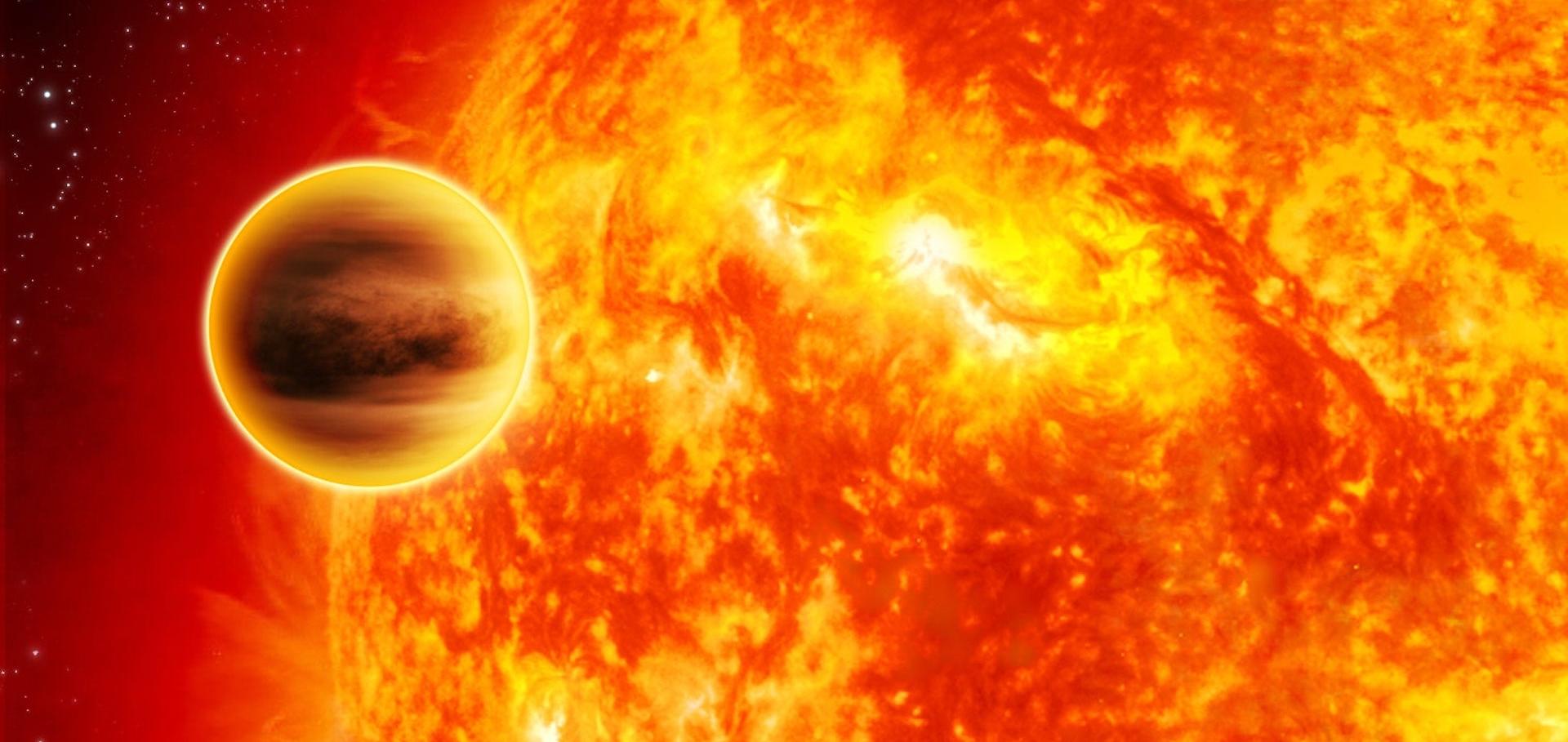
ARES I: WASP-76 b, A Tale of Two HST Spectra* * ARES: Ariel Retrieval of Exoplanets School.
The Astronomical Journal American Astronomical Society 160:1 (2020) 8
A transition between the hot and the ultra-hot Jupiter atmospheres
Astronomy & Astrophysics EDP Sciences 639 (2020) a36
Pleiades or Not? Resolving the Status of the Lithium-rich M Dwarfs HHJ 339 and HHJ 430
Astronomical Journal American Astronomical Society 160:1 (2020) 30
Abstract:
Oppenheimer et al. discovered two M5 dwarfs in the Pleiades with nearly primordial lithium. These stars are not low enough in mass to represent the leading edge of the lithium depletion boundary at Pleiades age (~125 Myr). A possible explanation for the enhanced lithium in these stars is that they are actually not members of the Pleiades but instead are members of a younger moving group seen in projection toward the Pleiades. We have used data from Gaia DR2 to confirm that these two stars, HHJ 339 and HHJ 430, are indeed not members of the Pleiades. Based on their space motions, parallaxes, and positions in a Gaia-based color–magnitude diagram, it is probable that these two stars are about 40 parsecs foreground to the Pleiades and have ages of ~25 Myr. Kinematically they are best matched to the 32 Ori moving group.Thermodynamic and energetic limits on continental silicate weathering strongly impact the climate and habitability of wet, rocky worlds
Astrophysical Journal American Astronomical Society 896:2 (2020) 115
Abstract:
The “liquid water habitable zone” (HZ) concept is predicated on the ability of the silicate weathering feedback to stabilize climate across a wide range of instellations. However, representations of silicate weathering used in current estimates of the effective outer edge of the HZ do not account for the thermodynamic limit on concentration of weathering products in runoff set by clay precipitation, nor for the energetic limit on precipitation set by planetary instellation. We find that when the thermodynamic limit is included in an idealized coupled climate/weathering model, steady-state planetary climate loses sensitivity to silicate dissolution kinetics, becoming sensitive to temperature primarily through the effect of temperature on runoff and to pCO2 through an effect on solute concentration mediated by pH. This increases sensitivity to land fraction, CO2 outgassing, and geological factors such as soil age and lithology, all of which are found to have a profound effect on the position of the effective outer edge of the HZ. The interplay between runoff sensitivity and the energetic limit on precipitation leads to novel warm states in the outer reaches of the HZ, owing to the decoupling of temperature and precipitation. We discuss strategies for detecting the signature of silicate weathering feedback through exoplanet observations in light of insights derived from the revised picture of weathering.THOR 2.0: Major Improvements to the Open-source General Circulation Model
The Astrophysical Journal Supplement Series American Astronomical Society 248:2 (2020) 30