

The Impact of Scattering Clouds when Studying Exoplanet Emission Spectra with JWST
Copernicus Publications (2024)
Time-resolved Hubble Space Telescope Wide Field Camera 3 Spectrophotometry Reveals Inefficient Day-to-night Heat Redistribution in the Highly Irradiated Brown Dwarf SDSS 1557B
The Astrophysical Journal American Astronomical Society 966:1 (2024) 4
The Mantis Network
Astronomy & Astrophysics EDP Sciences 685 (2024) a139
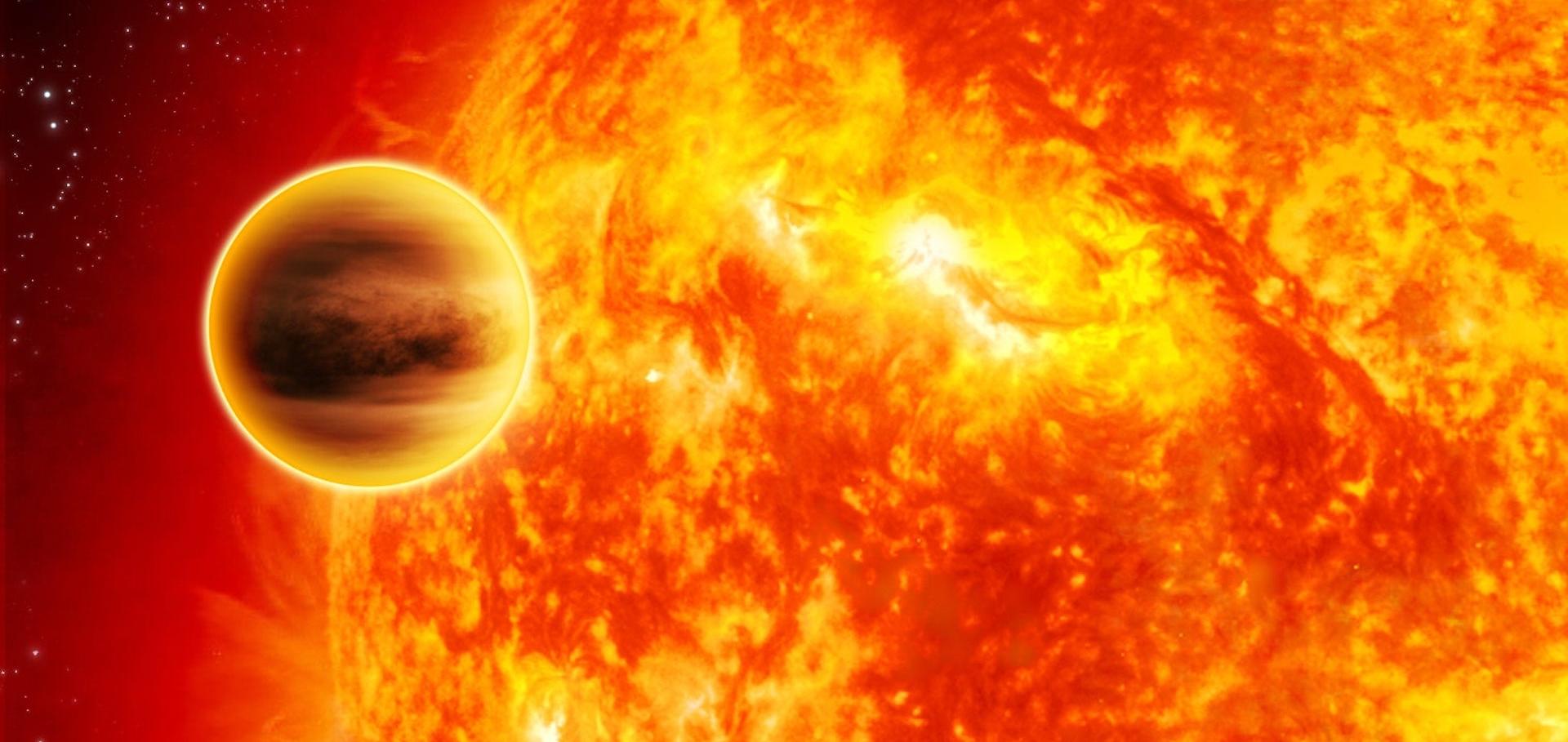
Nightside clouds and disequilibrium chemistry on the hot Jupiter WASP-43b
Nature Astronomy Nature Research 8:7 (2024) 879-898
Abstract:
Hot Jupiters are among the best-studied exoplanets, but it is still poorly understood how their chemical composition and cloud properties vary with longitude. Theoretical models predict that clouds may condense on the nightside and that molecular abundances can be driven out of equilibrium by zonal winds. Here we report a phase-resolved emission spectrum of the hot Jupiter WASP-43b measured from 5 μm to 12 μm with the JWST’s Mid-Infrared Instrument. The spectra reveal a large day–night temperature contrast (with average brightness temperatures of 1,524 ± 35 K and 863 ± 23 K, respectively) and evidence for water absorption at all orbital phases. Comparisons with three-dimensional atmospheric models show that both the phase-curve shape and emission spectra strongly suggest the presence of nightside clouds that become optically thick to thermal emission at pressures greater than ~100 mbar. The dayside is consistent with a cloudless atmosphere above the mid-infrared photosphere. Contrary to expectations from equilibrium chemistry but consistent with disequilibrium kinetics models, methane is not detected on the nightside (2σ upper limit of 1–6 ppm, depending on model assumptions). Our results provide strong evidence that the atmosphere of WASP-43b is shaped by disequilibrium processes and provide new insights into the properties of the planet’s nightside clouds. However, the remaining discrepancies between our observations and our predictive atmospheric models emphasize the importance of further exploring the effects of clouds and disequilibrium chemistry in numerical models.Planet Hunters TESS. V. A Planetary System Around a Binary Star, Including a Mini-Neptune in the Habitable Zone
Astronomical Journal IOP Publishing 167:5 (2024) 241