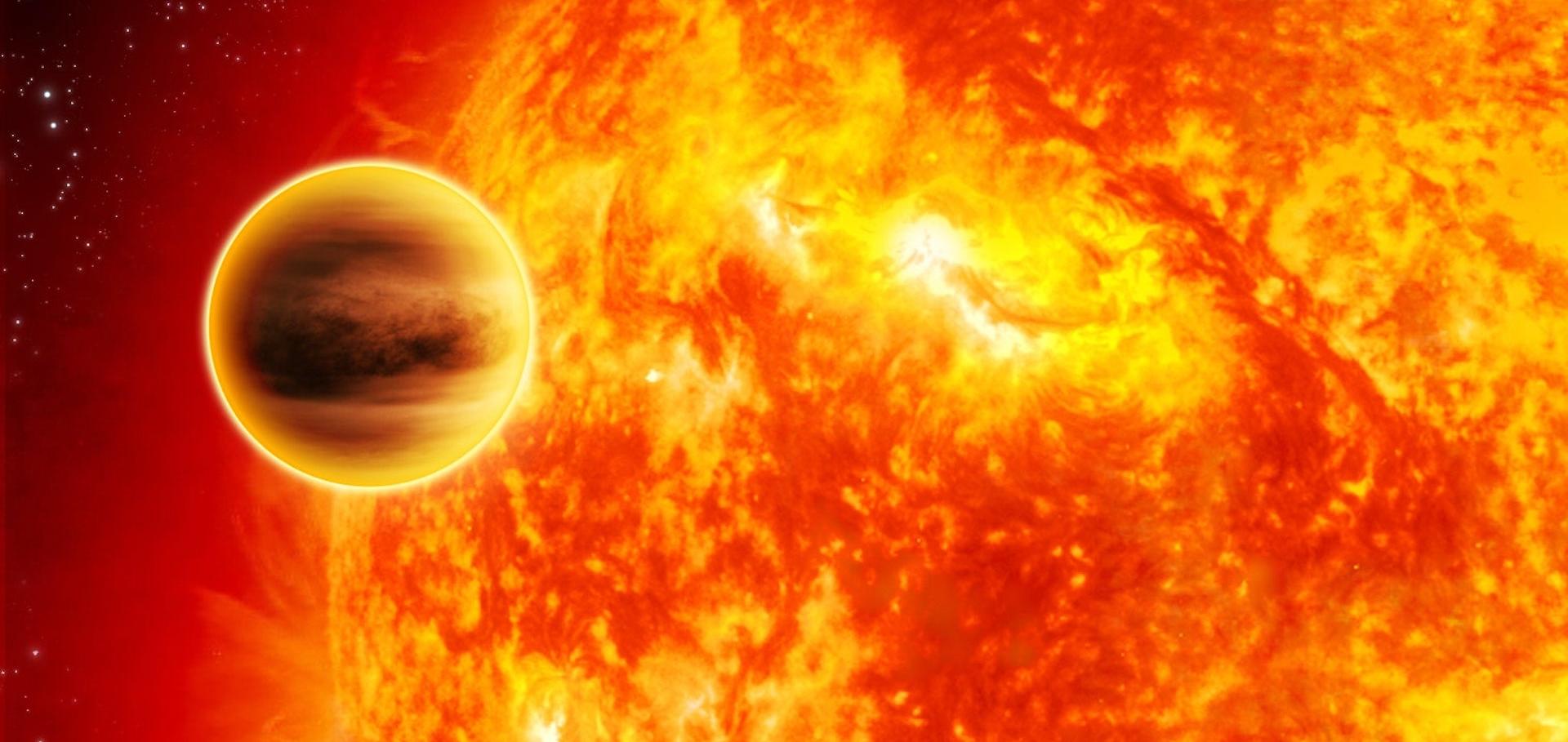
Modelling the day–night temperature variations of ultra-hot Jupiters: confronting non-grey general circulation models and observations

Monthly Notices of the Royal Astronomical Society Oxford University Press (OUP) 528:1 (2024) 1016-1036

Authors:

Xianyu Tan, Thaddeus D Komacek, Natasha E Batalha, Drake Deming, Roxana Lupu, Vivien Parmentier, Raymond T Pierrehumbert

Modeling Noncondensing Compositional Convection for Applications to Super-Earth and Sub-Neptune Atmospheres

The Astrophysical Journal American Astronomical Society 961:1 (2024) 35-35

Authors:

Namrah Habib, Raymond T Pierrehumbert

Abstract:

Abstract Compositional convection is atmospheric mixing driven by density variations caused by compositional gradients. Previous studies have suggested that compositional gradients of atmospheric trace species within planetary atmospheres can impact convection and the final atmospheric temperature profile. In this work, we employ 3D convection-resolving simulations using Cloud Model 1 (CM1) to gain a fundamental understanding of how compositional variation influences convection and the final atmospheric state of exoplanet atmospheres. We perform 3D initial value problem simulations of noncondensing compositional convection for Earth-air, H 2 , and CO 2 atmospheres. Conventionally, atmospheric convection is assumed to mix the atmosphere to a final, marginally stable state defined by a unique temperature profile. However, when there is compositional variation within an atmosphere, a continuous family of stable end states is possible, differing in the final state composition profile. Our CM1 simulations are used to determine which of the family of possible compositional end states is selected. Leveraging the results from our CM1 simulations, we develop a dry convective adjustment scheme for use in general circulation models (GCMs). This scheme relies on an energy analysis to determine the final adjusted atmospheric state. Our convection scheme produces results that agree with our CM1 simulations and can easily be implemented in GCMs to improve modeling of compositional convection in exoplanet atmospheres.

Modelling stellar variability in archival HARPS data: I -- Rotation and activity properties with multi-dimensional Gaussian Processes

(2024)

Authors:

Haochuan Yu, Suzanne Aigrain, Baptiste Klein, Oscar Barragán, Annelies Mortier, Niamh K O'Sullivan, Michael Cretignier

PlatoSim: an end-to-end PLATO camera simulator for modelling high-precision space-based photometry

Astronomy and Astrophysics EDP Sciences 681 (2024) A18

Authors:

N Jannsen, J De Ridder, D Seynaeve, S Regibo, R Huygen, P Royer, C Paproth, D Grießbach, R Samadi, Dr Reese, M Pertenais, E Grolleau, R Heller, Sm Niemi, J Cabrera, A Börner, S Aigrain, J Mccormac, P Verhoeve, P Astier, N Kutrowski, B Vandenbussche, A Tkachenko, C Aerts

Abstract:

Context. PLAnetary Transits and Oscillations of stars (PLATO) is the ESA M3 space mission dedicated to detect and characterise transiting exoplanets including information from the asteroseismic properties of their stellar hosts. The uninterrupted and high-precision photometry provided by space-borne instruments such as PLATO require long preparatory phases. An exhaustive list of tests are paramount to design a mission that meets the performance requirements and, as such, simulations are an indispensable tool in the mission preparation.

Aims. To accommodate PLATO’s need of versatile simulations prior to mission launch that at the same time describe innovative yet complex multi-telescope design accurately, in this work we present the end-to-end PLATO simulator specifically developed for that purpose, namely PlatoSim. We show, step-by-step, the algorithms embedded into the software architecture of PlatoSim that allow the user to simulate photometric time series of charge-coupled device (CCD) images and light curves in accordance to the expected observations of PLATO.

Methods. In the context of the PLATO payload, a general formalism of modelling, end-to-end, incoming photons from the sky to the final measurement in digital units is discussed. According to the light path through the instrument, we present an overview of the stellar field and sky background, the short- and long-term barycentric pixel displacement of the stellar sources, the cameras and their optics, the modelling of the CCDs and their electronics, and all main random and systematic noise sources.

Results. We show the strong predictive power of PlatoSim through its diverse applicability and contribution to numerous working groups within the PLATO mission consortium. This involves the ongoing mechanical integration and alignment, performance studies of the payload, the pipeline development, and assessments of the scientific goals.

Conclusions. PlatoSim is a state-of-the-art simulator that is able to produce the expected photometric observations of PLATO to a high level of accuracy. We demonstrate that PlatoSim is a key software tool for the PLATO mission in the preparatory phases until mission launch and prospectively beyond.

ATMOSPHERIX: II- Characterizing exoplanet atmospheres through transmission spectroscopy with SPIRou

Monthly Notices of the Royal Astronomical Society, Volume 527, Issue 1, pp.566-582

Authors:

Florian Debras, Baptiste Klein, Jean-Francois Donati et al.

Abstract:

In a companion paper, we introduced a publicly available pipeline to characterize exoplanet atmospheres through high-resolution spectroscopy. In this paper, we use this pipeline to study the biases and degeneracies that arise in atmospheric characterization of exoplanets in near-infrared ground-based transmission spectroscopy. We inject synthetic planetary transits into sequences of SPIRou spectra of the well known M dwarf star Gl 15 A, and study the effects of different assumptions on the retrieval. We focus on (i) mass and radius uncertainties, (ii) non-isothermal vertical profiles, and (iii) identification and retrieval of multiple species. We show that the uncertainties on mass and radius should be accounted for in retrievals and that depth-dependent temperature information can be derived from high-resolution transmission spectroscopy data. Finally, we discuss the impact of selecting wavelength orders in the retrieval and the issues that arise when trying to identify a single species in a multispecies atmospheric model. This analysis allows us to understand better the results obtained through transmission spectroscopy and their limitations in preparation to the analysis of actual SPIRou data.