

Extremely well isolated two-dimensional spin-1/2 antiferromagnetic Heisenberg layers with a small exchange coupling in the molecular-based magnet CuPOF
PHYSICAL REVIEW B 102:6 (2020) 64431
Abstract:
© 2020 authors. We report on a comprehensive characterization of the newly synthesized Cu2+-based molecular magnet [Cu(pz)2(2-HOpy)2](PF6)2 (CuPOF), where pz=C4H4N2 and 2-HOpy=C5H4NHO. From a comparison of theoretical modeling to results of bulk magnetometry, specific heat, μ+SR, ESR, and NMR spectroscopy, this material is determined as an excellent realization of the two dimensional square-lattice S=12 antiferromagnetic Heisenberg model with a moderate intraplane nearest-neighbor exchange coupling of J/kB=6.80(5) K, and an extremely small interlayer interaction of about 1 mK. At zero field, the bulk magnetometry reveals a temperature-driven crossover of spin correlations from isotropic to XY type, caused by the presence of a weak intrinsic easy-plane anisotropy. A transition to long-range order, driven by the low-temperature XY anisotropy under the influence of the interlayer coupling, occurs at TN=1.38(2) K, as revealed by μ+SR. In applied magnetic fields, our H1-NMR data reveal a strong increase of the magnetic anisotropy, manifested by a pronounced enhancement of the transition temperature to commensurate long-range order at TN=2.8 K and 7 T.Information and Decoherence in a Muon-Fluorine Coupled System
PHYSICAL REVIEW LETTERS 125:8 (2020) 87201
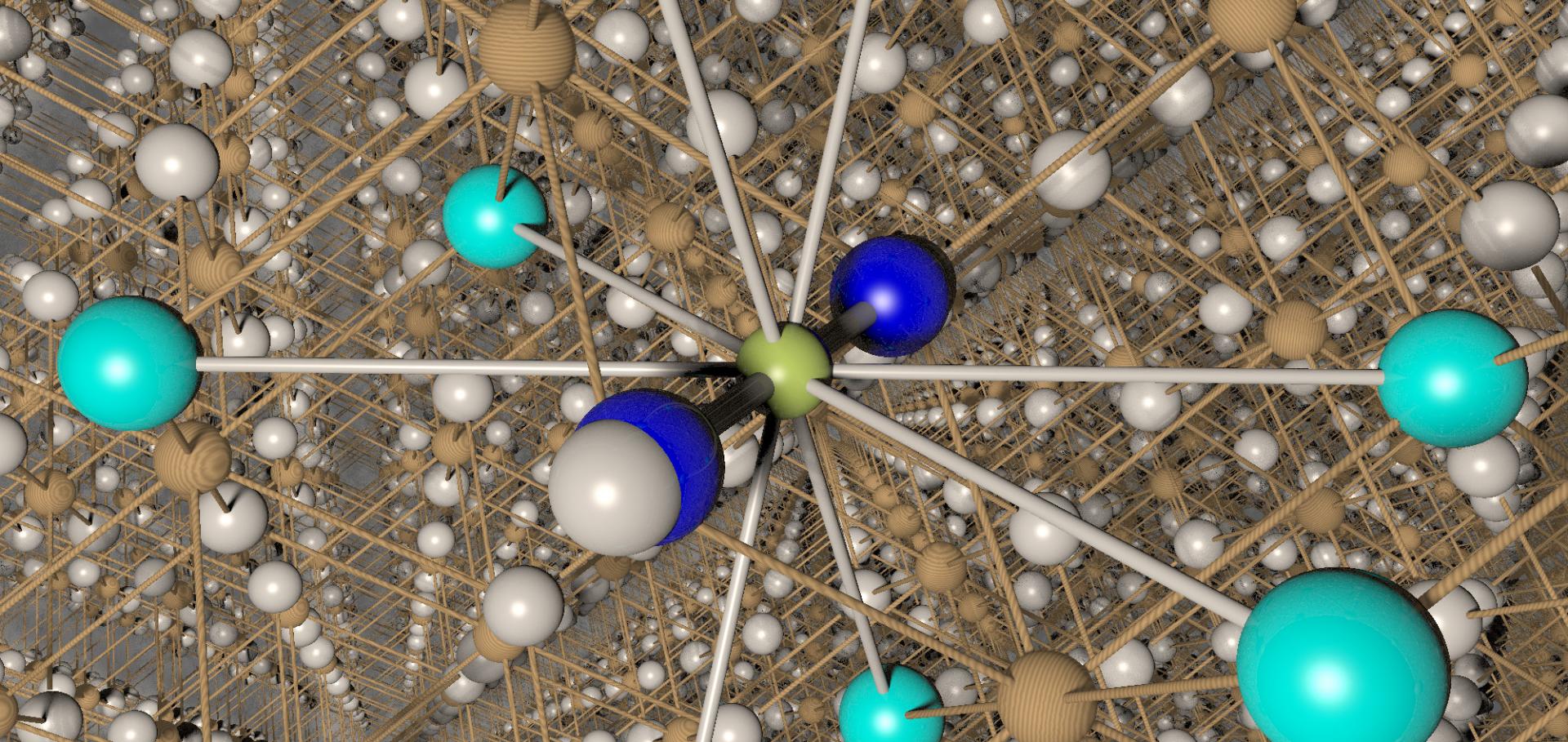
Information and decoherence in a muon-fluorine coupled system
Physical Review Letters American Physical Society 125:8 (2020) 87201
Abstract:
The unitary evolution of a quantum system preserves its coherence, but interactions between the system and its environment result in decoherence, a process in which the quantum information stored in the system becomes degraded. A spin-polarized positively charged muon implanted in a fluoride crystal realizes such a coherent quantum system, and the entanglement of muon and nearest-neighbor fluorine nuclear spins gives rise to an oscillatory time dependence of the muon polarization that can be detected and measured. Here we show that the decohering effect of more distant nuclear spins can be modelled quantitatively, allowing a very detailed description of the decoherence processes coupling the muon-fluorine “system” with its “environment,” and allowing us to track the system entropy as the quantum information degrades. These results show how to precisely quantify the spin relaxation of muons implanted into quantum entangled states in fluoride crystals.Observation of a neutron spin resonance in the bilayered superconductor CsCa2Fe4As4F2.
Journal of physics. Condensed matter : an Institute of Physics journal 32:43 (2020) ARTN 435603