

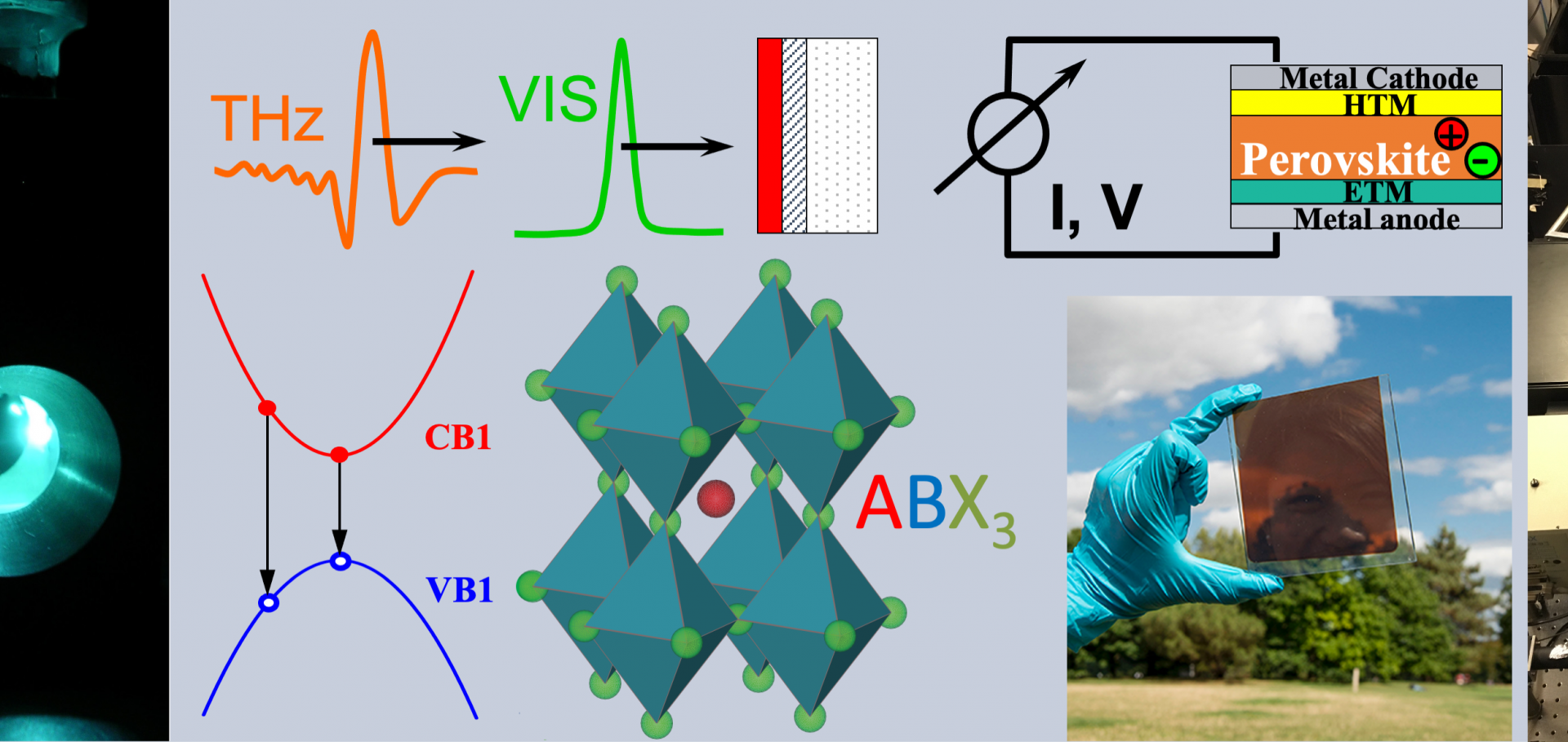
Structural and electronic features enabling delocalized charge-carriers in CuSbSe 2
Nature Communications Nature Research 16:1 (2025) 65
Abstract:
Inorganic semiconductors based on heavy pnictogen cations (Sb3+ and Bi3+) have gained significant attention as potential nontoxic and stable alternatives to lead-halide perovskites for solar cell applications. A limitation of these novel materials, which is being increasingly commonly found, is carrier localization, which substantially reduces mobilities and diffusion lengths. Herein, CuSbSe2 is investigated and discovered to have delocalized free carriers, as shown through optical pump terahertz probe spectroscopy and temperature-dependent mobility measurements. Using a combination of theory and experiment, the critical enabling factors are found to be: 1) having a layered structure, which allows distortions to the unit cell during the propagation of an acoustic wave to be relaxed in the interlayer gaps, with minimal changes in bond length, thus limiting deformation potentials; 2) favourable quasi-bonding interactions across the interlayer gap giving rise to higher electronic dimensionality; 3) Born effective charges not being anomalously high, which, combined with the small bandgap (≤1.2 eV), result in a low ionic contribution to the dielectric constant compared to the electronic contribution, thus reducing the strength of Fröhlich coupling. These insights can drive forward the rational discovery of perovskite-inspired materials that can avoid carrier localization.Unlocking photoanode performance through a roadmap for electrophoretic deposition of carbon nitride/tungsten oxide heterojunction thin films
Materials Advances Royal Society of Chemistry 6:12 (2025) 4106-4114
Abstract:
The formation of high-quality semiconductor thin films is a significant challenge that requires precise control over various factors, including film thickness, uniformity, crystallinity, and strong adhesion to the underlying substrate. These parameters are particularly critical in photoelectrode fabrication, where the thin film must efficiently interact with incident light to maximise absorption and facilitate effective photogenerated charge separation and transport to improve the overall photoelectrochemical performance. In this work, we systematically investigate the formation of graphitic carbon nitride/tungsten oxide (g-C3N4/WO3) hybrid material thin film using electrophoretic deposition (EPD). Transmission electron microscopy reveals direct contact between g-C3N4 and WO3, while X-ray photoelectron spectroscopy indicates electron transfer from g-C3N4 to WO3, confirming the formation of an effective n–n-heterojunction at the interface. We identified four key EPD coating parameters that affect the thin film quality and photoanode performance, including substrate pretreatment, suspension solvent, deposition voltage and time, and post-annealing. Notably, the dispersion of g-C3N4/WO3 heterojunction particles in acetone, in the presence of iodine, results in an excellent film compared to those prepared in water and isopropanol. The most important parameter is the thickness of the film, which must be optimal for light absorption and charge separation: if the film is too thin, it absorbs insufficient light; conversely, if it's too thick, the photogenerated charge carriers recombine before reaching the electrode or electrolyte. By exploring a range of conditions, we determined the optimal substrate surface chemistry and identified acetone as the best solvent with a suspension concentration of 3 mg mL−1. The ideal deposition parameters were a voltage of 60 V for 10 seconds, and post-annealing at 300 °C for 2 hours in air. These optimised conditions allowed us to maximise the functional characteristics of the resulting photoanode, achieving a photocurrent density of 0.2 mA cm−2 at 1.23 V vs. RHE, which outperformed other carbon nitride-based materialsSpontaneous Formation of Single-Crystalline Spherulites in a Chiral 2D Hybrid Perovskite.
Journal of the American Chemical Society 147:4 (2025) 3631-3640
Abstract:
In two-dimensional (2D) chiral metal-halide perovskites (MHPs), chiral organic spacers induce structural chirality and chiroptical properties in the metal-halide sublattice. This structural chirality enables reversible crystalline-glass phase transitions in (S-NEA)2PbBr4, a prototypical chiral 2D MHP where NEA+ represents 1-(1-naphthyl)ethylammonium. Here, we investigate two distinct spherulite states of (S-NEA)2PbBr4, exhibiting either radial-like or stripe-like banded patterns depending on the annealing conditions of the amorphous film. Despite similarities in optical absorption and photoluminescence, the stripe-like, banded spherulite exhibits higher crystallinity and improved optical transparency compared to those of radial-like spherulite. X-ray nanoprobe measurements reveal tilting-angle modulations in the octahedral plane of stripe-like spherulites, correlating with the film's surface geometry. Transfer matrix calculations indicate that the optical contrast in stripe-like patterns, seen in bright-field optical microscopy, arises from optical interference effects, differing from the contrast mechanism observed in polymer spherulites. Ultrafast carrier dynamics experiments suggest that the stripe-like spherulites resemble single crystals more closely than radial-like spherulites, while electrical conductivity measurements show enhanced charge carrier transport in stripe-like spherulites. These findings offer insights into MHP spherulite states with a single composition but different morphologies, previously observed only in polymers, highlighting their potential for optoelectronic applications.Mid-infrared photodetection with 2D metal halide perovskites at ambient temperature.
Science advances 10:50 (2024) eadk2778
Abstract:
The detection of mid-infrared (MIR) light is technologically important for applications such as night vision, imaging, sensing, and thermal metrology. Traditional MIR photodetectors either require cryogenic cooling or have sophisticated device structures involving complex nanofabrication. Here, we conceive spectrally tunable MIR detection by using two-dimensional metal halide perovskites (2D-MHPs) as the critical building block. Leveraging the ultralow cross-plane thermal conductivity and strong temperature-dependent excitonic resonances of 2D-MHPs, we demonstrate ambient-temperature, all-optical detection of MIR light with sensitivity down to 1 nanowatt per square micrometer, using plastic substrates. Through the adoption of membrane-based structures and a photonic enhancement strategy unique to our all-optical detection modality, we further improved the sensitivity to sub-10 picowatt-per-square-micrometer levels. The detection covers the mid-wave infrared regime from 2 to 4.5 micrometers and extends to the long-wave infrared wavelength at 10.6 micrometers, with wavelength-independent sensitivity response. Our work opens a pathway to alternative types of solution-processable, long-wavelength thermal detectors for molecular sensing, environmental monitoring, and thermal imaging.Author Correction: Vertically oriented low-dimensional perovskites for high-efficiency wide band gap perovskite solar cells.
Nature communications 15:1 (2024) 10379-10379