

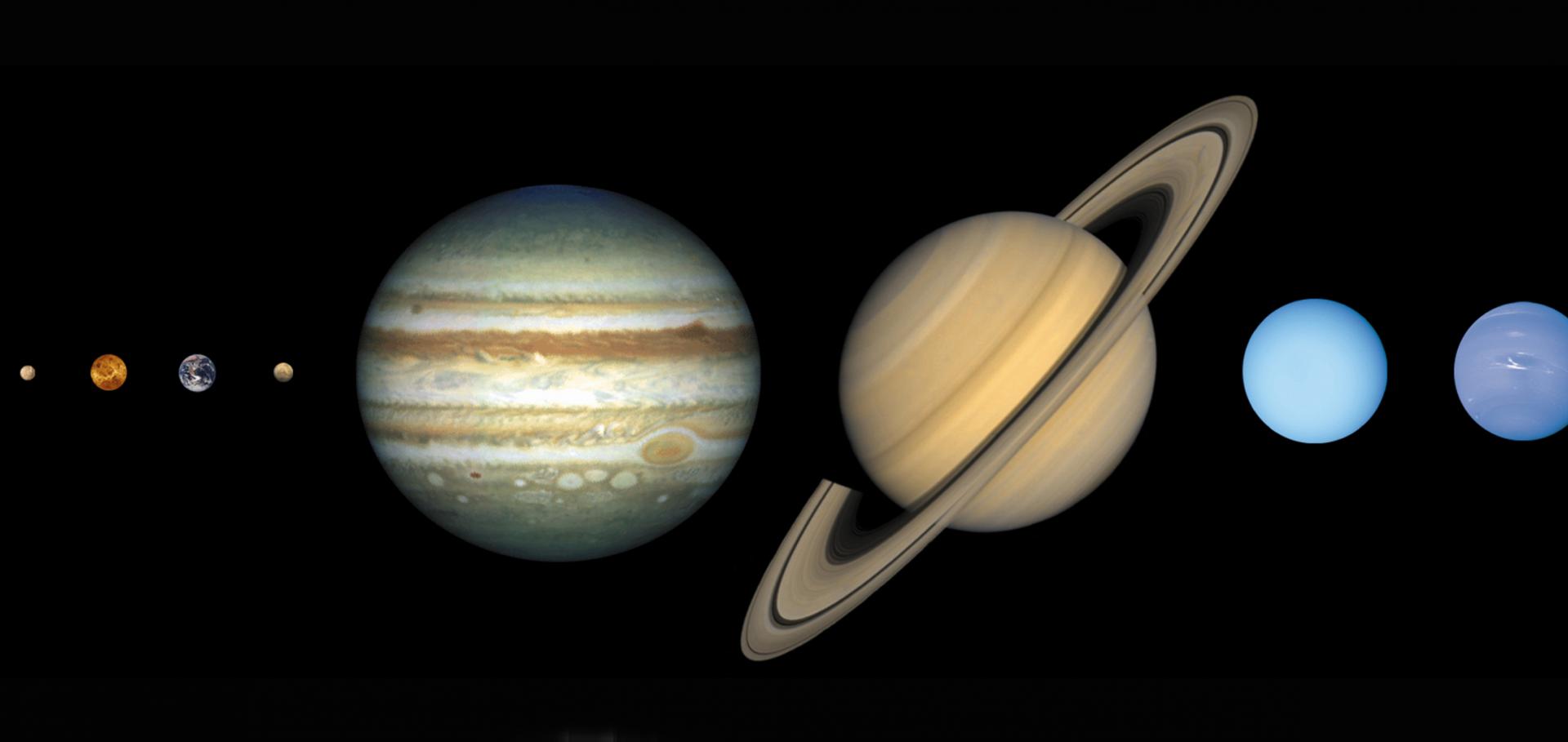
Wave Activity in Jupiter's North Equatorial Belt From Near-Infrared Reflectivity Observations
Geophysical Research Letters 46:3 (2019) 1232-1241
Abstract:
©2019. American Geophysical Union. All Rights Reserved. High spatial resolution images of Jupiter at 1.58–2.28 μm are used to track and characterize a wave pattern observed in 2017 at a planetocentric latitude of 14°N. The wave pattern has a wave number of 18 and spans ∼5° in latitude. One bright crest remains stationary in System III longitude, while the remaining crests move slowly westward. The bright and dark regions of the near-infrared wave pattern are caused by variations in the vertical location of the upper tropospheric haze layer. A comparison with thermal infrared observations shows a correlation with temperature anomalies in the upper troposphere. The results are consistent with a Rossby wave, generated by flow around a stationary vortex.Seasonal evolution of temperatures in Titan's lower stratosphere
(2019)
Abundance measurements of Titan's stratospheric HCN, HC3N, C3H4, and CH3CN from ALMA observations
Icarus 319 (2019) 417-432
Abstract:
© 2018 Elsevier Inc. Previous investigations have employed more than 100 close observations of Titan by the Cassini orbiter to elucidate connections between the production and distribution of Titan's vast, organic-rich chemical inventory and its atmospheric dynamics. However, as Titan transitions into northern summer, the lack of incoming data from the Cassini orbiter presents a potential barrier to the continued study of seasonal changes in Titan's atmosphere. In our previous work (Thelen et al., 2018), we demonstrated that the Atacama Large Millimeter/submillimeter Array (ALMA) is well suited for measurements of Titan's atmosphere in the stratosphere and lower mesosphere (∼100−500 km) through the use of spatially resolved (beam sizes < 1′′) flux calibration observations of Titan. Here, we derive vertical abundance profiles of four of Titan's trace atmospheric species from the same 3 independent spatial regions across Titan's disk during the same epoch (2012–2015): HCN, HC3N, C3H4, and CH3CN. We find that Titan's minor constituents exhibit large latitudinal variations, with enhanced abundances at high latitudes compared to equatorial measurements; this includes CH3CN, which eluded previous detection by Cassini in the stratosphere, and thus spatially resolved abundance measurements were unattainable. Even over the short 3-year period, vertical profiles and integrated emission maps of these molecules allow us to observe temporal changes in Titan's atmospheric circulation during northern spring. Our derived abundance profiles are comparable to contemporary measurements from Cassini infrared observations, and we find additional evidence for subsidence of enriched air onto Titan's south pole during this time period. Continued observations of Titan with ALMA beyond the summer solstice will enable further study of how Titan's atmospheric composition and dynamics respond to seasonal changes.Modeling the angular dependence of emissivity of randomly rough surfaces
Journal of Geophysical Research American Geophysical Union 124:2 (2019) 585-601
Abstract:
Directional emissivity (DE) describes how the emissivity of an isothermal surface changes with viewing angle across thermal infrared wavelengths. The Oxford Space Environment Goniometer (OSEG) is a novel instrument that has been specifically designed to measure the DE of regolith materials derived from planetary surfaces. The DE of Nextel high emissivity black paint was previously measured by the OSEG and showed that the measured emissivity decreases with increasing emission angle, from an emissivity of 0.97 ± 0.01 at 0° emission angle to an emissivity of 0.89± 0.01 at 71° emission angle. The Nextel target measured was isothermal (<0.1 K surface temperature variation) and the observed change in emissivity was due to Fresnel related effects and was not due to non-isothermal effects. Here we apply several increasingly complex modelling techniques to model the measured DE of Nextel black paint. The modelling techniques used here include the Hapke DE model, the Fresnel equations, a multiple slope Fresnel model and a Monte Carlo ray-tracing model. It was found that only the Monte Carlo raytracing model could accurately fit the OSEG measured Nextel data. We show that this is because the Monte Carlo ray-tracing model is the only model that fully accounts for the surface roughness of the Nextel surface by including multiple scattering effects.SEIS: Insight's Seismic Experiment for Internal Structure of Mars
SPACE SCIENCE REVIEWS 215:1 (2019) UNSP 12