Science From the Moon
Supervisors: David DeBoer, Kris Zarbadami, Neil Bowles
Note: students interested in this project should apply to the Atmospheric Oceanic and Planetary Physics programme (not the Astrophysics one). Their website, which also lists other projects in planetary physics can be found here.
We uniquely rely on radio telescopes to understand the bulk of baryonic matter in the early Universe and the evolution of the Universe across early Cosmic times. There are two unavoidable limitations to our exploration of the Cosmos with terrestrial-based radio telescopes:
- the prevalence of interfering radio transmissions from human activity, and
- the Earth’s ionosphere and atmosphere, which are opaque or disruptive to many important radio frequency ranges.
These limitations are overcome by reaching above the atmosphere and beyond Earth, a capability that, to date, has generally been the exclusive purview of expensive, government-funded space-based “Great Observatories”.
However, we are now on the cusp of a new era, with cost-effective and opportunity-laden access to space (including the lunar surface) becoming a reality. Such unfettered access will enable disparate groups to send instruments there, bringing about a transition from Earth-based observatories to space-based and cislunar telescopes (Fig. 1). Although this shift provides exciting opportunities for new science, it will also introduce sources of radio frequency interference (RFI) to the quietest remaining location to which we have access: the lunar Farside. Measurements from a generally RFI-free environment must be taken before the lunar skies have a multitude of orbiters.
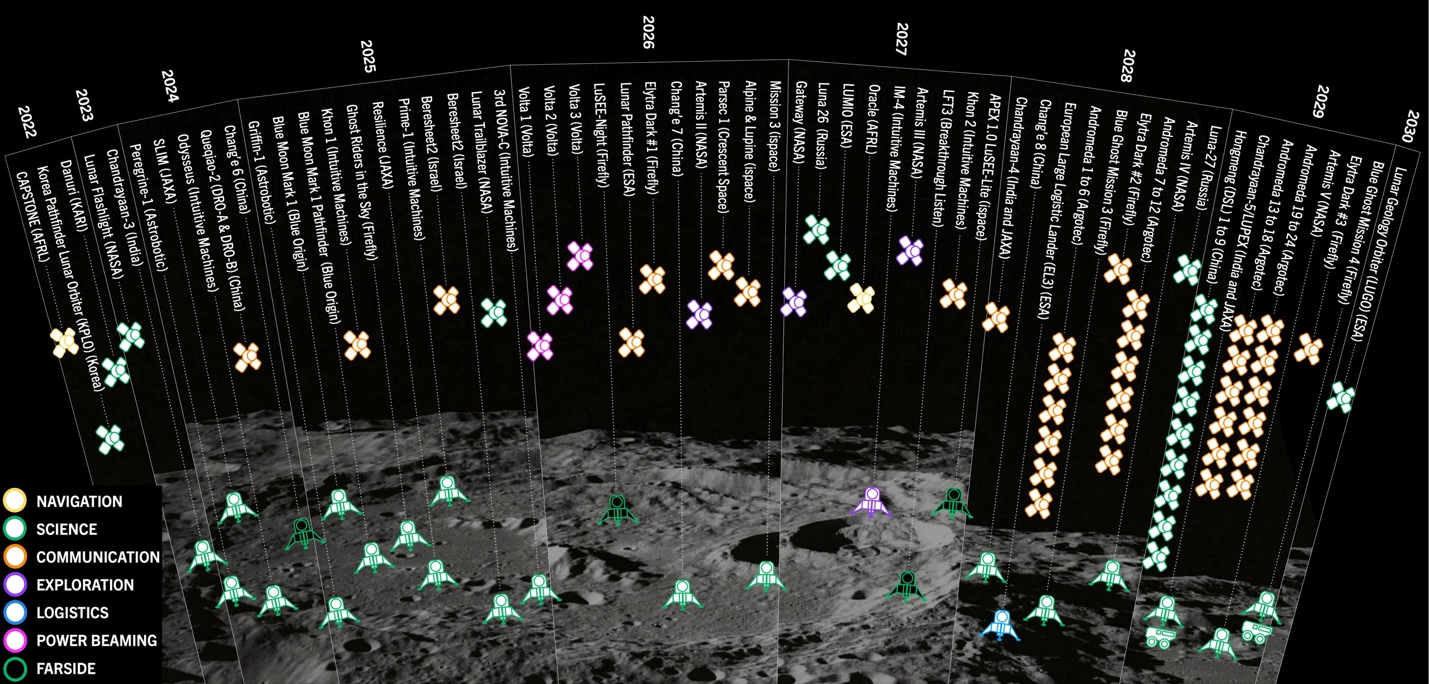
One mission in the planning stage is the Lunar Farside Technosignature and Transients Telescope (LFT3). Being led out of Oxford, this mission would seek to arrive on the lunar farside surface before 2030, to take unique-in-history measurements from 1 - 2700 MHz.. The science case is wide and spans technosignatures, transients, cosmology and lunar studies. This project would explore instrumentation for scientific outcomes for LFT3 and any potential “ride-along” instruments. This could include all mission aspects as well as foundational and preparatory science and instrumentation. The overall goal is science from the Moon, which also includes regolith studies and operations from the Moon. Specifically, this project would work with the LFT3 instrument design and strive to maximize the scientific impact of the data to be collected from the Moon at this unique time.
CMB B-mode Polarization: Commissioning and first science observations with SO:UK
Supervisors: Angela Taylor, Mike Jones, Jamie Leech
The search for the signature of inflation in the polarization of the cosmic microwave background (CMB) is one of the most important topics in observational cosmology. The primordial B-mode (curl-like) polarization of the CMB contains information about the high-energy physics of the very early universe that cannot be obtained any other way. Detecting it will answer questions about the nature of inflation and the fundamental physics of the Big Bang.
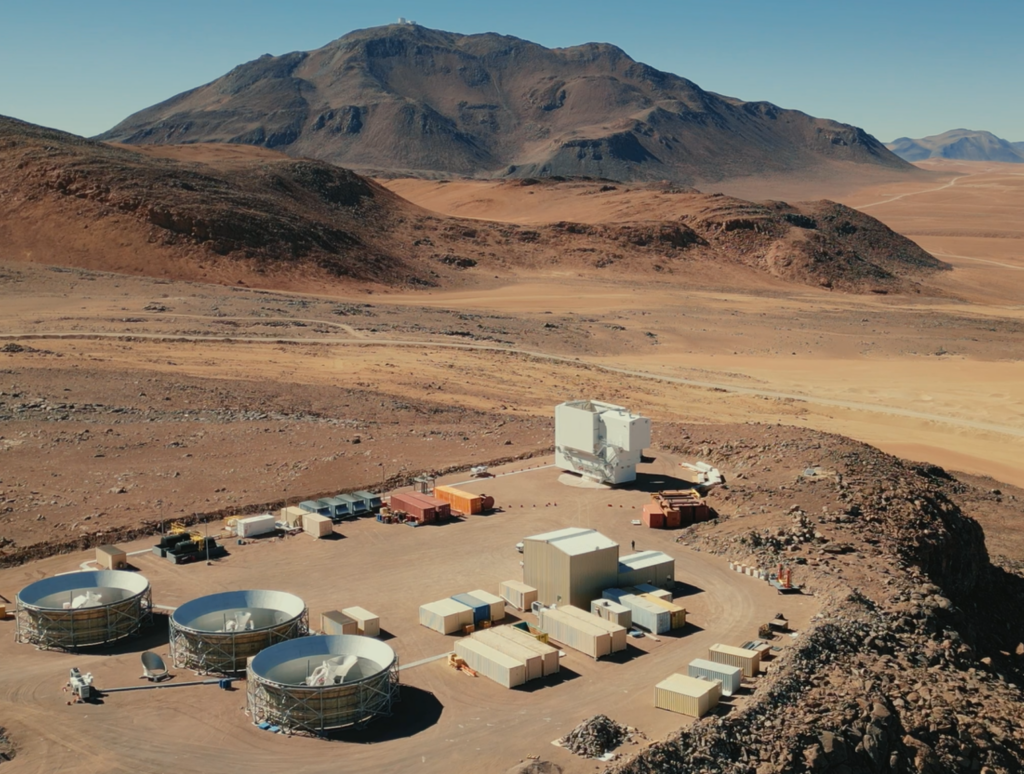
A major international effort is underway to detect the B-modes and determine other cosmological parameters, such as the mass of the neutrino. As part of this, the UK has joined the Simons Observatory (https://simonsobservatory.org), an international collaboration to detect the CMB B-mode polarization from a high-altitude site in Chile. We are building two Small-Aperture Telescopes (SATs) to join the three SATs already built in the US and operating on site, and one being built in Japan. There is also a Large-Aperture Telescope (LAT) to provide higher resolution data essential for removing the effects of gravitational lensing from the CMB. The UK SATs are being deployed in late 2026, with commissioning and then first science observations beginning in 2027.
This DPhil offers the opportunity to join the experiment at a particularly exciting stage, as the UK telescopes begin commissioning and make their first scientific observations. We are looking for a student to take part in the commissioning of the UK SATs, travelling to the site and developing the calibration and data analysis procedures, and taking part in the operations and science exploitation. Oxford has a unique role in the project - we are currently analysing data from the existing SO telescopes and have designed and built the data readout system for the UK telescopes. The team therefore have a unique perspective on the data flow from raw detectors to final science results. We have also been leading an independent project to characterize the Galactic foreground signals that will tend to mask any primordial signal, and there will be the opportunity for the student to work on these data sets as well. The student will be joining a large and well-organised international collaboration, as well as the established team in Oxford and will have the opportunity to make significant individual contributions to this major project.