


Fast Radio Bursts and Long-Period radio Transients
Supervisors: Kaustubh Rajwade, Aris Karastergiou
We are offering a project to study two exciting types of astrophysical phenomena with potential close connections to Neutron star Astrophysics. Fast Radio Bursts (FRBs) are millisecond flashes from across the Universe, probing extreme physical environments and otherwise difficult-to-detect matter between galaxies. Long-period radio transients (LPTs), which vary or pulse over minutes to hours, represent a newly emerging population. The majority of discovered LPTs are attributed to magnetically interacting white-dwarf binaries. Legacy datasets may also include new but undiscovered LPTs. Our understanding of the physics of neutron-star magnetospheres is key to understanding both of these classes of objects. The highly variable radio emission from radio pulsars provides a framework of interpretation of the magnetic-field structure, particle acceleration, variability timescales and energetics, between neutron stars, LPTs, and FRBs. The student will explore how the diversity of coherent radio transients can be understood within a unified picture of compact-object magnetospheres and propagation through the intervening interstellar medium.
The project will involve searching for new LPTs in images from the LOFAR telescope, long-term monitoring of highly energetic neutron stars with the Lovell/Murriyang telescopes, and investigating a vast dataset on a large sample of neutron stars taken with the MeerKAT telescope.
Type Ia supernova cosmology with the Rubin Observatory’s Legacy Survey of Space and Time, the ATLAS SN Ia sample and the 4MOST spectrograph
Supervisors: Maria Vincenzi, Stephen Smartt, Matt Jarvis
It’s an exciting time for cosmology. Over the past two years, numerous independent cosmological studies have been published using very different techniques (Type Ia supernovae, baryon acoustic oscillations and the cosmic microwave background). Remarkably, taken together, these findings seem to point to the same conclusion: the properties of dark energy are more complex than previously understood.
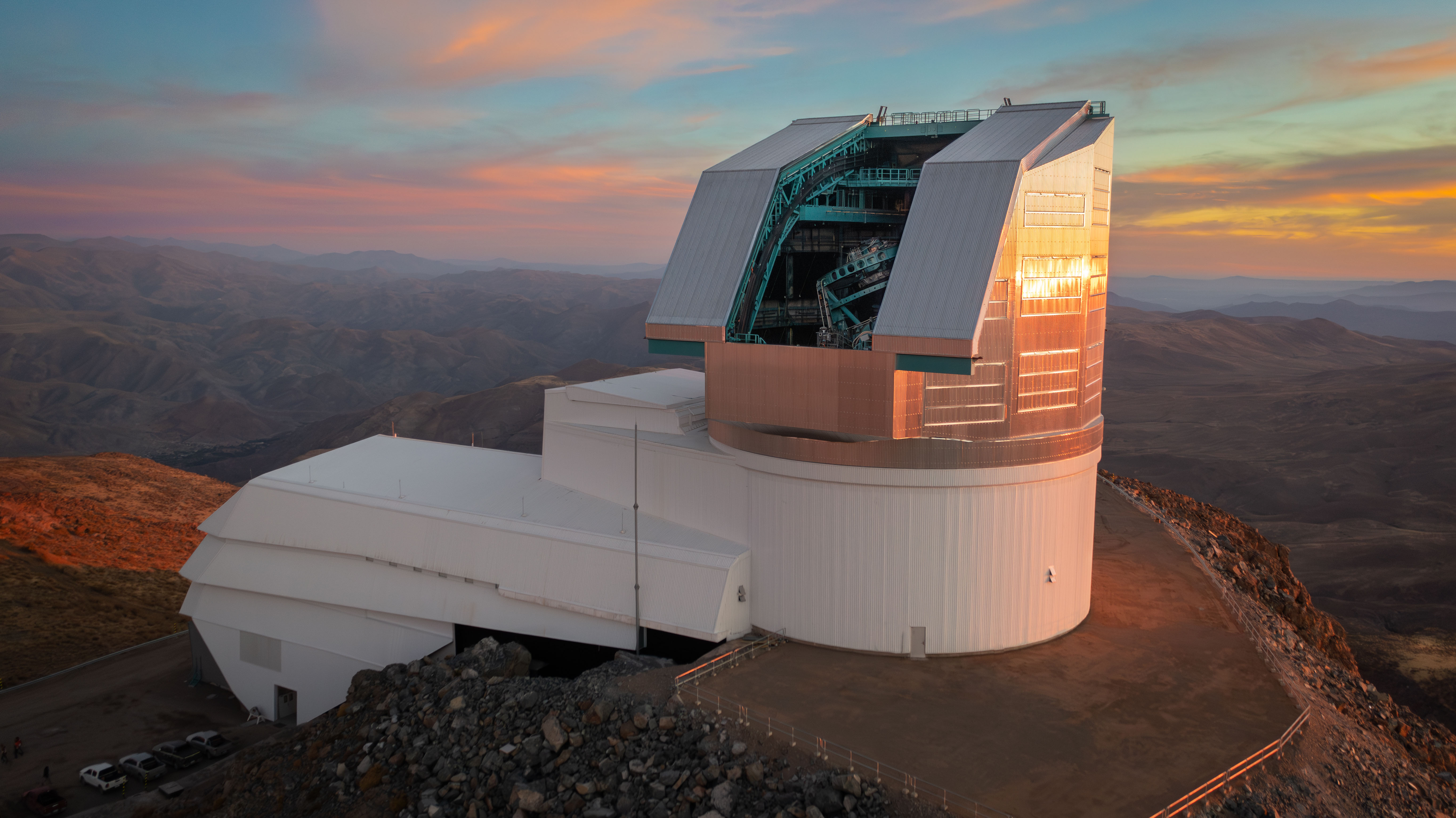
Type Ia supernovae (SNe Ia) are among the most well-established tools in modern cosmology, with dozens of successful cosmological experiments conducted over the past three decades. After 15 years of design and construction, the Vera C. Rubin Observatory’s Legacy Survey of Space and Time (LSST) began in summer 2026. LSST is expected to transform the field: in its first year of operations alone, it will discover more SNe Ia than have been observed since the field began.
Our team is heavily involved in the analysis of the first LSST transient data. We work on a wide range of projects, both observation-oriented and simulation-oriented. They revolve around developing and testing transient discovery and classification pipelines, optimising LSST spectroscopic follow-up programmes, studying the host galaxies where these SNe explode, and designing new approaches to SN cosmology to minimise sources of systematic biases.
With other UK scientists, we are also involved in the TiDES spectroscopic follow-up programme. It will use the 4MOST spectrograph to follow up tens of thousands of LSST transients and their host galaxies, providing crucial insights into their properties and redshifts.
Besides LSST, which will mainly discover high-redshift (z > 0.1) SNe Ia, we are leading the cosmological analysis of the ATLAS SN Ia sample, the largest low-redshift (z < 0.1) SN Ia sample ever compiled for cosmology.
The DPhil project will focus on preparing for future SN Ia cosmological measurements using LSST, TiDES and ATLAS data, with an emphasis on addressing the key sources of uncertainty that affect these measurements.
Dynamics of stars and black holes in galactic nuclei
Supervisors: Bence Kocsis
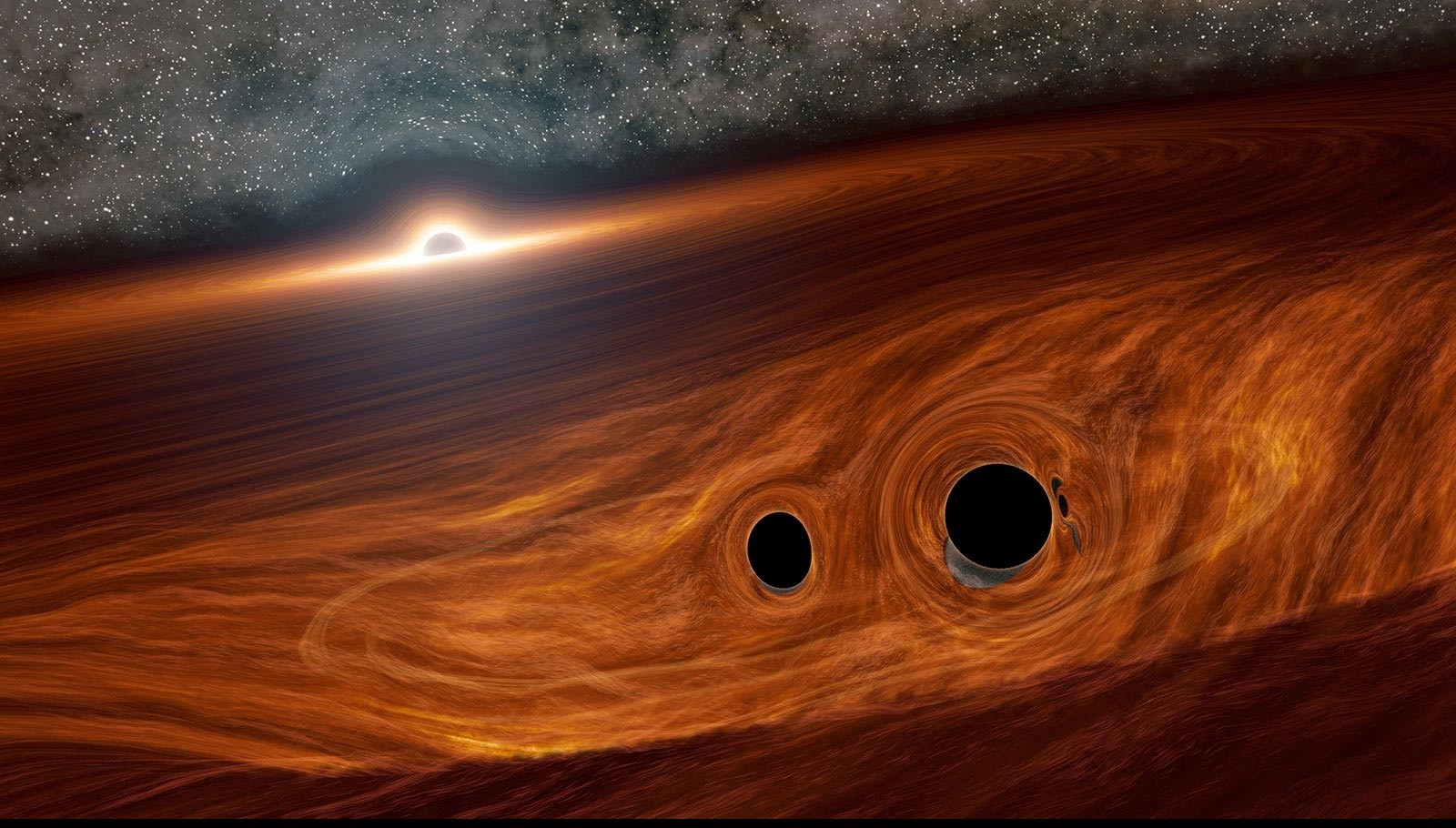
Galactic nuclei are among the most extreme environments in the Universe. A supermassive black hole is surrounded by a dense cluster of stars and stellar-mass black holes, and, when active, by a luminous gaseous accretion disc. The gravitational interactions between these components drive complex dynamics and may produce black hole mergers, tidal disruption events, and distinctive electromagnetic signals. Understanding these processes is essential for interpreting observations of the Galactic centre, active galactic nuclei (AGN), and gravitational wave sources.
In this project, the student will work with Prof. Bence Kocsis to develop theoretical and numerical models of the dynamics and observational signatures of galactic nuclei. Several complementary research directions are possible. One is to model the coupled evolution of an AGN disc and the surrounding nuclear star cluster: stellar objects interact with the gas, some become embedded in the disc, and black holes can form binaries that eventually merge. Another is to investigate gravitational lensing by supermassive black holes and their binaries, including how the inhomogeneous stellar environment modifies the resulting magnification patterns and light curves. A third direction is to study how a massive perturber, such as an intermediate-mass black hole, changes the structure and long-term evolution of nuclear star clusters and stellar discs.
The project will combine analytical methods, stellar dynamics, statistical physics, and computational simulations. The precise research questions will be selected together with the student, allowing the project to develop according to their interests and the most promising new results.
Links to further reading
- Tagawa, Haiman & Kocsis (2026), ApJ, 1007, 67 — Properties of black hole mergers in disks of active galactic nuclei
- Rowan, Whitehead & Kocsis (2024) — Black Hole Merger Rates in AGN: contribution from gas-captured binaries
- Wang, Zumalacárregui & Kocsis (2026), PRL, 136, 061403 — Black Holes as Telescopes: Discovering Supermassive Binaries through Quasiperiodic Lensed Starlight
- Panamarev, Zou & Kocsis (2026), MNRAS — Stellar discs and intermediate-mass black holes in galactic nuclei I
- Panamarev & Kocsis (2026) — Stellar discs and intermediate-mass black holes in galactic nuclei II