

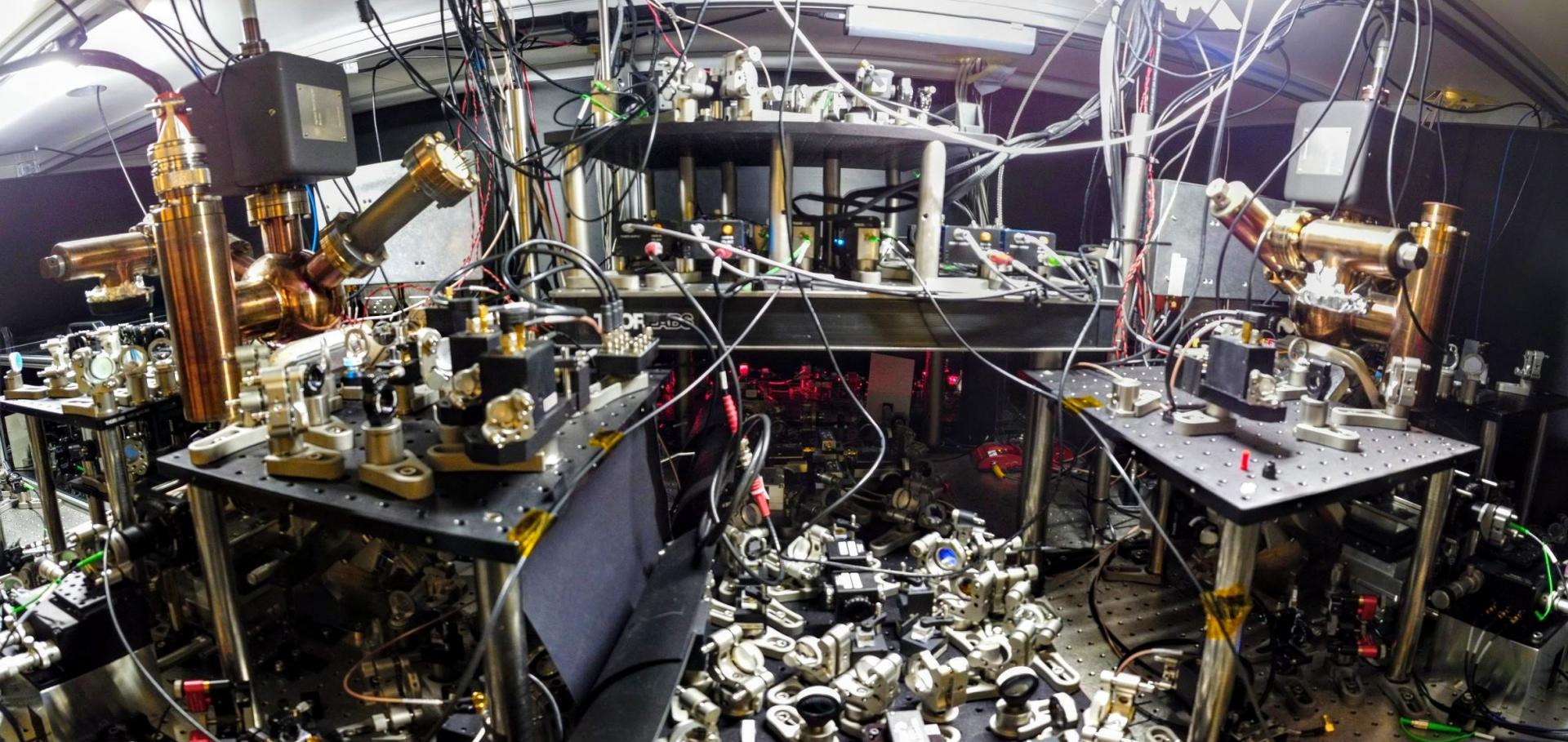

Multipartite Mixed-Species Entanglement over a Quantum Network
(2025)
Experimental quantum advantage in the odd-cycle game
Physical Review Letters American Physical Society 134 (2025) 070201
Abstract:
We report the first experimental demonstration of the odd-cycle game. We entangle two atoms separated by ∼ 2 m and the players use them to win the odd-cycle game with a probability ∼ 26σ above that allowed by the best classical strategy. The experiment implements the optimal quantum strategy, is free of loopholes, and achieves 97.8(3) % of the theoretical limit to the quantum winning probability. We perform the associated Bell test and measure a nonlocal content of 0.54(2) – the largest value for physically separate devices, free of the detection loophole, ever observed.
Distributed quantum computing across an optical network link
Nature Nature Research 638:8050 (2025) 383-388
Abstract:
Distributed quantum computing (DQC) combines the computing power of multiple networked quantum processing modules, ideally enabling the execution of large quantum circuits without compromising performance or qubit connectivity1, 2. Photonic networks are well suited as a versatile and reconfigurable interconnect layer for DQC; remote entanglement shared between matter qubits across the network enables all-to-all logical connectivity through quantum gate teleportation (QGT)3, 4. For a scalable DQC architecture, the QGT implementation must be deterministic and repeatable; until now, no demonstration has satisfied these requirements. Here we experimentally demonstrate the distribution of quantum computations between two photonically interconnected trapped-ion modules. The modules, separated by about two metres, each contain dedicated network and circuit qubits. By using heralded remote entanglement between the network qubits, we deterministically teleport a controlled-Z (CZ) gate between two circuit qubits in separate modules, achieving 86% fidelity. We then execute Grover’s search algorithm5—to our knowledge, the first implementation of a distributed quantum algorithm comprising several non-local two-qubit gates—and measure a 71% success rate. Furthermore, we implement distributed iSWAP and SWAP circuits, compiled with two and three instances of QGT, respectively, demonstrating the ability to distribute arbitrary two-qubit operations6. As photons can be interfaced with a variety of systems, the versatile DQC architecture demonstrated here provides a viable pathway towards large-scale quantum computing for a range of physical platforms.Towards quantum computing Feynman diagrams in hybrid qubit-oscillator devices
(2024)
Generating arbitrary superpositions of nonclassical quantum harmonic oscillator states
(2024)