Home
Department Of Physics text logo
  • Research
    • Our research
    • Our research groups
    • Our research in action
    • Research funding support
    • Summer internships for undergraduates
  • Study
    • Undergraduates
    • Postgraduates
  • Engage
    • For alumni
    • For business
    • For schools
    • For the public
  • Support
Menu
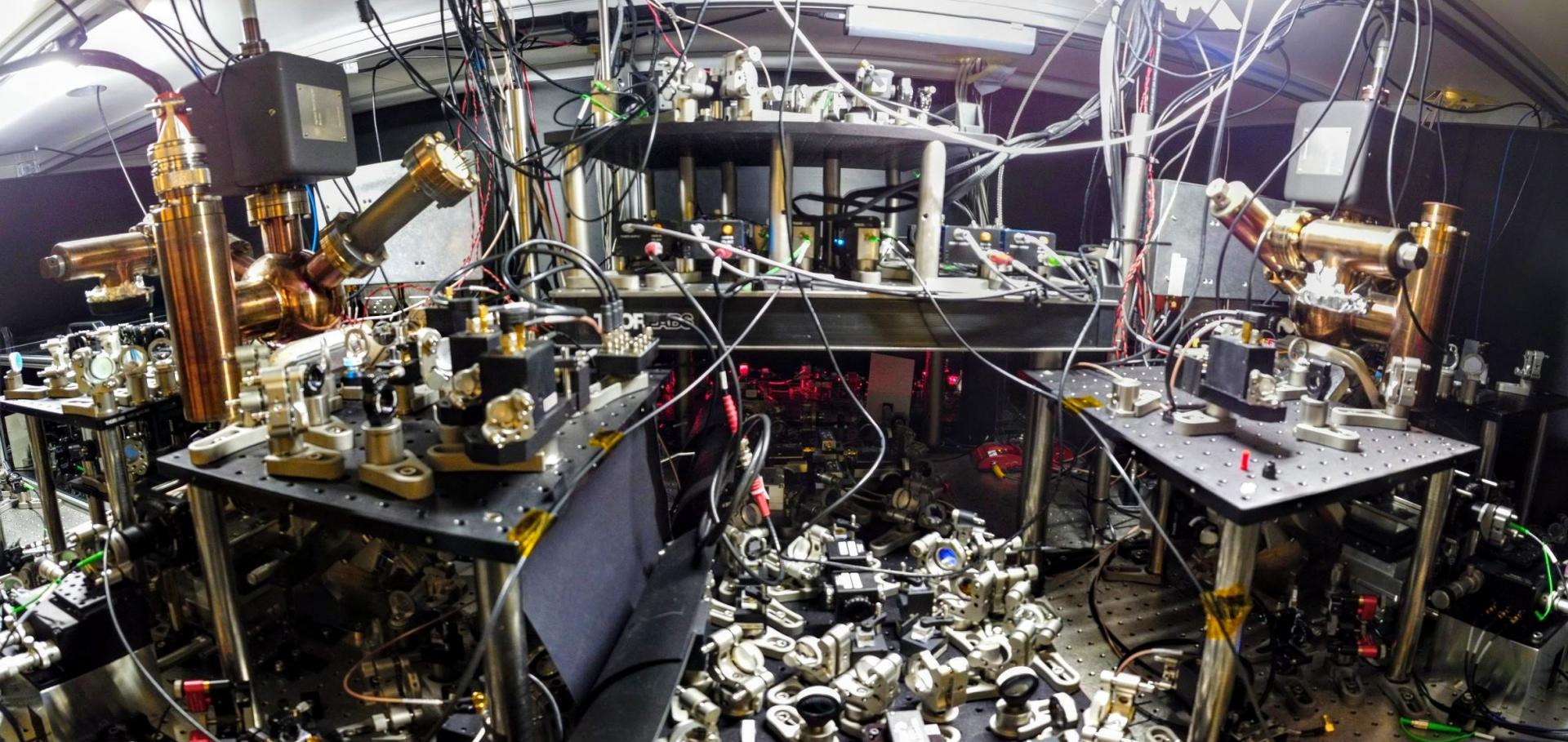
Quantum Network setup

Two vacuum chambers with segmented ion traps are used to create remote entanglement between atomic ions

Dr. Gabriel Araneda Machuca

Senior Researcher

Research theme

  • Quantum information and computation

Sub department

  • Atomic and Laser Physics

Research groups

  • Ion trap quantum computing
gabriel.aranedamachuca@physics.ox.ac.uk
Clarendon Laboratory
  • About
  • Publications

Experimental quantum key distribution certified by Bell's theorem

Nature Springer Nature 607:7920 (2022) 682-686

Authors:

Dp Nadlinger, P Drmota, Bc Nichol, G Araneda, D Main, R Srinivas, Dm Lucas, Cj Ballance, K Ivanov, Ey-Z Tan, P Sekatski, Rl Urbanke, R Renner, N Sangouard, J-D Bancal

Abstract:

Cryptographic key exchange protocols traditionally rely on computational conjectures such as the hardness of prime factorization<sup>1</sup> to provide security against eavesdropping attacks. Remarkably, quantum key distribution protocols such as the Bennett-Brassard scheme<sup>2</sup> provide information-theoretic security against such attacks, a much stronger form of security unreachable by classical means. However, quantum protocols realized so far are subject to a new class of attacks exploiting a mismatch between the quantum states or measurements implemented and their theoretical modelling, as demonstrated in numerous experiments<sup>3-6</sup>. Here we present the experimental realization of a complete quantum key distribution protocol immune to these vulnerabilities, following Ekert's pioneering proposal<sup>7</sup> to use entanglement to bound an adversary's information from Bell's theorem<sup>8</sup>. By combining theoretical developments with an improved optical fibre link generating entanglement between two trapped-ion qubits, we obtain 95,628 key bits with device-independent security<sup>9-12</sup> from 1.5 million Bell pairs created during eight hours of run time. We take steps to ensure that information on the measurement results is inaccessible to an eavesdropper. These measurements are performed without space-like separation. Our result shows that provably secure cryptography under general assumptions is possible with real-world devices, and paves the way for further quantum information applications based on the device-independence principle.
More details from the publisher
Details from ORA
More details
More details

Position Measurement of a Levitated Nanoparticle via Interference with Its Mirror Image

Physical Review Letters American Physical Society (APS) 129:1 (2022) 013601

Authors:

Lorenzo Dania, Katharina Heidegger, Dmitry S Bykov, Giovanni Cerchiari, Gabriel Araneda, Tracy E Northup
More details from the publisher
More details
More details

A quantum network of entangled optical atomic clocks

(2021)

Authors:

BC Nichol, R Srinivas, DP Nadlinger, P Drmota, D Main, G Araneda, CJ Ballance, DM Lucas
More details from the publisher
Details from ArXiV

Experimental quantum key distribution certified by Bell's theorem

(2021)

Authors:

DP Nadlinger, P Drmota, BC Nichol, G Araneda, D Main, R Srinivas, DM Lucas, CJ Ballance, K Ivanov, EY-Z Tan, P Sekatski, RL Urbanke, R Renner, N Sangouard, J-D Bancal
More details from the publisher
Details from ArXiV

Measuring ion oscillations at the quantum level with fluorescence light

Physical Review Letters American Physical Society 127:6 (2021) 63603

Authors:

G Cerchiari, Gabriel Araneda Machuca, L Podhora, L Slodička, Y Colombe, R Blatt

Abstract:

We demonstrate an optical method for detecting the mechanical oscillations of an atom with single-phonon sensitivity. The measurement signal results from the interference between the light scattered by a trapped atomic ion and that of its mirror image. We detect the oscillations of the atom in the Doppler cooling limit and reconstruct average trajectories in phase space. We demonstrate single-phonon sensitivity near the ground state of motion after electronically induced transparency cooling. These results could be applied for motion detection of other light scatterers of fundamental interest, such as trapped nanoparticles.
More details from the publisher
Details from ORA
More details
More details

Pagination

  • First page First
  • Previous page Prev
  • Page 1
  • Page 2
  • Current page 3
  • Page 4
  • Page 5
  • Page 6
  • Next page Next
  • Last page Last

Footer Menu

  • Contact us
  • Giving to the Dept of Physics
  • Work with us
  • Media

User account menu

  • Log in

Follow us

FIND US

Clarendon Laboratory,

Parks Road,

Oxford,

OX1 3PU

CONTACT US

Tel: +44(0)1865272200

University of Oxfrod logo Department Of Physics text logo
IOP Juno Champion logo Athena Swan Silver Award logo

© University of Oxford - Department of Physics

Cookies | Privacy policy | Accessibility statement

Built by: Versantus

  • Home
  • Research
  • Study
  • Engage
  • Our people
  • News & Comment
  • Events
  • Our facilities & services
  • About us
  • Giving to Physics
  • Current students
  • Staff intranet