

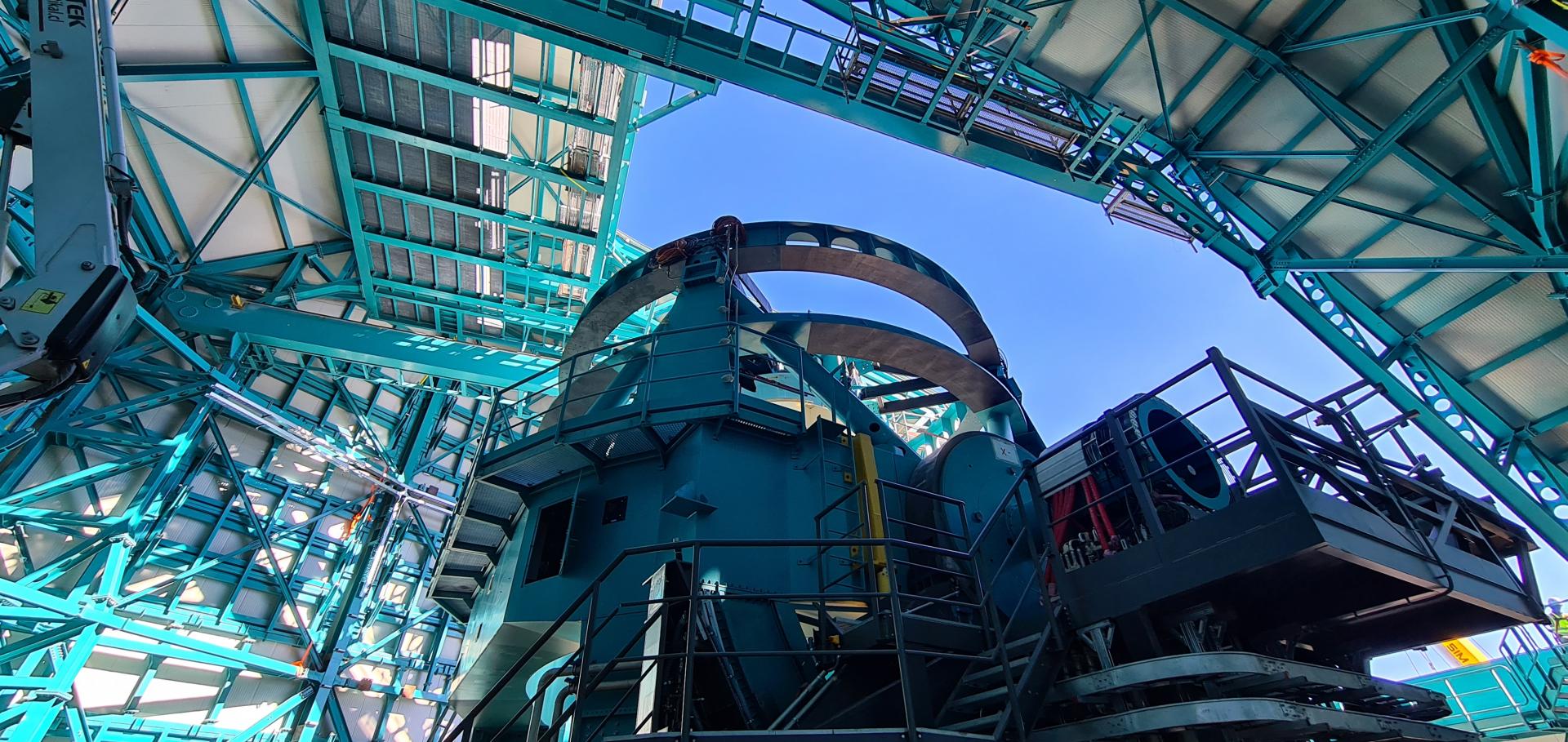

NSF-DOE Vera C. Rubin Observatory Observations of Interstellar Comet 3I/ATLAS (C/2025 N1)
Abstract:
We report on the observation and measurement of astrometry, photometry, morphology, and activity of the interstellar object 3I/ATLAS, also designated C/2025 N1 (ATLAS) with the NSF-DOE Vera C. Rubin Observatory. Comet 3I/ATLAS, the third known interstellar object, was discovered on UT 2025 July 1. Rubin Observatory had coincidentally collected images of the object’s region of the sky during routine commissioning. Facilitated by Rubin’s high resolution and large aperture, we successfully recovered object detections from Rubin observations spanning UT 2025 June 21 (10 days before discovery, when 3I/ATLAS was 4.5 au from the Sun) through the date of discovery, and we acquired additional images through UT 2025 July 20 as part of commissioning. We measure on-sky locations of 3I/ATLAS in Rubin ugrizy bands, with a typical precision of ∼70 mas, and briefly describe the reason this is coarser than our measured static source astrometric precision of ∼3 mas in Rubin images. We measure grizy magnitudes of 3I/ATLAS photometry at ∼0.01 mag precision, detecting no short-term photometric variability above 0.01 mag. We derive an estimated near-nucleus dust-to-nucleus scattering cross-sectional ratio of η ≳ 13 on UT 2025 July 2 based on Rubin photometry and an upper limit nucleus size computed from Hubble Space Telescope observations. We find Rubin colors of g − r = (0.657 ± 0.013) mag, r − i = (0.235 ± 0.018) mag, i − z = (0.147 ± 0.042) mag, and z − y = (0.047 ± 0.052) mag. These data represent the earliest observations of this object by a large (≳8 m class) telescope and illustrate the type of measurements (and discoveries) Rubin’s Legacy Survey of Space and Time will provide after it begins in early 2026.Operation of a Modular 3D-Pixelated Liquid Argon Time-Projection Chamber in a Neutrino Beam
Abstract:
The 2x2 Demonstrator, a prototype for the Deep Underground Neutrino Experiment (DUNE) liquid argon (LAr) Near Detector, was exposed to the Neutrinos from the Main Injector (NuMI) neutrino beam at Fermi National Accelerator Laboratory (Fermilab). This detector is a prototype of a new modular design for a liquid argon time-projection chamber (LArTPC), comprising a two-by-two array of four modules, each further segmented into two optically isolated LArTPCs. The 2x2 Demonstrator features a number of pioneering technologies, including a low-profile resistive field shell to establish drift fields, native 3D ionization pixelated imaging, and a high-coverage dielectric light readout system. The 2.4-tonne active mass detector is flanked upstream and downstream by supplemental solid-scintillator tracking planes, repurposed from the MINERvA experiment, which track ionizing particles exiting the argon volume. The antineutrino beam data collected by the detector over a 4.5 day period in 2024 include over 30,000 neutrino interactions in the LAr active volume—the first neutrino interactions reported by a DUNE detector prototype. During its physics-quality run, the 2x2 Demonstrator operated at a nominal drift field of 500 V/cm and maintained good LAr purity, with a stable electron lifetime of approximately 1.25 ms. This paper describes the detector and supporting systems, summarizes the installation and commissioning, and presents the initial validation of collected NuMI beam and off-beam self-triggers. In addition, it highlights observed interactions in the detector volume, including candidate muon antineutrino events.Data-driven core-collapse supernova multilateration with first neutrino events
Abstract:
A Galactic core-collapse supernova (CCSN) is likely to be observed in neutrino detectors around the world minutes to hours before the electromagnetic radiation arrives. The SuperNova Early Warning System (SNEWS2.0) network of neutrino and dark matter detectors aims to use the relative arrival times of the neutrinos at the different experiments to point back to the supernova so as to facilitate follow-up observation. One of the simplest methods to estimate the CCSN direction is to use the first neutrino events detected through the inverse decay (IBD) process, . We will consider neutrino detectors sensitive to IBD interactions with low backgrounds. The difference in signal arrival times between a large and a small detector will be biased, however, with the first event at the smaller detector, on average, arriving later than that at the larger detector. This bias can be mitigated by using these first events in a data-driven approach without recourse to simulations or models. The resulting method requires, at minimum, only the times of the first events at most detectors, along with a longer time series of events from one larger detector to act as a reference lightcurve. In this article, we demonstrate this method and its uncertainty estimate using pairs of detectors of different sizes and with different supernova distances. Finally, we use this method to calculate probability skymaps using four detectors currently in operation, Super-Kamiokande, Jiangmen Underground Neutrino Observatory (JUNO), Large Volume Detector (LVD), and , and show that the calculated probabilities yield appropriate confidence intervals for all supernova directions. The area of the 68% confidence interval varies by distance and direction, but is expected to be a few thousand square degrees. The resulting skymaps should be useful for the multimessenger community as a rapid, initial pointing to follow up on the SNEWS2.0 Galactic CCSN neutrino alert.Data-driven core collapse supernova multilateration with first neutrino events
Abstract:
A Galactic core-collapse supernova (CCSN) is likely to be observed in neutrino detectors around the world minutes to hours before the electromagnetic radiation arrives. The SNEWS2.0 network of neutrino and dark matter detectors aims to use the relative arrival times of the neutrinos at the different experiments to point back to the supernova so as to facilitate follow-up observation. One of the simplest methods to estimate the CCSN direction is to use the first neutrino events detected through the inverse beta decay (IBD) process, v̄ep → e+n. We will consider neutrino detectors sensitive to IBD interactions with low backgrounds. The difference in signal arrival times between a large and a small detector will be biased, however, with the first event at the smaller detector, on average, arriving later than that at the larger detector. This bias can be mitigated by using these first events in a data-driven approach without recourse to simulations or models. The resulting method requires, at minimum, only the times of the first events at most detectors, along with a longer time series of events from one larger detector to act as a reference lightcurve. In this article, we demonstrate this method and its uncertainty estimate using pairs of detectors of different sizes and with different supernova distances. Finally, we use this method to calculate probability skymaps using four detectors currently in operation (Super-Kamiokande, JUNO, LVD, and SNO+) and show that the calculated probabilities yield appropriate confidence intervals for all supernova directions. The area of the 68\% confidence interval varies by distance and direction, but is expected to be a few thousand square degrees. The resulting skymaps should be useful for the multi-messenger community as a rapid, initial pointing to follow up on the SNEWS2.0 Galactic CCSN neutrino alert.