Home
Department Of Physics text logo
  • Research
    • Our research
    • Our research groups
    • Our research in action
    • Research funding support
    • Summer internships for undergraduates
  • Study
    • Undergraduates
    • Postgraduates
  • Engage
    • For alumni
    • For business
    • For schools
    • For the public
Menu
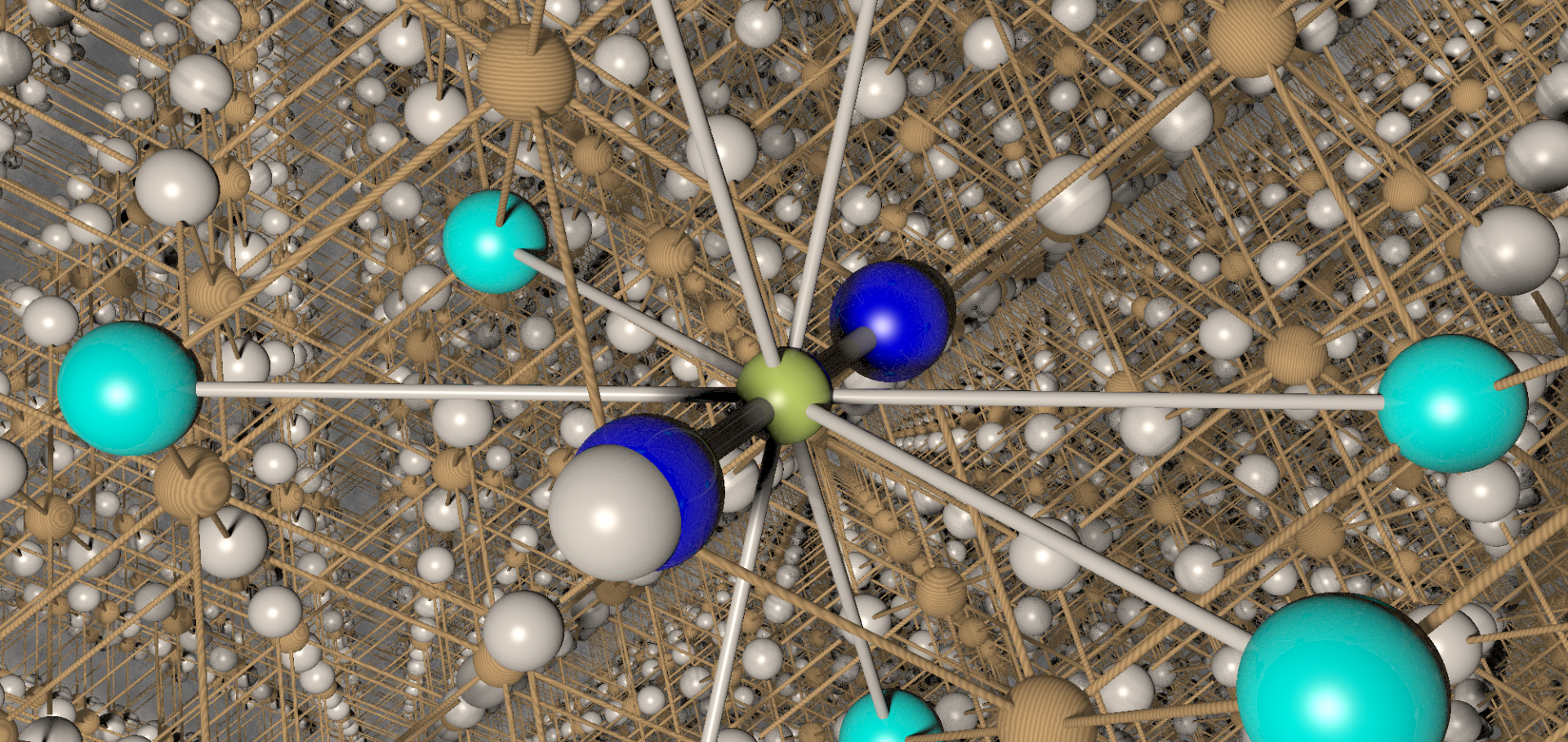
Crystal structure inside calcium fluoride with an implanted muon
Credit: SJB

Professor Stephen Blundell

Professor of Physics

Research theme

  • Quantum materials

Sub department

  • Condensed Matter Physics

Research groups

  • Muons and magnets
Stephen.Blundell@physics.ox.ac.uk
Telephone: 01865 (2)72347
Clarendon Laboratory, room 108
  • About
  • Books
  • Teaching
  • Research
  • Publications

Magnetostriction-Driven Muon Localization in an Antiferromagnetic Oxide

(2023)

Authors:

Pietro Bonfà, Ifeanyi John Onuorah, Franz Lang, Iurii Timrov, Lorenzo Monacelli, Chennan Wang, Xiao Sun, Oleg Petracic, Giovanni Pizzi, Nicola Marzari, Stephen J Blundell, Roberto De Renzi
More details from the publisher

Beyond single tetrahedron physics of the breathing pyrochlore compound Ba3Yb2Zn5O11

Physical Review B American Physical Society 107:14 (2023) L140408

Authors:

R Bag, Se Dissanayake, H Yan, Z Shi, D Graf, Es Choi, C Marjerrison, F Lang, T Lancaster, Y Qiu, W Chen, SJ Blundell, Ah Nevidomskyy, S Haravifard

Abstract:

Recently, a new class of quantum magnets, the so-called breathing pyrochlore spin systems, have attracted much attention due to their potential to host exotic emergent phenomena. Here, we present magnetometry, heat capacity, thermal conductivity, muon-spin relaxation, and polarized inelastic neutron scattering measurements performed on high-quality single crystal samples of the breathing pyrochlore compound Ba3Yb2Zn5O11. We interpret these results using a simplified toy model and provide insight into the low-energy physics of this system beyond the single tetrahedron physics proposed previously.
More details from the publisher
Details from ORA
More details

Low-temperature magnetism of KAgF3

Physical Review B American Physical Society 107:14 (2023) 144422

Authors:

Jm Wilkinson, Sj Blundell, S Biesenkamp, M Braden, Tc Hansen, K Koteras, W Grochala, P Barone, J Lorenzana, Z Mazej, G Tavčar

Abstract:

KAgF3 is a quasi-one-dimensional quantum antiferromagnet hosting a series of intriguing structural and magnetic transitions. Here we use powder neutron diffraction, μSR spectroscopy, and density functional theory calculations to elucidate the low-temperature magnetic phases. Below TN1 = 29 K we find that the material orders as an A-type antiferromagnet with an ordered moment of 0.52 μ B . Both neutrons and muons provide evidence for an intermediate phase at temperatures TN1 < T < TN2 with TN2 ≈ 66 K from a previous magnetometry study. However, the evidence is at the limit of detection and its nature remains an open problem.

More details from the publisher
Details from ORA
More details

Extending WiMDA for the data analysis of µ−SR experiments

Journal of Physics: Conference Series IOP Publishing 2462:1 (2023)

Authors:

George JW Gill, FL Pratt, Stephen J Blundell

Abstract:

A software extension to the Windows Muon Data Analysis software package WiMDA has been developed for the analysis of µ−SR data, which has been dubbed Negative-WiMDA. In designing Negative-WiMDA, some key features were considered: it should be easily accessed from the main analysis window of WiMDA; it should be able to account for multiple elements in a sample; it should be able to subtract signals treated as unwanted background, allowing the user to focus on a particular element of interest; it should be able to handle transverse-field (TF) data, and perhaps most importantly, it should be intuitive to use. The main features of Negative-WiMDA are presented here with a few examples of their use.
More details from the publisher
Details from ORA
More details

Identifying muon sites "by eye" in KPF6 and KBF4

Journal of Physics: Conference Series IOP Publishing 2462:1 (2023)

Authors:

John M Wilkinson, Franz Lang, Pj Baker, Sp Cottrell, Stephen J Blundell

Abstract:

Molecular magnets are one of the key research themes of µSR, but locating the muon stopping site in these compounds using density functional theory is often very challenging as their unit cells tend to contain a very large number of atoms. Nevertheless, many molecular magnets contain the [PF6]− and [BF4]− molecular ions, which, due to their fluorine nuclei, produce a distinctive µSR spectrum, which can give information about the muon stopping site. This paper details the calculation of the muon sites in the much simpler materials KPF6 and KBF4, providing insights which can be applied to situations where these molecular ions are found in complicated molecular magnets.
More details from the publisher
Details from ORA
More details

Pagination

  • First page First
  • Previous page Prev
  • …
  • Page 4
  • Page 5
  • Page 6
  • Page 7
  • Current page 8
  • Page 9
  • Page 10
  • Page 11
  • Page 12
  • …
  • Next page Next
  • Last page Last

Footer Menu

  • Contact us
  • Giving to the Dept of Physics
  • Work with us
  • Media

User account menu

  • Log in

Follow us

FIND US

Clarendon Laboratory,

Parks Road,

Oxford,

OX1 3PU

CONTACT US

Tel: +44(0)1865272200

University of Oxfrod logo Department Of Physics text logo
IOP Juno Champion logo Athena Swan Silver Award logo

© University of Oxford - Department of Physics

Cookies | Privacy policy | Accessibility statement

Built by: Versantus

  • Home
  • Research
  • Study
  • Engage
  • Our people
  • News & Comment
  • Events
  • Our facilities & services
  • About us
  • Giving to Physics
  • Current students
  • Staff intranet