

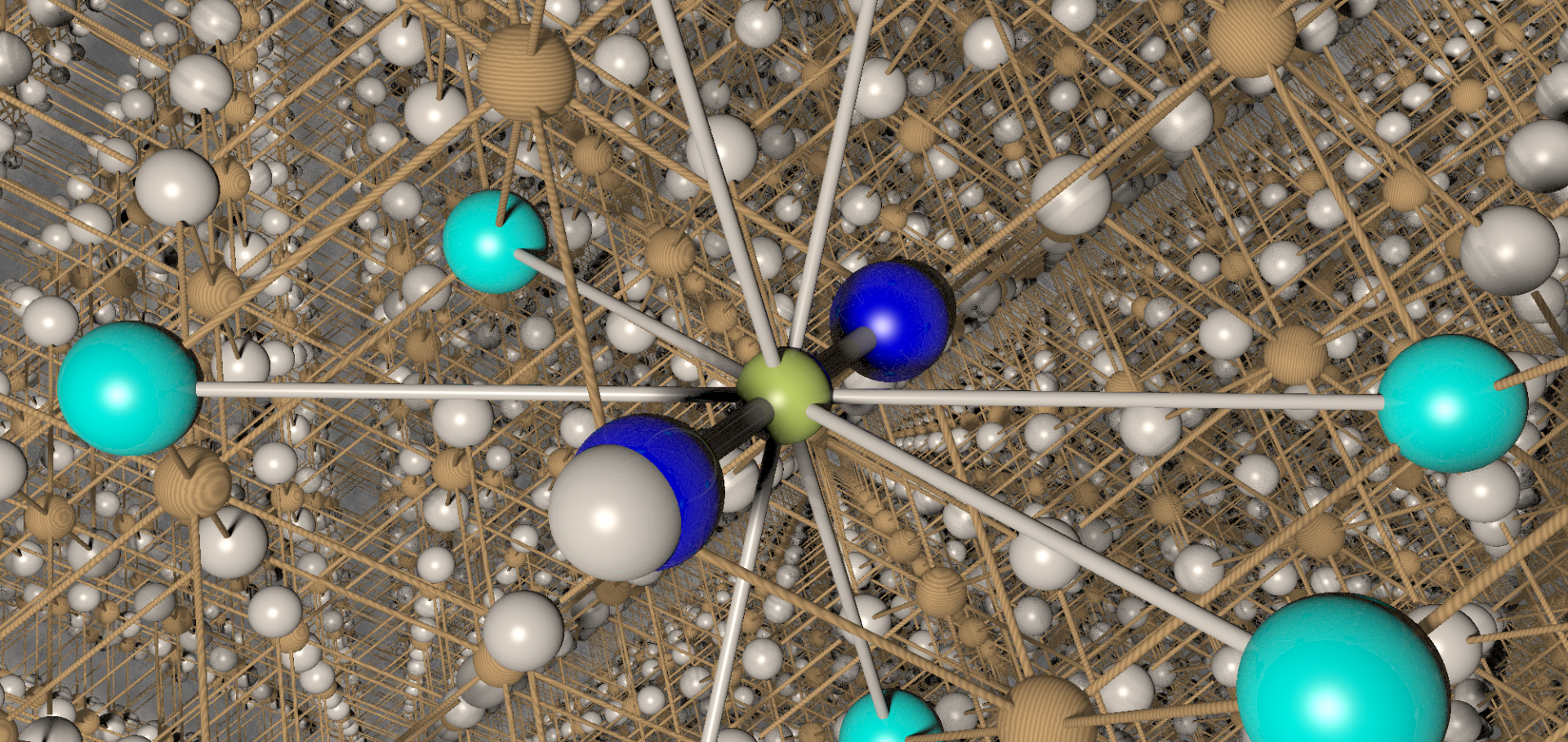

Importance of halogen···halogen contacts for the structural and magnetic properties of CuX2(pyrazine-N,N′-dioxide)(H2O)2 (X = Cl and Br).
Inorg Chem 51:4 (2012) 2121-2129
Abstract:
The structural and magnetic properties of the newly crystallized CuX(2)(pyzO)(H(2)O)(2) (X = Cl, Br; pyzO = pyrazine-N,N'-dioxide) coordination polymers are reported. These isostructural compounds crystallize in the monoclinic space group C2/c with, at 150 K, a = 17.0515(7) Å, b = 5.5560(2) Å, c = 10.4254(5) Å, β = 115.400(2)°, and V = 892.21(7) Å(3) for X = Cl and a = 17.3457(8) Å, b = 5.6766(3) Å, c = 10.6979(5) Å, β = 115.593(2)°, and V = 950.01(8) Å(3) for X = Br. Their crystal structure is characterized by one-dimensional chains of Cu(2+) ions linked through bidentate pyzO ligands. These chains are joined together through OH···O hydrogen bonds between the water ligands and pyzO oxygen atoms and Cu-X···X-Cu contacts. Bulk magnetic susceptibility measurements at ambient pressure show a broad maximum at 7 (Cl) and 28 K (Br) that is indicative of short-range magnetic correlations. The dominant spin exchange is the Cu-X···X-Cu supersuperexchange because the magnetic orbital of the Cu(2+) ion is contained in the CuX(2)(H(2)O)(2) plane and the X···X contact distances are short. The magnetic data were fitted to a Heisenberg 1D uniform antiferromagnetic chain model with J(1D)/k(B) = -11.1(1) (Cl) and -45.9(1) K (Br). Magnetization saturates at fields of 16.1(3) (Cl) and 66.7(5) T (Br), from which J(1D) is determined to be -11.5(2) (Cl) and -46.4(5) K (Br). For the Br analog the pressure dependence of the magnetic susceptibility indicates a gradual increase in the magnitude of J(1D)/k(B) up to -51.2 K at 0.84 GPa, suggesting a shortening of the Br···Br contact distance under pressure. At higher pressure X-ray powder diffraction data indicates a structural phase transition at ∼3.5 GPa. Muon-spin relaxation measurements indicate that CuCl(2)(pyzO)(H(2)O)(2) is magnetically ordered with T(N) = 1.06(1) K, while the signature for long-range magnetic order in CuBr(2)(pyzO)(H(2)O)(2) was much less definitive down to 0.26 K. The results for the CuX(2)(pyzO)(H(2)O)(2) complexes are compared to the related CuX(2)(pyrazine) materials.Importance of halogen ··· halogen contacts for the structural and magnetic properties of CuX 2 (pyrazine-N,N'-dioxide) (H 2 O) 2 (X = Cl and Br)
Inorganic Chemistry 51:4 (2012) 2121-2129
Abstract:
The structural and magnetic properties of the newly crystallized CuX 2(pyzO)(H 2O) 2 (X = Cl, Br; pyzO = pyrazine-N,N'-dioxide) coordination polymers are reported. These isostructural compounds crystallize in the monoclinic space group C2/c with, at 150 K, a = 17.0515(7) Å, b = 5.5560(2) Å, c = 10.4254(5) Å, β = 115.400(2)°, and V = 892.21(7) Å 3 for X = Cl and a = 17.3457(8) Å, b = 5.6766(3) Å, c = 10.6979(5) Å, β = 115.593(2)°, and V = 950.01(8) Å 3 for X = Br. Their crystal structure is characterized by one-dimensional chains of Cu 2+ ions linked through bidentate pyzO ligands. These chains are joined together through OH···O hydrogen bonds between the water ligands and pyzO oxygen atoms and Cu-X⋯X-Cu contacts. Bulk magnetic susceptibility measurements at ambient pressure show a broad maximum at 7 (Cl) and 28 K (Br) that is indicative of short-range magnetic correlations. The dominant spin exchange is the Cu-X···X-Cu supersuperexchange because the magnetic orbital of the Cu 2+ ion is contained in the CuX 2(H 2O) 2 plane and the X··· X contact distances are short. The magnetic data were fitted to a Heisenberg 1D uniform antiferromagnetic chain model with J 1D/k B = -11.1(1) (Cl) and -45.9(1) K (Br). Magnetization saturates at fields of 16.1(3) (Cl) and 66.7(5) T (Br), from which J 1D is determined to be -11.5(2) (Cl) and -46.4(5) K (Br). For the Br analog the pressure dependence of the magnetic susceptibility indicates a gradual increase in the magnitude of J 1D/k B up to -51.2 K at 0.84 GPa, suggesting a shortening of the Br···Br contact distance under pressure. At higher pressure X-ray powder diffraction data indicates a structural phase transition at ∼3.5 GPa. Muon-spin relaxation measurements indicate that CuCl2(pyzO)(H 2O) 2 is magnetically ordered with T N = 1.06(1) K, while the signature for long-range magnetic order in CuBr2(pyzO)(H 2O) 2 was much less definitive down to 0.26 K. The results for the CuX 2(pyzO)(H 2O) 2 complexes are compared to the related CuX 2(pyrazine) materials. © 2012 American Chemical Society.Dimensionality selection in a molecule-based magnet.
Phys Rev Lett 108:7 (2012) 077208
Abstract:
Gaining control of the building blocks of magnetic materials and thereby achieving particular characteristics will make possible the design and growth of bespoke magnetic devices. While progress in the synthesis of molecular materials, and especially coordination polymers, represents a significant step towards this goal, the ability to tune the magnetic interactions within a particular framework remains in its infancy. Here we demonstrate a chemical method which achieves dimensionality selection via preferential inhibition of the magnetic exchange in an S=1/2 antiferromagnet along one crystal direction, switching the system from being quasi-two- to quasi-one-dimensional while effectively maintaining the nearest-neighbor coupling strength.Spin waves and revised crystal structure of honeycomb iridate Na2IrO3
(2012)
Spin waves and revised crystal structure of honeycomb iridate Na2IrO3
ArXiv 1202.1268 (2012)