Home
Department Of Physics text logo
  • Research
    • Our research
    • Our research groups
    • Our research in action
    • Research funding support
    • Summer internships for undergraduates
  • Study
    • Undergraduates
    • Postgraduates
  • Engage
    • For alumni
    • For business
    • For schools
    • For the public
Menu
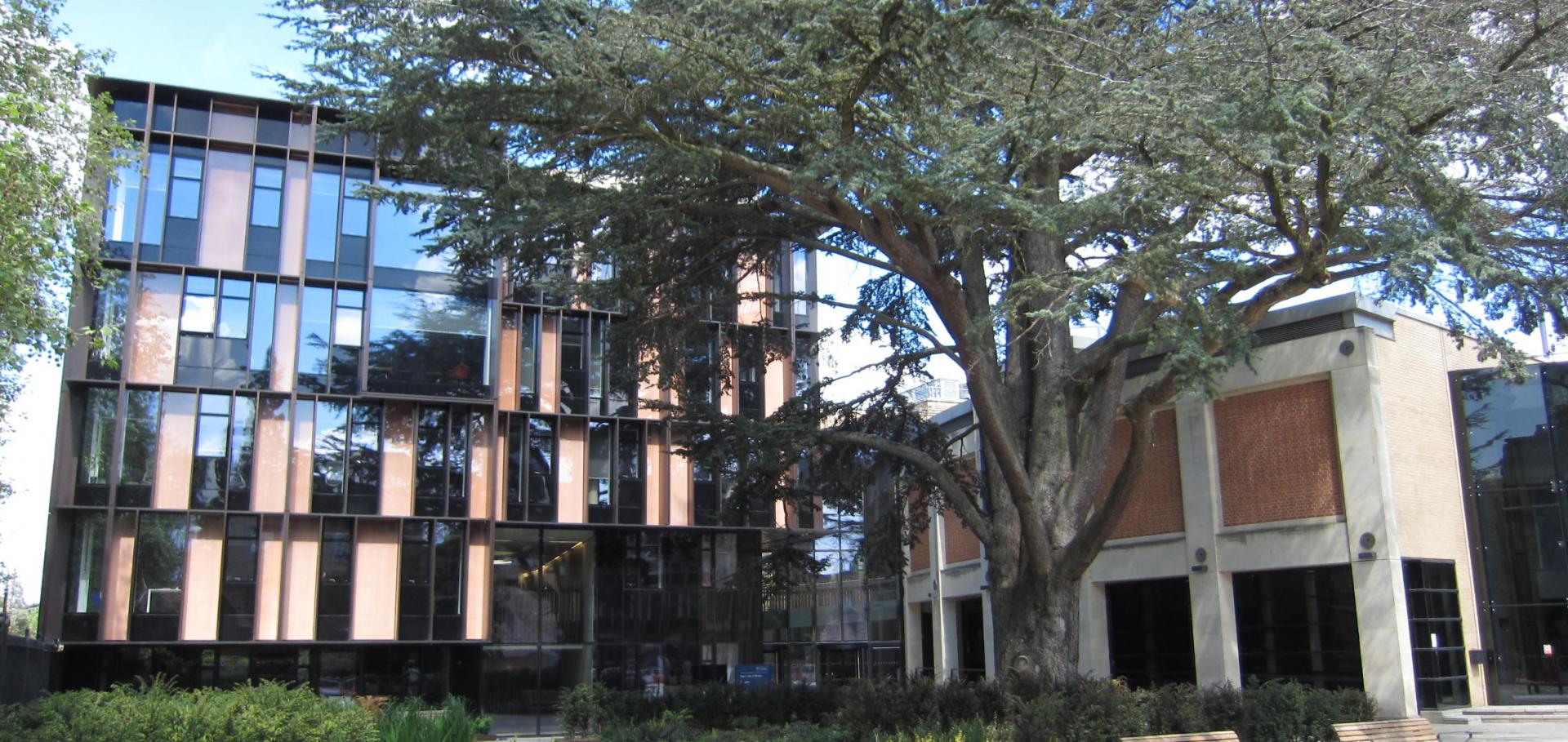
Clarendon Laboratory and Beecroft Building

Andrew Boothroyd

Head of Department

Research theme

  • Quantum materials

Sub department

  • Condensed Matter Physics

Research groups

  • X-ray and neutron scattering
Andrew.Boothroyd@physics.ox.ac.uk
Telephone: 01865 (2)72376
Clarendon Laboratory, room 311,172
ORCID ID 0000-0002-3575-7471
ResearcherID AAA-7883-2021
  • About
  • News
  • Research
  • Teaching
  • Prizes, awards and recognition
  • Software
  • Vacancies
  • Publications

Textbook

Principles of Neutron Scattering from Condensed Matter

Published by Oxford University Press in July 2020

Buy now

Topological electronic bands in crystalline solids

Contemporary Physics Taylor and Francis 63:4 (2023) 305-327

Abstract:

Topology is now securely established as a means to explore and classify electronic states in crystalline solids. This review provides a gentle but firm introduction to topological electronic band structure suitable for new researchers in the field. I begin by outlining the relevant concepts from topology, then give a summary of the theory of non-interacting electrons in periodic potentials. Next, I explain the concepts of the Berry phase and Berry curvature, and derive key formulae. The remainder of the article deals with how these ideas are applied to classify crystalline solids according to the topology of the electronic states, and the implications for observable properties. Among the topics covered are the role of symmetry in determining band degeneracies in momentum space, the Chern number and 𝒵2 topological invariants, surface electronic states, two- and three-dimensional topological insulators, and Weyl and Dirac semimetals
More details from the publisher
Details from ORA
More details

Coherent magnetic excitations in the Kondo semimetal CeFe 2 Al 10

Acta Crystallographica Section A: Foundations and advances International Union of Crystallography (IUCr) 79:a2 (2023) c128-c128

Authors:

DT Adroja, Zhihui Luo, Dao-Xin Yao, Peter S Riseborough, Y Muro, HC Walker, Yijie Zeng, T Takabatake, J-M Mignot, KA McEwen, AT Boothroyd
More details from the publisher
More details

Interplay between magnetism and electronic band topology

Acta Crystallographica Section A: Foundations and advances International Union of Crystallography (IUCr) 79:a2 (2023) c572-c572

Authors:

Jian-Rui Soh, AT Boothroyd
More details from the publisher
More details

Room-temperature type-II multiferroic phase induced by pressure in cupric oxide

Acta Crystallographica Section A: Foundations and advances International Union of Crystallography (IUCr) 79:a2 (2023) c1213-c1213

Authors:

Noriki Terada, Dmitry D Khalyavin, Pascal Manuel, Fabio Orlandi, Christopher J Ridley, Craig L Bull, Ryota Ono, Igor Solovyev, Takashi Naka, Dharmalingam Prabhakaran, Andrew T Boothroyd
More details from the publisher
More details

High-energy spin waves in the spin-1 square-lattice antiferromagnet La2NiO4

Physical Review Research American Physical Society 5:3 (2023) 033113

Authors:

An Petsch, Ns Headings, D Prabhakaran, Ai Kolesnikov, Cd Frost, At Boothroyd, R Coldea, Sm Hayden

Abstract:

Inelastic neutron scattering is used to study the magnetic excitations of the S=1 square-lattice antiferromagnet La2NiO4. We find that the spin waves cannot be described by a simple classical (harmonic) Heisenberg model with only nearest-neighbor interactions. The spin-wave dispersion measured along the antiferromagnetic Brillouin-zone boundary shows a minimum energy at the (1/2,0) position as is observed in some S=1/2 square-lattice antiferromagnets. Thus, our results suggest that the quantum dispersion renormalization effects or longer-range exchange interactions observed in cuprates and other S =1/2 square-lattice antiferromagnets are also present in La2NiO4. We also find that the overall intensity of the spin-wave excitations is suppressed relative to linear spin-wave theory, indicating that covalency is important. Two-magnon scattering is also observed.

More details from the publisher
Details from ORA
More details

Pagination

  • First page First
  • Previous page Prev
  • Page 1
  • Page 2
  • Current page 3
  • Page 4
  • Page 5
  • Page 6
  • Page 7
  • Page 8
  • Page 9
  • …
  • Next page Next
  • Last page Last

Footer Menu

  • Contact us
  • Giving to the Dept of Physics
  • Work with us
  • Media

User account menu

  • Log in

Follow us

FIND US

Clarendon Laboratory,

Parks Road,

Oxford,

OX1 3PU

CONTACT US

Tel: +44(0)1865272200

University of Oxfrod logo Department Of Physics text logo
IOP Juno Champion logo Athena Swan Silver Award logo

© University of Oxford - Department of Physics

Cookies | Privacy policy | Accessibility statement

Built by: Versantus

  • Home
  • Research
  • Study
  • Engage
  • Our people
  • News & Comment
  • Events
  • Our facilities & services
  • About us
  • Giving to Physics
  • Current students
  • Staff intranet