Home
Department Of Physics text logo
  • Research
    • Our research
    • Our research groups
    • Our research in action
    • Research funding support
    • Summer internships for undergraduates
  • Study
    • Undergraduates
    • Postgraduates
  • Engage
    • For alumni
    • For business
    • For schools
    • For the public
  • Support
Menu
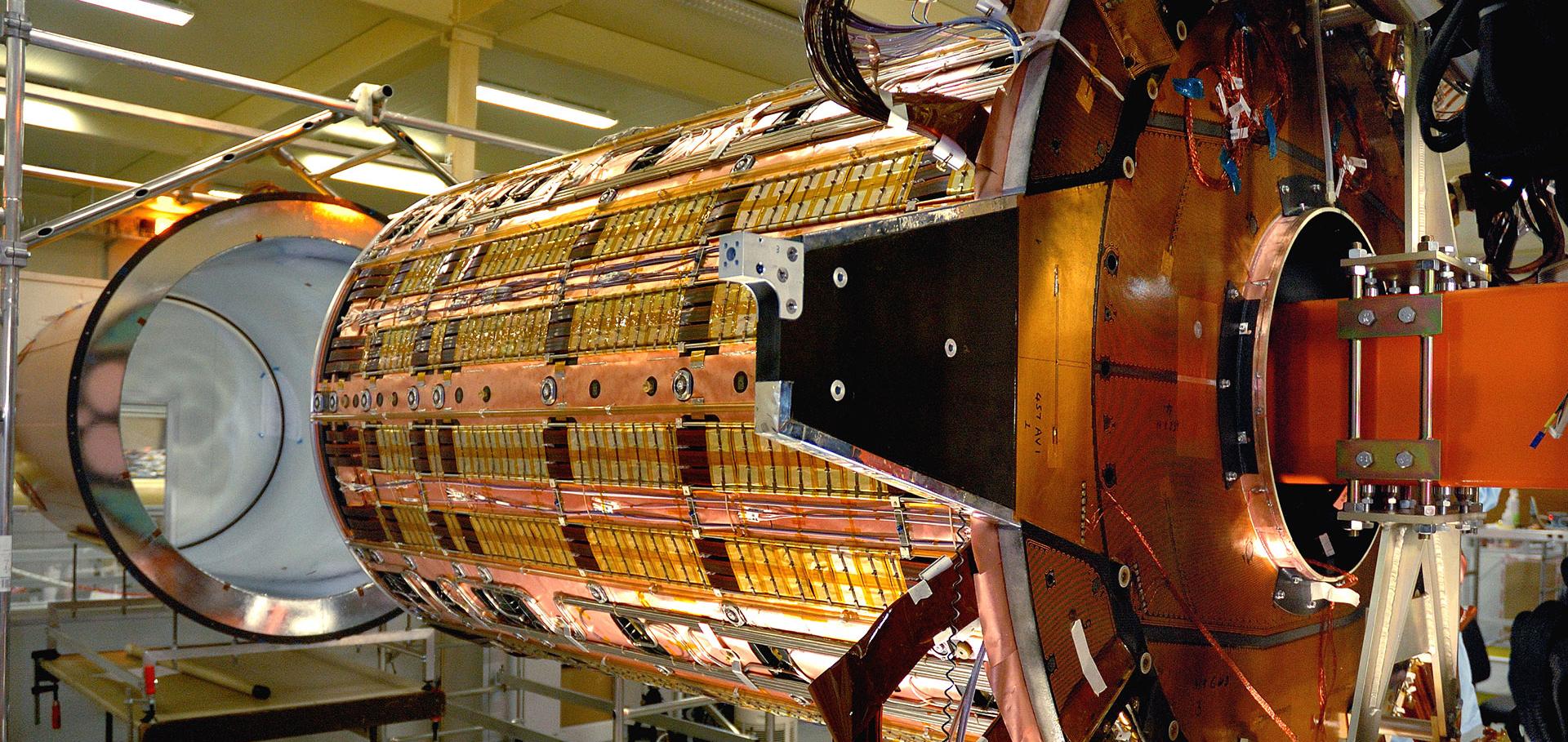
Insertion of STC into TRT at the Department of Physics, Oxford
Credit: CERN

Professor Daniela Bortoletto

Professor and Head of Particle Physics

Research theme

  • Instrumentation
  • Fundamental particles and interactions

Sub department

  • Particle Physics

Research groups

  • AION/Magis
  • ATLAS
  • Future Colliders
  • Mu3e
  • OPMD
daniela.bortoletto@physics.ox.ac.uk
Telephone: 01865 (2)73635
Denys Wilkinson Building, room 608c1
  • About
  • Students
  • Research
  • Teaching
  • Publications

Observation of the associated production of a top quark and a $Z$ boson in $pp$ collisions at $\sqrt{s} = 13$ TeV with the ATLAS detector

ArXiv 2002.07546 (2020)
Details from ArXiV

Search for electroweak production of charginos and sleptons decaying into final states with two leptons and missing transverse momentum in √s=13 TeV pp collisions using the ATLAS detector

European Physical Journal C Springer Nature 80:2 (2020) 123

Authors:

ATLAS Collaboration, G Aad, B Abbott, Alan Barr

Abstract:

A search for the electroweak production of charginos and sleptons decaying into final states with two electrons or muons is presented. The analysis is based on 139 fb−1 of proton–proton collisions recorded by the ATLAS detector at the Large Hadron Collider at s√=13 TeV. Three R-parity-conserving scenarios where the lightest neutralino is the lightest supersymmetric particle are considered: the production of chargino pairs with decays via either W bosons or sleptons, and the direct production of slepton pairs. The analysis is optimised for the first of these scenarios, but the results are also interpreted in the others. No significant deviations from the Standard Model expectations are observed and limits at 95% confidence level are set on the masses of relevant supersymmetric particles in each of the scenarios. For a massless lightest neutralino, masses up to 420 GeV are excluded for the production of the lightest-chargino pairs assuming W-boson-mediated decays and up to 1 TeV for slepton-mediated decays, whereas for slepton-pair production masses up to 700 GeV are excluded assuming three generations of mass-degenerate sleptons.
More details from the publisher
Details from ORA
More details

Test of CP invariance in vector-boson fusion production of the Higgs boson in the $H\rightarrowττ$ channel in proton$-$proton collisions at $\sqrt{s}$ = 13 TeV with the ATLAS detector

ArXiv 2002.05315 (2020)
Details from ArXiV

Measurement of the azimuthal anisotropy of charged-particle production in Xe plus Xe collisions at root S-NN=5.44 TeV with the ATLAS detector

Physical Review C American Physical Society 101:2 (2020) 24906

Authors:

G Aad, B Abbott, Dc Abbott, A Abed Abud, K Abeling, Dk Abhayasinghe, Sh Abidi, Os AbouZeid, Nl Abraham, H Abramowicz, H Abreu, Y Abulaiti, Bs Acharya, B Achkar, S Adachi, L Adam, C Adam Bourdarios, L Adamczyk, L Adamek, J Adelman, M Adersberger, A Adiguzel, S Adorni, T Adye, Aa Affolder, Y Afik, C Agapopoulou, Mn Agaras, A Aggarwal, C Agheorghiesei, Ja Aguilar-Saavedra, F Ahmadov, Ws Ahmed, X Ai, G Aielli, S Akatsuka, Tpa Akesson, E Akilli, Av Akimov, K Al Khoury, Gl Alberghi, J Albert, MJ Alconada Verzini, S Alderweireldt, M Aleksa, In Aleksandrov, C Alexa, T Alexopoulos, A Alfonsi

Abstract:

This paper describes the measurements of flow harmonics v2-v6 in 3μb-1 of Xe+Xe collisions at sNN=5.44 TeV performed using the ATLAS detector at the Large Hadron Collider (LHC). Measurements of the centrality, multiplicity, and pT dependence of the vn obtained using two-particle correlations and the scalar product technique are presented. The measurements are also performed using a template-fit procedure, which was developed to remove nonflow correlations in small collision systems. This nonflow removal is shown to have a significant influence on the measured vn at high pT, especially in peripheral events. Comparisons of the measured vn with measurements in Pb+Pb collisions and p+Pb collisions at sNN=5.02 TeV are also presented. The vn values in Xe+Xe collisions are observed to be larger than those in Pb+Pb collisions for n=2, 3, and 4 in the most central events. However, with decreasing centrality or increasing harmonic order n, the vn values in Xe+Xe collisions become smaller than those in Pb+Pb collisions. The vn in Xe+Xe and Pb+Pb collisions are also compared as a function of the mean number of participating nucleons, (Npart), and the measured charged-particle multiplicity in the detector. The v3 values in Xe+Xe and Pb+Pb collisions are observed to be similar at the same (Npart) or multiplicity, but the other harmonics are significantly different. The ratios of the measured vn in Xe+Xe and Pb+Pb collisions, as a function of centrality, are also compared to theoretical calculations.
More details from the publisher
Details from ORA
More details

Mini-MALTA: Radiation hard pixel designs for small-electrode monolithic CMOS sensors for the High Luminosity LHC

Journal of Instrumentation IOP Publishing 15:2 (2020) P02005

Authors:

M Dyndal, V Dao, P Allport, Ia Tortajada, M Barbero, S Bhat, D Bortoletto, I Berdalovic, C Bespin, C Buttar, I Caicedo, R Cardella, F Dachs, Y Degerli, H Denizli, Lfs De Acedo, P Freeman, L Gonella, A Habib, T Hemperek, T Hirono, B Hiti, T Kugathasan, I Mandić, D Maneuski, M Mikuž, K Moustakas, M Munker, Ky Oyulmaz, P Pangaud, H Pernegger, F Piro, P Riedler, H Sandaker, Ej Schioppa, P Schwemling, A Sharma, Ls Argemi, Cs Sanchez, W Snoeys, T Suligoj, T Wang, N Wermes, S Worm

Abstract:

Depleted Monolithic Active Pixel Sensor (DMAPS) prototypes developed in the TowerJazz 180 nm CMOS imaging process have been designed in the context of the ATLAS upgrade Phase-II at the HL-LHC. The pixel sensors are characterized by a small collection electrode (3 μm) to minimize capacitance, a small pixel size (36.4× 36.4 μm2), and are produced on high resistivity epitaxial p-type silicon. The design targets a radiation hardness of 1×10¹⁵ 1 MeV neq/cm2, compatible with the outermost layer of the ATLAS ITK Pixel detector. This paper presents the results from characterization in particle beam tests of the Mini-MALTA prototype that implements a mask change or an additional implant to address the inefficiencies on the pixel edges. Results show full efficiency after a dose of 1×10¹⁵ 1 MeV neq/cm2.
More details from the publisher
Details from ORA
More details

Pagination

  • First page First
  • Previous page Prev
  • …
  • Page 215
  • Page 216
  • Page 217
  • Page 218
  • Current page 219
  • Page 220
  • Page 221
  • Page 222
  • Page 223
  • …
  • Next page Next
  • Last page Last

Footer Menu

  • Contact us
  • Giving to the Dept of Physics
  • Work with us
  • Media

User account menu

  • Log in

Follow us

FIND US

Clarendon Laboratory,

Parks Road,

Oxford,

OX1 3PU

CONTACT US

Tel: +44(0)1865272200

University of Oxfrod logo Department Of Physics text logo
IOP Juno Champion logo Athena Swan Silver Award logo

© University of Oxford - Department of Physics

Cookies | Privacy policy | Accessibility statement

Built by: Versantus

  • Home
  • Research
  • Study
  • Engage
  • Our people
  • News & Comment
  • Events
  • Our facilities & services
  • About us
  • Giving to Physics
  • Current students
  • Staff intranet