Home
Department Of Physics text logo
  • Research
    • Our research
    • Our research groups
    • Our research in action
    • Research funding support
    • Summer internships for undergraduates
  • Study
    • Undergraduates
    • Postgraduates
  • Engage
    • For young people
    • For teachers
    • For the public
    • For alumni
    • For business
  • Support
Menu
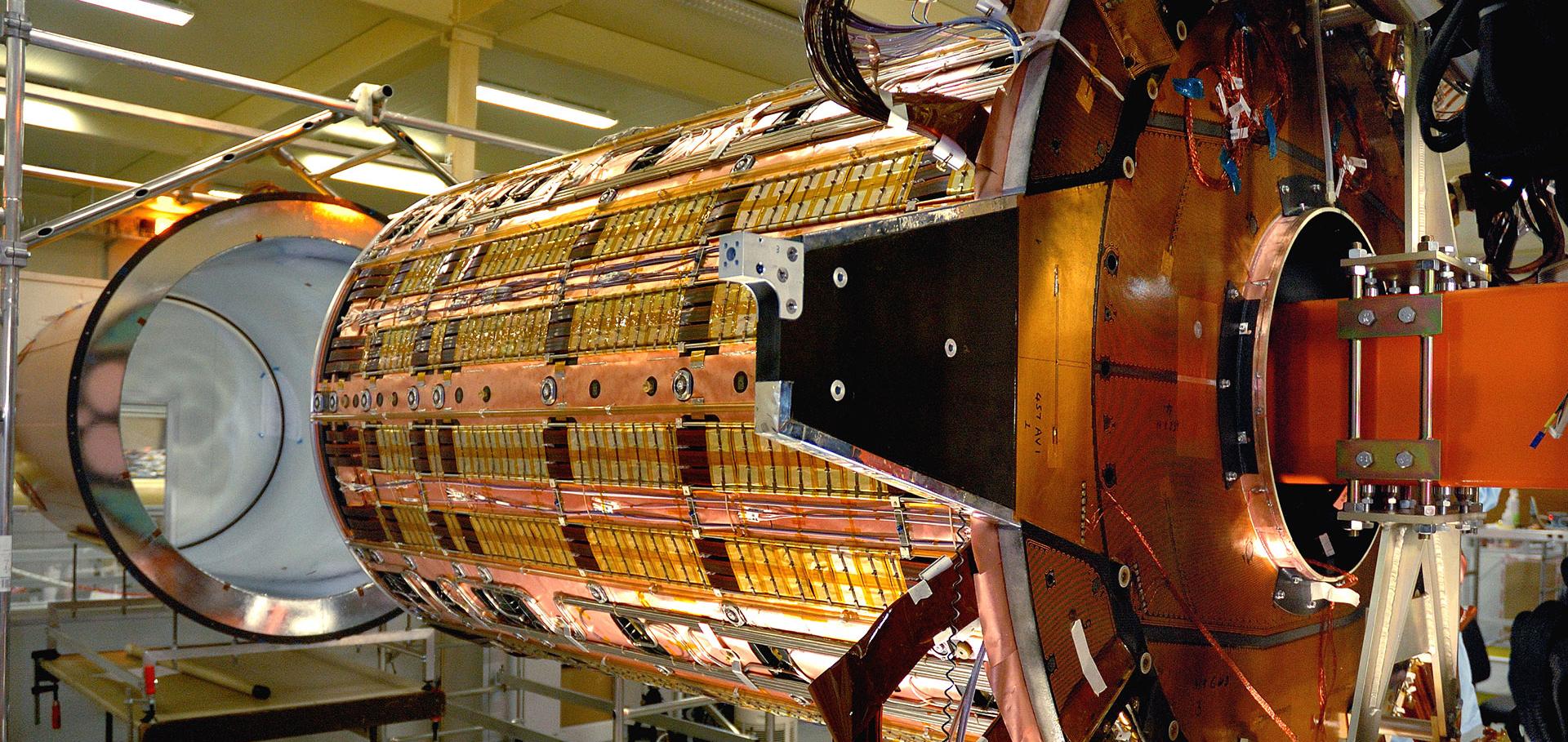
Insertion of STC into TRT at the Department of Physics, Oxford
Credit: CERN

Professor Daniela Bortoletto

Professor and Head of Particle Physics

Research theme

  • Instrumentation
  • Fundamental particles and interactions

Sub department

  • Particle Physics

Research groups

  • AION/Magis
  • ATLAS
  • Future Colliders
  • Mu3e
  • OPMD
daniela.bortoletto@physics.ox.ac.uk
Telephone: 01865 (2)73635
Denys Wilkinson Building, room 608c1
  • About
  • Students
  • Research
  • Teaching
  • Publications

Search for Beyond the Standard Model physics with anomaly detection in multilepton final states in pp collisions at $$\sqrt{s}=13~\textrm{TeV}$$ with the ATLAS detector

The European Physical Journal C SpringerOpen 86:3 (2026) 247

Authors:

G Aad, E Aakvaag, B Abbott, S Abdelhameed, K Abeling, NJ Abicht, SH Abidi, M Aboelela, A Aboulhorma, H Abramowicz, Y Abulaiti, BS Acharya, A Ackermann, C Adam Bourdarios, L Adamczyk, SV Addepalli, MJ Addison, J Adelman, A Adiguzel, T Adye, AA Affolder, Y Afik, MN Agaras, A Aggarwal, C Agheorghiesei

Abstract:

A model-agnostic search for Beyond the Standard Model physics is presented, targeting final states with at least four light leptons (electrons or muons). The search regions are separated by event topology and unsupervised machine learning is used to identify anomalous events in the full 140 fb-1$$^{-1}$$ of proton–proton collision data collected with the ATLAS detector during Run 2. No significant excess above the Standard Model background expectation is observed. Model-agnostic limits are presented in each topology, along with limits on several benchmark models including vector-like leptons, wino-like charginos and neutralinos, or smuons. Limits are set on the flavourful vector-like lepton model for the first time.
More details from the publisher
Details from ORA
More details

Search for decays of the Higgs boson into pair-produced pseudoscalar particles decaying into $τ^+τ^-τ^+τ^-$ using $pp$ collisions at $\sqrt{s}=13$ TeV with the ATLAS detector

ArXiv 2603.08323 (2026)
Details from ArXiV

Search for long-lived charginos and $τ$-sleptons using final states with a disappearing track in $pp$ collisions at $\sqrt{s} = 13$ TeV with the ATLAS detector

ArXiv 2603.08315 (2026)
Details from ArXiV

A novel approach for fault detection and failure analysis of CMOS copper metal stacks

IEEE Transactions on Nuclear Science IEEE 73:4 (2026) 1501-1506

Authors:

Gregor Eberwein, Gianluca Aglieri Rinella, Daniela Bortoletto, Szymon Bugiel, Francesca Carnesecchi, Antonello Di Mauro, Pedro Vicente Leitao, Hartmut Hillemanns, Marc Alain Imhoff, Antoine Junique, Alex Kluge, Magnus Mager, Paolo Martinengo, Iaroslav Panasenko, Ivan Ravasenga, Felix Reidt, Valerio Sarritzu, Walter Snoeys, Miljenko Šuljić

Abstract:

For the Inner Tracking System 3 (ITS3) upgrade, the ALICE experiment at CERN requires monolithic active pixel sensors of dimensions up to 97 mm×266 mm, occupying a large fraction of a 300 mm wafer. To manufacture such a wafer-scale device, larger than the single design reticle size, stitching is employed. The MOnolithic Stitched Sensor (MOSS) is a prototype silicon pixel sensor of 14 mm×259 mm size with the primary goal of understanding the stitching technique and yield. Given the large size, high yield is paramount for the ITS3 sensors, and an in-depth yield characterization was performed on these MOSS sensors. In a collaborative effort, the foundry adapted the metal stack to the requirements of the project, but recurrent fault signatures were discovered with various frequencies across all 20 wafers tested, and correlated through dedicated measurements and analyses. Following these findings, the foundry implemented a mitigation strategy to avoid the issue in the future. This article does not describe process details but concentrates on the measurements and analysis method.
More details from the publisher
Details from ORA

Detective Quantum Efficiency of the Timepix4 Hybrid Pixel Detector and its Application to Parallel-Beam Diffraction

ArXiv 2603.06857 (2026)

Authors:

Zhiyuan Ding, Nina Dimova, Jonathan S Barnard, Giulio Crevatin, Liam O'Ryan, Richard Plackett, Daniela Bortoletto, Angus I Kirkland, Marcus Gallagher-Jones
Details from ArXiV

Pagination

  • First page First
  • Previous page Prev
  • …
  • Page 20
  • Page 21
  • Page 22
  • Page 23
  • Current page 24
  • Page 25
  • Page 26
  • Page 27
  • Page 28
  • …
  • Next page Next
  • Last page Last

Footer Menu

  • Contact us
  • Giving to the Dept of Physics
  • Work with us
  • Media

User account menu

  • Log in

Follow us

FIND US

Clarendon Laboratory,

Parks Road,

Oxford,

OX1 3PU

CONTACT US

Tel: +44(0)1865272200

University of Oxfrod logo Department Of Physics text logo
IOP Juno Champion logo Athena Swan Silver Award logo

© University of Oxford - Department of Physics

Cookies | Privacy policy | Accessibility statement

Built by: Versantus

  • Home
  • Research
  • Study
  • Engage
  • Our people
  • News & Comment
  • Events
  • Our facilities & services
  • About us
  • Giving to Physics
  • Current students
  • Staff intranet