Home
Department Of Physics text logo
  • Research
    • Our research
    • Our research groups
    • Our research in action
    • Research funding support
    • Summer internships for undergraduates
  • Study
    • Undergraduates
    • Postgraduates
  • Engage
    • For alumni
    • For business
    • For schools
    • For the public
  • Support
Menu
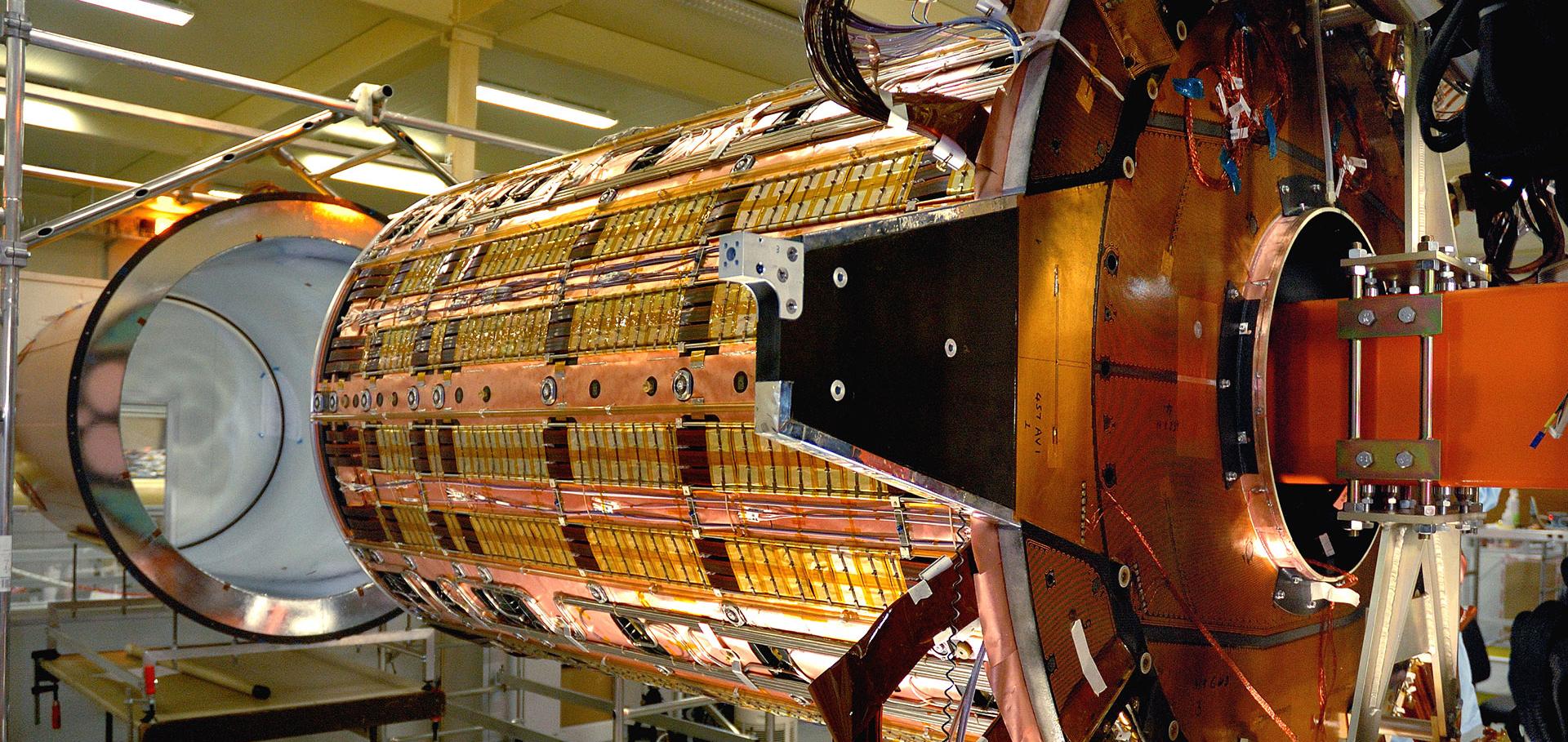
Insertion of STC into TRT at the Department of Physics, Oxford
Credit: CERN

Professor Daniela Bortoletto

Professor and Head of Particle Physics

Research theme

  • Instrumentation
  • Fundamental particles and interactions

Sub department

  • Particle Physics

Research groups

  • AION/Magis
  • ATLAS
  • Future Colliders
  • Mu3e
  • OPMD
daniela.bortoletto@physics.ox.ac.uk
Telephone: 01865 (2)73635
Denys Wilkinson Building, room 608c1
  • About
  • Students
  • Research
  • Teaching
  • Publications

Inclusive search for squarks and gluinos in pp collisions at √s=7TeV

Physical Review D - Particles, Fields, Gravitation and Cosmology 85:1 (2012)

Authors:

S Chatrchyan, V Khachatryan, AM Sirunyan, A Tumasyan, W Adam, T Bergauer, M Dragicevic, J Erö, C Fabjan, M Friedl, R Frühwirth, VM Ghete, J Hammer, S Hänsel, M Hoch, N Hörmann, J Hrubec, M Jeitler, W Kiesenhofer, M Krammer, D Liko, I Mikulec, M Pernicka, B Rahbaran, H Rohringer, R Schöfbeck, J Strauss, A Taurok, F Teischinger, P Wagner, W Waltenberger, G Walzel, E Widl, CE Wulz, V Mossolov, N Shumeiko, J Suarez Gonzalez, S Bansal, L Benucci, EA De Wolf, X Janssen, T Maes, L Mucibello, S Ochesanu, B Roland, R Rougny, M Selvaggi, H Van Haevermaet, P Van Mechelen, N Van Remortel, F Blekman, S Blyweert, J D'hondt, O Devroede, R Gonzalez Suarez, A Kalogeropoulos, M Maes, W Van Doninck, P Van Mulders, GP Van Onsem, I Villella, O Charaf, B Clerbaux, G De Lentdecker, V Dero, APR Gay, GH Hammad, T Hreus, PE Marage, A Raval, L Thomas, C Vander Velde, P Vanlaer, V Adler, A Cimmino, S Costantini, M Grunewald, B Klein, J Lellouch, A Marinov, J Mccartin, D Ryckbosch, F Thyssen, M Tytgat, L Vanelderen, P Verwilligen, S Walsh, N Zaganidis, S Basegmez, G Bruno, J Caudron, L Ceard, E Cortina Gil, J De Favereau De Jeneret, C Delaere, D Favart, A Giammanco, G Grégoire, J Hollar, V Lemaitre

Abstract:

A search is performed for heavy particle pairs produced in √s=7TeV proton-proton collisions with 35pb-1 of data collected by the CMS experiment at the LHC. The search is sensitive to squarks and gluinos of generic supersymmetry models, provided they are kinematically accessible, with minimal assumptions on properties of the lightest superpartner particle. The kinematic consistency of the selected events is tested against the hypothesis of heavy particle pair production using the dimensionless razor variable R, related to the missing transverse energy ETmiss. The new physics signal is characterized by a broad peak in the distribution of MR, an event-by-event indicator of the heavy particle mass scale. This new approach is complementary to ETmiss-based searches. After background modeling based on data, and background rejection based on R and MR, no significant excess of events is found beyond the standard model expectations. The results are interpreted in the context of the constrained minimal supersymmetric standard model as well as two simplified supersymmetry models. © 2012 CERN.
More details from the publisher

Search for a Higgs Boson in the diphoton final state in pp̄ collisions at √s=1.96TeV

Physical Review Letters 108:1 (2012)

Authors:

T Aaltonen, B Álvarez González, S Amerio, D Amidei, A Anastassov, A Annovi, J Antos, G Apollinari, JA Appel, A Apresyan, T Arisawa, A Artikov, J Asaadi, W Ashmanskas, B Auerbach, A Aurisano, F Azfar, W Badgett, A Barbaro-Galtieri, VE Barnes, BA Barnett, P Barria, P Bartos, M Bauce, G Bauer, F Bedeschi, D Beecher, S Behari, G Bellettini, J Bellinger, D Benjamin, A Beretvas, A Bhatti, M Binkley, D Bisello, I Bizjak, KR Bland, B Blumenfeld, A Bocci, A Bodek, D Bortoletto, J Boudreau, A Boveia, L Brigliadori, A Brisuda, C Bromberg, E Brucken, M Bucciantonio, J Budagov, HS Budd, S Budd, K Burkett, G Busetto, P Bussey, A Buzatu, C Calancha, S Camarda, M Campanelli, M Campbell, F Canelli, B Carls, D Carlsmith, R Carosi, S Carrillo, S Carron, B Casal, M Casarsa, A Castro, P Catastini, D Cauz, V Cavaliere, M Cavalli-Sforza, A Cerri, L Cerrito, YC Chen, M Chertok, G Chiarelli, G Chlachidze, F Chlebana, K Cho, D Chokheli, JP Chou, WH Chung, YS Chung, CI Ciobanu, MA Ciocci, A Clark, C Clarke, G Compostella, ME Convery, J Conway, M Corbo, M Cordelli, CA Cox, DJ Cox, F Crescioli, C Cuenca Almenar, J Cuevas, R Culbertson, D Dagenhart

Abstract:

A search for a narrow Higgs boson resonance in the diphoton mass spectrum is presented based on data corresponding to 7.0fb-1 of integrated luminosity from pp̄ collisions at √s=1.96TeV collected by the CDF experiment. No evidence of such a resonance is observed, and upper limits are set on the cross section times branching ratio of the resonant state as a function of Higgs boson mass. The limits are interpreted in the context of the standard model and one fermiophobic benchmark model where the data exclude fermiophobic Higgs bosons with masses below 114GeV/c2 at a 95% Bayesian credibility level. © 2012 American Physical Society.
More details from the publisher
More details
Details from ArXiV

Centrality dependence of dihadron correlations and azimuthal anisotropy harmonics in PbPb collisions at √SNN = 2.76 Tev

European Physical Journal C 72:5 (2012) 1-26

Authors:

S Chatrchyan, V Khachatryan, AM Sirunyan, A Tumasyan, W Adam, T Bergauer, M Dragicevic, J Erö, C Fabjan, M Friedl, R Frühwirth, VM Ghete, J Hammer, M Hoch, N Hörmann, J Hrubec, M Jeitler, W Kiesenhofer, A Knapitsch, M Krammer, D Liko, I Mikulec, M Pernicka, B Rahbaran, C Rohringer, H Rohringer, R Schöfbeck, J Strauss, A Taurok, F Teischinger, P Wagner, W Waltenberger, G Walzel, E Widl, CE Wulz, V Mossolov, N Shumeiko, J Suarez Gonzalez, S Bansal, L Benucci, T Cornelis, EA de Wolf, X Janssen, S Luyckx, T Maes, L Mucibello, S Ochesanu, B Roland, R Rougny, M Selvaggi, H van Haevermaet, P van Mechelen, N van Remortel, A van Spilbeeck, F Blekman, S Blyweert, J D'Hondt, R Gonzalez Suarez, A Kalogeropoulos, M Maes, A Olbrechts, W van Doninck, P van Mulders, GP van Onsem, I Villella, O Charaf, B Clerbaux, G de Lentdecker, V Dero, APR Gay, GH Hammad, T Hreus, A Léonard, PE Marage, L Thomas, C Vander Velde, P Vanlaer, J Wickens, V Adler, K Beernaert, A Cimmino, S Costantini, G Garcia, M Grunewald, B Klein, J Lellouch, A Marinov, J Mccartin, AA Ocampo Rios, D Ryckbosch, N Strobbe, F Thyssen, M Tytgat, L Vanelderen, P Verwilligen, S Walsh, N Zaganidis, S Basegmez, G Bruno, J Caudron

Abstract:

Measurements from the CMS experiment at the LHC of dihadron correlations for charged particles produced in PbPb collisions at a nucleon-nucleon centre-of-mass energy of 2. 76 TeV are presented. The results are reported as a function of the particle transverse momenta (pT) and collision centrality over a broad range in relative pseudorapidity (Δη) and the full range of relative azimuthal angle (Δφ). The observed two-dimensional correlation structure in Δη and Δφ is characterised by a narrow peak at (Δη,Δφ)≈(0,0) from jet-like correlations and a long-range structure that persists up to at least {pipe}Δη{pipe}=4. An enhancement of the magnitude of the short-range jet peak is observed with increasing centrality, especially for particles of pT around 1-2 GeV/c. The long-range azimuthal dihadron correlations are extensively studied using a Fourier decomposition analysis. The extracted Fourier coefficients are found to factorise into a product of single-particle azimuthal anisotropies up to pT≈3-3. 5 GeV/c for at least one particle from each pair, except for the second-order harmonics in the most central PbPb events. Various orders of the single-particle azimuthal anisotropy harmonics are extracted for associated particle pT of 1-3 GeV/c, as a function of the trigger particle pT up to 20 GeV/c and over the full centrality range. © 2012 CERN for the benefit of the CMS collaboration.
More details from the publisher

Exclusive γγ →+μμ- production in proton-proton collisions at √s = 7 TeV

Journal of High Energy Physics 2012:1 (2012)

Authors:

S Chatrchyan, V Khachatryan, AM Sirunyan, A Tumasyan, W Adam, T Bergauer, M Dragicevic, J Erö, C Fabjan, M Friedl, R Fruḧwirth, VM Ghete, J Hammer, S Hänsel, M Hoch, N Hörmann, J Hrubec, M Jeitler, W Kiesenhofer, M Krammer, D Liko, I Mikulec, M Pernicka, B Rahbaran, H Rohringer, R Schöfbeck, J Strauss, A Taurok, F Teischinger, C Trauner, P Wagner, W Waltenberger, G Walzel, E Widl, CE Wulz, V Mossolov, N Shumeiko, J Suarez, S Bansal, L Benucci, EA De Wolf, X Janssen, S Luyckx, T Maes, L Mucibello, S Ochesanu, B Roland, R Rougny, M Selvaggi, H Van Haevermaet, P Van Mechelen, N Van Remortel, F Blekman, S Blyweert, J D'Hondt, R Gonzalez Suarez, A Kalogeropoulos, M Maes, A Olbrechts, W Van Doninck, P Van Mulders, GP Van Onsem, I Villella, O Charaf, B Clerbaux, G De Lentdecker, V Dero, APR Gay, GH Hammad, T Hreus, A Léonard, PE Marage, L Thomas, C Vander Velde, P Vanlaer, J Wickens, V Adler, K Beernaert, A Cimmino, S Costantini, M Grunewald, B Klein, J Lellouch, A Marinov, J McCartin, D Ryckbosch, N Strobbe, F Thyssen, M Tytgat, L Vanelderen, P Verwilligen, S Walsh, N Zaganidis, S Basegmez, G Bruno, J Caudron, L Ceard, E Cortina Gil, J De Favereau De Jeneret, C Delaere

Abstract:

A measurement of the exclusive two-photon production of muon pairs in proton-proton collisions at √s = 7TeV, pp → pμ+μ -p, is reported using data corresponding to an integrated luminosity of 40 pb-1. For muon pairs with invariant mass greater than 11:5 GeV, transverse momentum p (μ) > 4 GeV and pseudorapidity σ(μ) < 2:1, a t to the dimuon pT(μ+μ-) distribution results in a measured cross section of η(p → pμ+μ -p) = 3:38+0:580:55 (stat:)±0:16 (syst:)±0:14 (lumi:) pb, consistent with the theoretical prediction evaluated with the event generator Lpair. The ratio to the predicted cross section is 0:83+0:14 -0:13 (stat:) ± 0:04 (syst:) ± 0:03 (lumi:). The characteristic distributions of the muon pairs produced via fusion, such as the muon acoplanarity, the muon pair invariant mass and transverse momentum agree with those from the theory. Copyright © CERN.
More details from the publisher

Forward energy flow, central charged-particle multiplicities, and pseudorapidity gaps in W and Z boson events from pp collisions at √s = 7 TeV

European Physical Journal C 72:1 (2012) 1-28

Authors:

S Chatrchyan, V Khachatryan, AM Sirunyan, A Tumasyan, W Adam, T Bergauer, M Dragicevic, J Erö, C Fabjan, M Friedl, R Frühwirth, VM Ghete, J Hammer, S Hänsel, M Hoch, N Hörmann, J Hrubec, M Jeitler, W Kiesenhofer, M Krammer, D Liko, I Mikulec, M Pernicka, B Rahbaran, H Rohringer, R Schöfbeck, J Strauss, A Taurok, F Teischinger, C Trauner, P Wagner, W Waltenberger, G Walzel, E Widl, CE Wulz, V Mossolov, N Shumeiko, J Suarez Gonzalez, S Bansal, L Benucci, EA de Wolf, X Janssen, T Maes, L Mucibello, S Ochesanu, B Roland, R Rougny, M Selvaggi, H Van Haevermaet, P Van Mechelen, N Van Remortel, F Blekman, S Blyweert, J D'Hondt, O Devroede, R Gonzalez Suarez, A Kalogeropoulos, M Maes, W Van Doninck, P Van Mulders, GP Van Onsem, I Villella, O Charaf, B Clerbaux, G de Lentdecker, V Dero, APR Gay, GH Hammad, T Hreus, PE Marage, A Raval, L Thomas, G Vander Marcken, C Vander Velde, P Vanlaer, V Adler, A Cimmino, S Costantini, M Grunewald, B Klein, J Lellouch, A Marinov, J Mccartin, D Ryckbosch, F Thyssen, M Tytgat, L Vanelderen, P Verwilligen, S Walsh, N Zaganidis, S Basegmez, G Bruno, J Caudron, L Ceard, E Cortina Gil, J de Favereau De Jeneret, C Delaere, D Favart, A Giammanco, G Grégoire

Abstract:

A study of forward energy flow and central charged-particle multiplicity in events with W and Z bosons decaying into leptons is presented. The analysis uses a sample of 7 TeV pp collisions, corresponding to an integrated luminosity of 36 pb-1, recorded by the CMS experiment at the LHC. The observed forward energy depositions, their correlations, and the central charged-particle multiplicities are not well described by the available non-diffractive soft-hadron production models. A study of about 300 events with no significant energy deposited in one of the forward calorimeters, corresponding to a pseudorapidity gap of at least 1. 9 units, is also presented. An indication for a diffractive component in these events comes from the observation that the majority of the charged leptons from the W(Z) decays are found in the hemisphere opposite to the gap. When fitting the signed lepton pseudorapidity distribution of these events with predicted distributions from an admixture of diffractive (pompyt) and non-diffractive (pythia) Monte Carlo simulations, the diffractive component is determined to be (50. 0 ± 9. 3 (stat.) ± 5. 2 (syst.))%. © 2012 CERN for the benefit of the CMS collaboration.
More details from the publisher

Pagination

  • First page First
  • Previous page Prev
  • …
  • Page 556
  • Page 557
  • Page 558
  • Page 559
  • Current page 560
  • Page 561
  • Page 562
  • Page 563
  • Page 564
  • …
  • Next page Next
  • Last page Last

Footer Menu

  • Contact us
  • Giving to the Dept of Physics
  • Work with us
  • Media

User account menu

  • Log in

Follow us

FIND US

Clarendon Laboratory,

Parks Road,

Oxford,

OX1 3PU

CONTACT US

Tel: +44(0)1865272200

University of Oxfrod logo Department Of Physics text logo
IOP Juno Champion logo Athena Swan Silver Award logo

© University of Oxford - Department of Physics

Cookies | Privacy policy | Accessibility statement

Built by: Versantus

  • Home
  • Research
  • Study
  • Engage
  • Our people
  • News & Comment
  • Events
  • Our facilities & services
  • About us
  • Giving to Physics
  • Current students
  • Staff intranet