
Home
Department Of Physics text logo
  • Research
    • Our research
    • Our research groups
    • Our research in action
    • Research funding support
    • Summer internships for undergraduates
  • Study
    • Undergraduates
    • Postgraduates
  • Engage
    • For young people
    • For teachers
    • For the public
    • For alumni
    • For business
  • Support
Menu
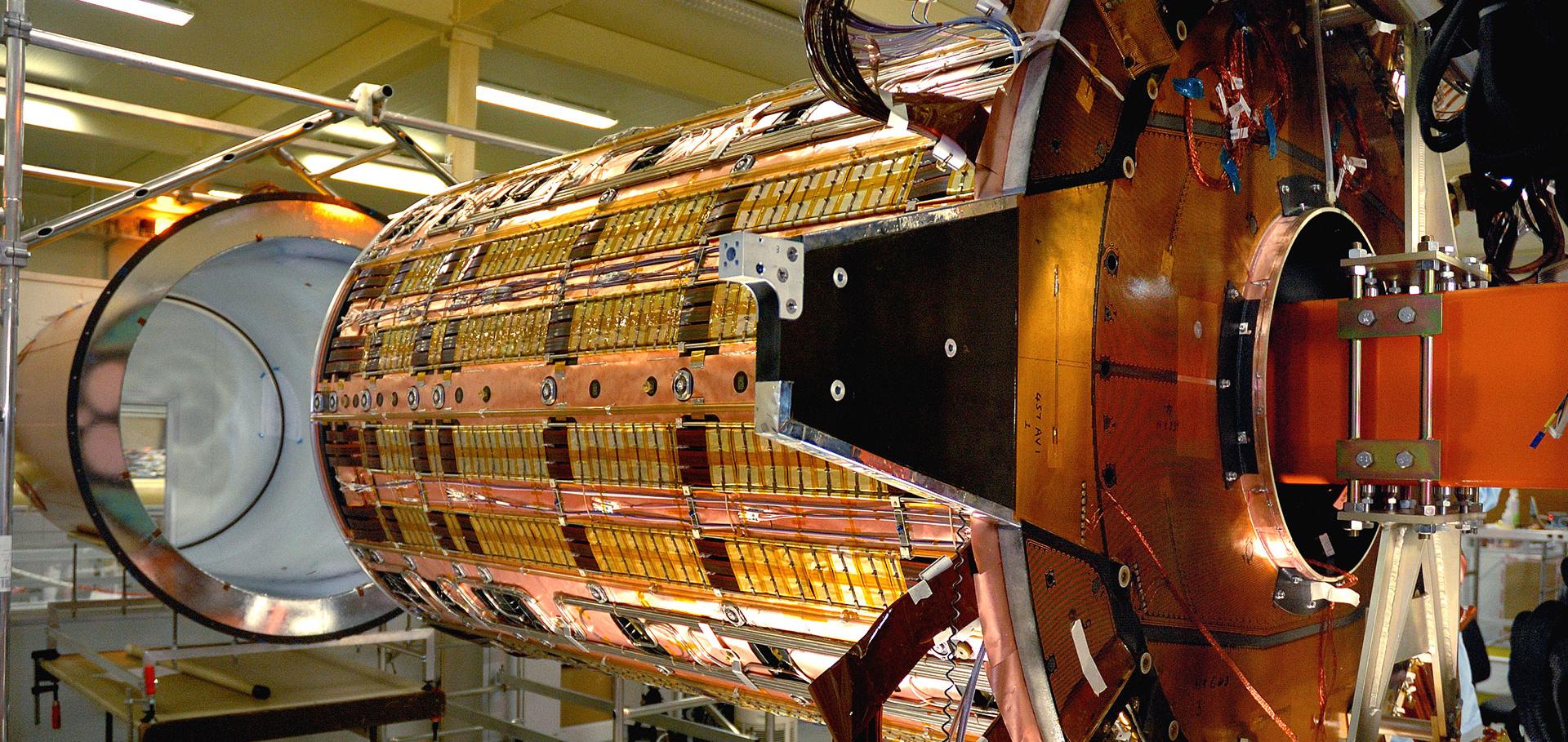
Insertion of STC into TRT at the Department of Physics, Oxford
Credit: CERN

Professor Daniela Bortoletto

Professor and Head of Particle Physics

Research theme

  • Instrumentation
  • Fundamental particles and interactions

Sub department

  • Particle Physics

Research groups

  • AION/Magis
  • ATLAS
  • Future Colliders
  • Mu3e
  • OPMD
daniela.bortoletto@physics.ox.ac.uk
Telephone: 01865 (2)73635
Denys Wilkinson Building, room 608c1
  • About
  • Students
  • Research
  • Teaching
  • Publications

The CDF Run IIb silicon detector

Nuclear Instruments and Methods in Physics Research Section A Accelerators Spectrometers Detectors and Associated Equipment Elsevier 518:1-2 (2004) 270-276

Authors:

M Aoki, N Bacchetta, S Behari, D Benjamin, D Bisello, G Bolla, D Bortoletto, A Burghard, G Busetto, S Cabrera, A Canepa, A Castro, G Cardoso, M Chertok, C Ciobanu, G Derylo, I Fang, B Flaugher, J Freeman, L Galtieri, J Galyardt, M Garcia-Sciveres, G Giurgiu, I Gorelov, C Haber, K Hara, M Hoeferkamp, B Holbrook, M Hrycyk, T Junk, S Kim, K Kobayashi, B Krieger, M Kruse, R Lander, R-S Lu, P Lukens, L Malferrari, C Manea, A Margotti, P Maksimovic, P Merkel, S Moccia, I Nakano, D Naoumov, J Novak, T Okusawa, Y Orlov, G Pancaldi, D Pantano, V Pavlicek, D Pellett, S Seidel, F Semeria, Y Takei, R Tanaka, Z Wang, P Watje, M Weber, W Wester, T Wilkes, K Yamamoto, W Yao, W Yao, S Zimmermann, S Zucchelli, A Zucchini
More details from the publisher
More details

Direct photon cross section with conversions at CDF

Physical Review D - Particles, Fields, Gravitation and Cosmology 70:7 (2004)

Authors:

D Acosta, T Affolder, MG Albrow, D Ambrose, D Amidei, K Anikeev, J Antos, G Apollinari, T Arisawa, A Artikov, W Ashmanskas, F Azfar, P Azzi-Bacchetta, N Bacchetta, H Bachacou, W Badgett, A Barbaro-Galtieri, VE Barnes, BA Barnett, S Baroiant, M Barone, G Bauer, F Bedeschi, S Behari, S Belforte, WH Bell, G Bellettini, J Bellinger, D Benjamin, A Beretvas, A Bhatti, M Binkley, D Bisello, M Bishai, RE Blair, C Blocker, K Bloom, B Blumenfeld, A Bocci, A Bodek, G Bolla, A Bolshov, D Bortoletto, J Boudreau, C Bromberg, E Brubaker, J Budagov, HS Budd, K Burkett, G Busetto, KL Byrum, S Cabrera, M Campbell, W Carithers, D Carlsmith, A Castro, D Cauz, A Cerri, L Cerrito, J Chapman, C Chen, YC Chen, M Chertok, G Chiarelli, G Chlachidze, F Chlebana, ML Chu, JY Chung, WH Chung, YS Chung, CI Ciobanu, AG Clark, M Coca, A Connolly, M Convery, J Conway, M Cordelli, J Cranshaw, R Culbertson, D Dagenhart, S D'Auria, P Barbaro, S Cecco, S Dell'Agnello, M Dell'Orso, S Demers, L Demortier, M Deninno, D Pedis, PF Derwent, C Dionisi, JR Dittmann, A Dominguez, S Donati, M D'Onofrio, T Dorigo, N Eddy, R Erbacher, D Errede, S Errede

Abstract:

We present a measurement of the isolated direct photon cross section in [Formula Presented] collisions at [Formula Presented] and [Formula Presented] using data collected between 1994 and 1995 by the Collider Detector at Fermilab (CDF). The measurement is based on events where the photon converts into an electron-positron pair in the material of the inner detector, resulting in a two track event signature. To remove [Formula Presented] and [Formula Presented] events from the data we use a new background subtraction technique which takes advantage of the tracking information available in a photon conversion event. We find that the shape of the cross section as a function of photon [Formula Presented] is poorly described by next-to-leading-order QCD predictions, but agrees with previous CDF measurements. © 2004 The American Physical Society.
More details from the publisher
More details

Heavy flavor properties of jets produced in pp̄ interactions at √s = 1.8 TeV

Physical Review D 69:7 (2004)

Authors:

D Acosta, D Ambrose, K Anikeev, J Antos, G Apollinari, T Arisawa, A Artikov, F Azfar, P Azzi-Bacchetta, N Bacchetta, VE Barnes, BA Barnett, M Barone, G Bauer, F Bedeschi, S Behari, S Belforte, WH Bell, G Bellettini, J Bellinger, A Beretvas, A Bhatti, D Bisello, C Blocker, B Blumenfeld, A Bocci, G Bolla, A Bolshov, D Bortoletto, J Budagov, HS Budd, K Burkett, G Busetto, S Cabrera, W Carithers, D Carlsmith, R Carosi, A Castro, D Cauz, A Cerri, C Chen, YC Chen, G Chiarelli, G Chlachidze, ML Chu, WH Chung, YS Chung, AG Clark, M Coca, M Convery, M Cordelli, J Cranshaw, D Dagenhart, S D'Auria, S Dell'Agnello, P de Barbaro, S de Cecco, M Dell'Orso, L Demortier, M Deninno, D de Pedis, C Dionisi, S Donati, M D'Onofrio, T Dorigo, R Eusebi, S Farrington, JP Fernandez, RD Field, I Fiori, A Foland, LR Flores-Castillo, M Franklin, J Friedman, I Furic, M Gallinaro, AF Garfinkel, E Gerstein, S Giagu, P Giannetti, K Giolo, M Giordani, P Giromini, V Glagolev, G Gomez, I Gorelov, AT Goshaw, K Goulianos, A Gresele, M Guenther, J Guimaraes da Costa, E Halkiadakis, C Hall, R Handler, F Happacher, K Hara, F Hartmann, K Hatakeyama, J Hauser, J Heinrich

Abstract:

We present a detailed examination of the heavy flavor properties of jets produced at the Fermilab Tevatron collider. The data set, collected with the Collider Detector at Fermilab, consists of events with two or more jets with transverse energy ET≥15 GeV and pseudorapidity |η|≤1.5. The heavy flavor content of the data set is enriched by requiring that at least one of the jets (lepton-jet) contains a lepton with a transverse momentum larger than 8 GeV/c. Jets containing hadrons with heavy flavor are selected via the identification of secondary vertices. The parton-level cross sections predicted by the HERWIG Monte Carlo generator program are tuned within theoretical and experimental uncertainties to reproduce the secondary-vertex rates in the data. The tuned simulation provides new information on the origin of the discrepancy between the bb̄ cross section measurements at the Tevatron and the next-to-leading order QCD prediction. We also compare the rate of away-jets (jets recoiling against the lepton-jet) containing a soft lepton (p T≥2 GeV/c) in the data to that in the tuned simulation. We find that this rate is larger than what is expected for the conventional production and semileptonic decay of pairs of hadrons with heavy flavor. © 2004 The American Physical Society.
More details from the publisher
More details

Measurement of the average time-integrated mixing probability of b-flavored hadrons produced at the Fermilab Tevatron

Physical Review D - Particles, Fields, Gravitation and Cosmology 69:1 (2004)

Authors:

D Acosta, T Affolder, H Akimoto, MG Albrow, D Ambrose, D Amidei, K Anikeev, J Antos, G Apollinari, T Arisawa, A Artikov, T Asakawa, W Ashmanskas, F Azfar, P Azzi-Bacchetta, N Bacchetta, H Bachacou, W Badgett, S Bailey, P Barbaro, A Barbaro-Galtieri, VE Barnes, BA Barnett, S Baroiant, M Barone, G Bauer, F Bedeschi, S Behari, S Belforte, WH Bell, G Bellettini, J Bellinger, D Benjamin, J Bensinger, A Beretvas, J Berryhill, A Bhatti, M Binkley, D Bisello, M Bishai, RE Blair, C Blocker, K Bloom, B Blumenfeld, SR Blusk, A Bocci, A Bodek, G Bolla, A Bolshov, Y Bonushkin, D Bortoletto, J Boudreau, A Brandl, C Bromberg, M Brozovic, E Brubaker, N Bruner, J Budagov, HS Budd, K Burkett, G Busetto, KL Byrum, S Cabrera, P Calafiura, M Campbell, W Carithers, J Carlson, D Carlsmith, W Caskey, A Castro, D Cauz, A Cerri, L Cerrito, AW Chan, PS Chang, PT Chang, J Chapman, C Chen, YC Chen, M Cheng, M Chertok, G Chiarelli, I Chirikov-Zorin, G Chlachidze, F Chlebana, L Christofek, ML Chu, JY Chung, W Chung, YS Chung, CI Ciobanu, AG Clark, M Coca, A Connolly, M Convery, J Conway, M Cordelli, J Cranshaw, R Culbertson, D Dagenhart

Abstract:

We have measured the number of like-sign (LS) and opposite-sign (OS) lepton pairs arising from double semileptonic decays of b and [Formula Presented] hadrons, pair produced at the Fermilab Tevatron collider. The data samples were collected with the Collider Detector at Fermilab during the 1992–1995 collider run by triggering on the existence of [Formula Presented] or [Formula Presented] candidates in an event. The observed ratio of LS to OS dileptons leads to a measurement of the average time-integrated mixing probability of all produced b-flavored hadrons which decay weakly, [Formula Presented] that is significantly larger than the world average [Formula Presented] © 2004 The American Physical Society.
More details from the publisher
More details

Simulation of the CMS prototype silicon pixel sensors and comparison with test beam measurements

IEEE Nuclear Science Symposium Conference Record 2 (2004) 1245-1250

Authors:

V Chiochia, M Swartz, D Bortoletto, L Cremaldi, S Cucciarelli, A Dorokhov, M Konecki, K Prokofiev, C Regenfus, T Rohe, DA Sanders, S Son, T Speer

Abstract:

Charge collection measurements performed on heavily irradiated p-spray dofz pixel sensors with a grazing angle hadron beam provide a sensitive determination of the electric field within the detectors. The data are compared with a complete charge transport simulation of the sensor which includes signal trapping and charge induction effects. A linearly varying electric field based upon the standard picture of a constant type-inverted effective doping density is inconsistent with the data. A two-trap double junction model implemented in ISE TCAD software can be tuned to produce a doubly-peaked electric field which describes the data reasonably well at two different fluences. The modeled field differs somewhat from previous determinations based upon the transient current technique. The model can also account for the level of signal trapping observed in the data. © 2004 IEEE.
More details

Pagination

  • First page First
  • Previous page Prev
  • …
  • Page 844
  • Page 845
  • Page 846
  • Page 847
  • Current page 848
  • Page 849
  • Page 850
  • Page 851
  • Page 852
  • …
  • Next page Next
  • Last page Last

Footer Menu

  • Contact us
  • Giving to the Dept of Physics
  • Work with us
  • Media

User account menu

  • Log in

Follow us

FIND US

Clarendon Laboratory,

Parks Road,

Oxford,

OX1 3PU

CONTACT US

Tel: +44(0)1865272200

University of Oxfrod logo Department Of Physics text logo
IOP Juno Champion logo Athena Swan Silver Award logo

© University of Oxford - Department of Physics

Cookies | Privacy policy | Accessibility statement

Built by: Versantus

  • Home
  • Research
  • Study
  • Engage
  • Our people
  • News & Comment
  • Events
  • Our facilities & services
  • About us
  • Giving to Physics
  • Current students
  • Staff intranet