Home
Department Of Physics text logo
  • Research
    • Our research
    • Our research groups
    • Our research in action
    • Research funding support
    • Summer internships for undergraduates
  • Study
    • Undergraduates
    • Postgraduates
  • Engage
    • For young people
    • For teachers
    • For the public
    • For alumni
    • For business
  • Support
Menu
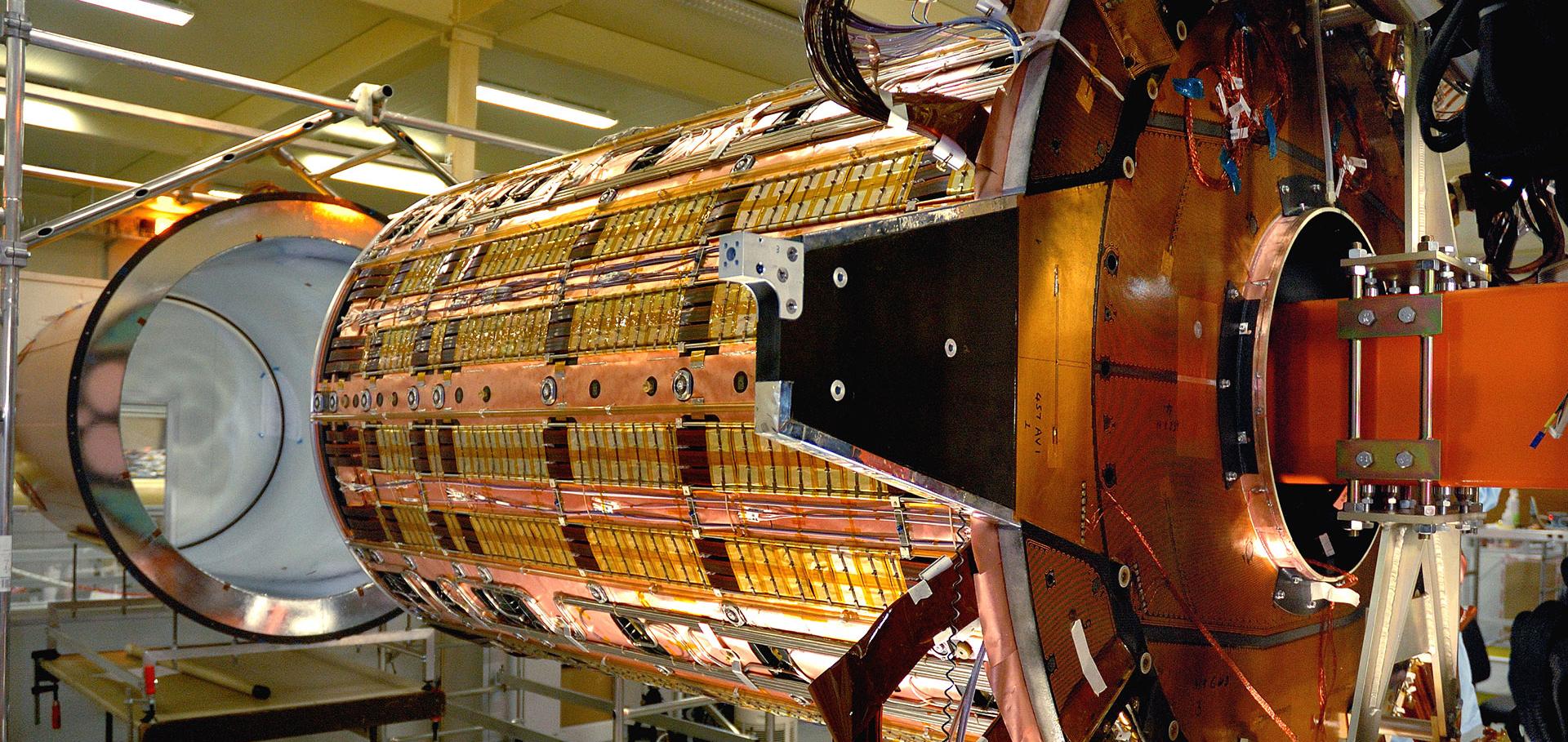
Insertion of STC into TRT at the Department of Physics, Oxford
Credit: CERN

Professor Daniela Bortoletto

Professor and Head of Particle Physics

Research theme

  • Instrumentation
  • Fundamental particles and interactions

Sub department

  • Particle Physics

Research groups

  • AION/Magis
  • ATLAS
  • Future Colliders
  • Mu3e
  • OPMD
daniela.bortoletto@physics.ox.ac.uk
Telephone: 01865 (2)73635
Denys Wilkinson Building, room 608c1
  • About
  • Students
  • Research
  • Teaching
  • Publications

Evidence for double φ production in the reaction K−p → φφΛ/Σ0 at 18.5 GeV/c

Physics Letters B Elsevier 121:1 (1983) 83-86

Authors:

Bari-Birmingham-CERN-LPNHE Paris-Milan-Pavia Collaboration, T Armstrong, M Baubillier, W Beusch, IJ Bloodworth, D Bortoletto, JC Brient, A Burns, E Calligarich, JN Carney, C Evangelista, B Ghidini, JB Kinson, K Knudson, V Lenti, G Liguori, L Mandelli, F Navach, A Palano, L Perini, Y Pons, E Quercigh, Z Strachman, M Tamborini, MF Worsell, G Zito, R Zitoun
More details from the publisher

AION: An Atom Interferometer Observatory and Network

Authors:

L Badurina, E Bentine, D Blas, K Bongs, D Bortoletto, T Bowcock, K Bridges, W Bowden, O Buchmueller, C Burrage, J Coleman, G Elertas, J Ellis, C Foot, V Gibson, Mg Haehnelt, T Harte, S Hedges, R Hobson, M Holynski, T Jones, M Langlois, S Lellouch, M Lewicki, R Maiolino, P Majewski, S Malik, J March-Russell, C McCabe, D Newbold, B Sauer, U Schneider, I Shipsey, Y Singh, Ma Uchida, T Valenzuela, M van der Grinten, V Vaskonen, J Vossebeld, D Weatherill, I Wilmut

Abstract:

We outline the experimental concept and key scientific capabilities of AION (Atom Interferometer Observatory and Network), a proposed UK-based experimental programme using cold strontium atoms to search for ultra-light dark matter, to explore gravitational waves in the mid-frequency range between the peak sensitivities of the LISA and LIGO/Virgo/ KAGRA/INDIGO/Einstein Telescope/Cosmic Explorer experiments, and to probe other frontiers in fundamental physics. AION would complement other planned searches for dark matter, as well as probe mergers involving intermediate mass black holes and explore early universe cosmology. AION would share many technical features with the MAGIS experimental programme in the US, and synergies would flow from operating AION in a network with this experiment, as well as with other atom interferometer experiments such as MIGA, ZAIGA and ELGAR. Operating AION in a network with other gravitational wave detectors such as LIGO, Virgo and LISA would also offer many synergies.
More details from the publisher
More details
Details from ArXiV

Combined CDF and D0 Upper Limits on Standard Model Higgs Boson Production with up to 8.2 fb$^-1$ of Data

Authors:

T Aaltonen, others
Details from ArXiV

Higgs self-coupling measurements using deep learning in the $b\bar{b}b\bar{b}$ final state

The Journal of High Energy Physics Springer Verlag (Germany)

Authors:

Jacob Amacker, William Balunas, Lydia Beresford, Daniela Bortoletto, James Frost, Cigdem Issever, Jesse Liu, James McKee, Alessandro Micheli, Santiago Paredes Saenz, Michael Spannowsky, Beojan Stanislaus

Abstract:

Measuring the Higgs trilinear self-coupling $\lambda_{hhh}$ is experimentally demanding but fundamental for understanding the shape of the Higgs potential. We present a comprehensive analysis strategy for the HL-LHC using di-Higgs events in the four $b$-quark channel ($hh \to 4b$), extending current methods in several directions. We perform deep learning to suppress the formidable multijet background with dedicated optimisation for BSM $\lambda_{hhh}$ scenarios. We compare the $\lambda_{hhh}$ constraining power of events using different multiplicities of large radius jets with a two-prong structure that reconstruct boosted $h \to bb$ decays. We show that current uncertainties in the SM top Yukawa coupling $y_t$ can modify $\lambda_{hhh}$ constraints by $\sim 20\%$. For SM $y_t$, we find prospects of $-0.8 < \lambda_{hhh} / \lambda_{hhh}^\text{SM} < 6.6$ at 68% CL under simplified assumptions for 3000~fb$^{-1}$ of HL-LHC data. Our results provide a careful assessment of di-Higgs identification and machine learning techniques for all-hadronic measurements of the Higgs self-coupling and sharpens the requirements for future improvement.
More details from the publisher
Details from ORA
More details
Details from ArXiV

Sensor Compendium

Office of Scientific and Technical Information (OSTI)

Authors:

M Artuso, et al.
More details from the publisher

Pagination

  • First page First
  • Previous page Prev
  • …
  • Page 934
  • Page 935
  • Page 936
  • Page 937
  • Page 938
  • Page 939
  • Page 940
  • Current page 941
  • Page 942
  • Next page Next
  • Last page Last

Footer Menu

  • Contact us
  • Giving to the Dept of Physics
  • Work with us
  • Media

User account menu

  • Log in

Follow us

FIND US

Clarendon Laboratory,

Parks Road,

Oxford,

OX1 3PU

CONTACT US

Tel: +44(0)1865272200

University of Oxfrod logo Department Of Physics text logo
IOP Juno Champion logo Athena Swan Silver Award logo

© University of Oxford - Department of Physics

Cookies | Privacy policy | Accessibility statement

Built by: Versantus

  • Home
  • Research
  • Study
  • Engage
  • Our people
  • News & Comment
  • Events
  • Our facilities & services
  • About us
  • Giving to Physics
  • Current students
  • Staff intranet